CHAPTER 1: THE FIRST SWATH
The envelope was thick, unsealed, and smelled of stale garage dust. Maya didn’t need to read the signature to know it came from the north side of the fence. The text inside was typed on an old ribbon, the letters h and e slightly elevated above the baseline like teeth missing their roots. Forty-eight hours to clear the nuisance, it read. The neighborhood has standards for drainage and sightlines. The city won’t protect an uncultivated plot.
Outside, the air was already heavy with the grey, oppressive humidity of a midwestern July. The sun hadn’t broken the tree line yet, but the ground was dry, the clay soil beneath the native clover cracking into thin, webbed fissures. Maya stepped onto the porch, her bare feet instantly collecting the fine grit that blew off the concrete curb.
Across the line, Harold Vance was already moving. He stood near his garage door, a rag in one hand and a yellow can of starter fluid in the other. His lawn was short—exactly two inches of uniform, chemical-dependent fescue, cut so low the parched brown thatch showed through like skin beneath a thinning coat. To Harold, the world was divided into what could be tamed by a straight blade and what was hostile to order.
“It’s not an uncultivated plot, Harold,” Maya called out, her voice cutting through the thick, pre-dawn silence of the subdivision. She didn’t shout; she kept her tone level, transactional, the way her father had taught her to speak when dealing with contractors who thought they could bill for unworked hours.
Harold didn’t look up from the engine deck of his John Deere. He wiped a smear of grease from the fuel cap with a slow, heavy rotation of his thumb. “The committee doesn’t look at labels, girl. They look at the curb. The weeds are catching the wind-blown trash from the turnpike. It’s an invitation for rodents.”
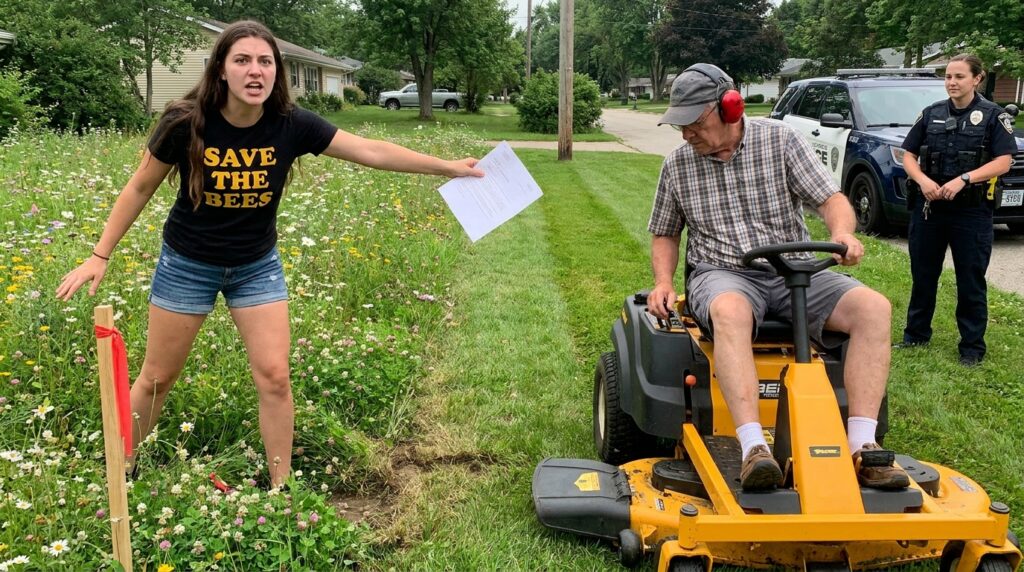
“They’re native milkweed and wild bergamot,” she said, stepping down from the porch onto the dry turf. Her black shirt, stiff from the wash, caught the first low glare of the sun. “The roots hold the moisture. If I cut them now, the topsoil turns to dust by August. The surveyor is coming at noon to set the iron pins. Until then, keep the deck on your side.”
Harold finally raised his head. His eyes were small behind his grease-filmed sunglasses, his gray cap pulled low enough to crease the skin above his brow. He didn’t answer. He simply reached down and pulled the red hearing protectors over his ears, sealing himself into a private world of mechanical vibration. The starter motor whined once, a sharp, metallic screech, before the two-cylinder engine caught, filling the narrow space between their houses with the thick, blue smoke of unburnt oil.
Maya watched the yellow machine crawl forward to the exact edge of his manicured green turf, its blades idling just above the soil line. Underneath the roar of the motor, a low, structural vibration seemed to rise from the ground—a dull hum that didn’t belong to the mower, but to something older, heavier, and buried deep beneath the grass.