CHAPTER 4: THE BOUNDARY BREACH
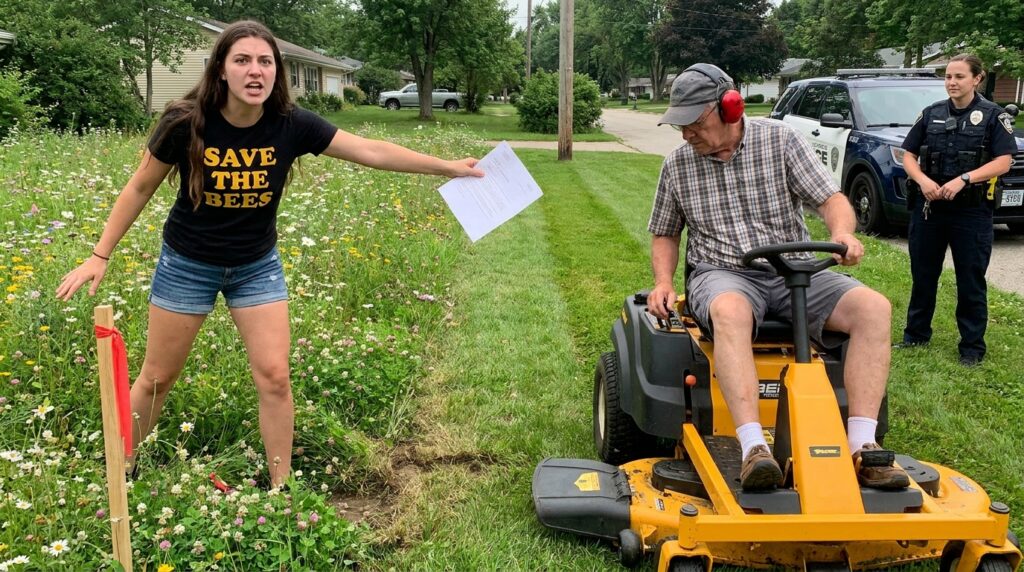
The roar didn’t build; it slammed into the midday heat as Harold threw the engagement lever. The twin steel blades underneath the yellow deck dropped with a heavy, ungreased groan, chewing into the parched earth before the machine even cleared his driveway. Harold didn’t look down. His red hearing protectors were pinned hard against his gray cap, his gloved hands locked onto the steering rubber like iron clamps.
“Harold! Stop!”
Maya didn’t hear her own scream over the two-cylinder engine. She was already moving across the parched yard, her sneakers slipping on the loose, dry clay the surveyor had left behind. The surveyor himself had retreated to his truck to escape the ninety-degree glare, leaving his wooden stakes standing like small, fragile bone-markers along the property edge.
Harold’s front tire struck the first stake. The dry pine snapped with a sound like a pistol shot, splintering into clean, white shards that spun out from under the heavy rubber tread. The red ribbon caught on the spinning spindle of the deck, wrapping twice before the blades shredded it into fine, synthetic lint. He was fourteen inches inside her line now, his blades set to the absolute lowest notch, scalping the earth down to the grey subsoil crust.
Maya threw her body into the cut lane. She planted her right foot directly ahead of the front left tire, her hands thrusting the white, limp county survey map straight toward the grease-filmed lenses of Harold’s sunglasses. The hot, oily back-draft from the mower exhaust hit her chest, smelling of unburnt fuel and scorched grass. The yellow steel cowl was less than two feet from her shins when the tires locked, skidding across the flattened stalks of wild bergamot and native clover.
“Stop crossing my line and mowing my garden down!” she shouted, her throat raw from the dust.
The engine idled down slightly, a low, rhythmic thump-thump that rattled the metal siding of Harold’s garage behind him. Harold remained bolted to the high-backed vinyl seat, his stocky frame leaning slightly forward over the controls. He looked down toward the mower deck, where a thick, fibrous mass of wild roots and dark, sulfurous mud was wedged between the cutting spindles. Tangled in the crushed green pulp was a long strip of heavy gray PVC binding tape—the kind city utility crews used to seal high-pressure conduits.
“The county stamped it, Harold. Read the stake,” Maya said, her breath coming in shallow, ragged gaps as she gestured down at the splintered wood beneath his rear tire. Her fingers were shaking against the edge of the plat map, the paper tearing slightly under the pressure of her thumb.
Harold didn’t lift his sunglasses. He pointed a thick, gloved hand down at the fresh, raw swath he had torn through the center of her habitat plot. The blades had missed the buried grey concrete vault by less than an inch, but the vibration had cracked the dry clay seal around the joint. A slow, thin trickle of warm, grey effluent was already bubbling up into the tread marks, carrying the distinct, chemical scent of old household detergent.
“You think you’ve got a boundary, girl,” Harold raspy voice cut through the mechanical idle, low and hard. He didn’t monologue; his counter-move was already built into his stance. He tilted his cap back, exposing the cold, calculating sweat lines on his weathered forehead. “That paper don’t change what’s under the turf. If I don’t clear this throat before the clouds turn tonight, the county won’t be checking my fence line. They’ll be condemning your foundation for a grey-water hazard.”
“This is my property,” Maya said, her voice dropping into a tight, transactional stone. She didn’t step back. Her shins were close enough to the yellow bumper to feel the ambient heat of the block. “The surveyor locked the coordinates. If you pull that lever again, it’s criminal vandalism and you know it.”
Harold didn’t look at her map. His gaze shifted past her shoulder, toward the hot asphalt of the street where a white-and-black cruiser was slowing down, its tires crunching against the loose gravel at the curb. He didn’t show fear or surprise; his jaw simply set into a harder, more stubborn line, his wrinkled hands remaining heavy on the steering grips as if waiting for the next mechanical cue.
The decoy paper he had shown her earlier—the old eighty-four drainage rider—crumbled into irrelevance as the physical evidence pooled between them. Maya looked down at the shred of gray PVC tape caught in his machine’s underbelly. It wasn’t forty years old. The plastic was clean, non-biodegraded, and bore the distinct, modern manufacturing stamp of the local water district. Her victory with the surveyor’s coordinates felt hollow, a temporary shield against a deeper, heavy machinery problem that was actively bubbling through the roots of her garden.