CHAPTER 3: DRIVING THE IRON
The heavy steel tip of the surveyor’s drive-rod hit something beneath the milkweed patch with a flat, hollow clunk that vibrated straight through the baked July crust. It wasn’t the dense, silent thud of limestone. It sounded like iron scraping against old concrete.
“That’s not your property pin,” the surveyor said, lifting his mud-streaked yellow cap to wipe his forehead with the back of a calloused hand. His shirt was soaked through with a gray, salt-rimmed circle of sweat, and the heavy leather tool belt around his waist creaked as he shifted his weight. He was holding a magnetic locator tube, its digital display flickering with a sharp, erratic whine that rose in pitch whenever he swung it near the center of Maya’s pollinator garden. “Pins are solid three-quarter-inch rebar. This thing down here has a hollow ring to it. Big, too.”
Maya leaned over the shallow hole he had dug through her native clover. The topsoil was bone-dry, breaking apart into dusty, gray crumbs that smelled faintly of old iron scale. Beneath the loose earth, a curved, scaling grey surface was starting to show. It looked like the calcified flank of a buried boiler, its rusted seams weeping a dark, slow moisture that didn’t match the parched afternoon.
“Can you trace the line from the curb?” Maya asked, her hand tightening around the official, stamped county plat map. The heavy paper was already limp from the humidity, the black surveyor lines smudging slightly against her fingertips.
“I can trace the legal boundary,” the man muttered, dropping a heavy iron stake with a metallic clink near the fence line. He pointed toward Harold’s driveway, where the bright yellow riding mower sat idling under the metal awning. “But according to the official township pins I found at the intersection, your lot line runs exactly fourteen inches inside Harold’s existing grass strip. The problem is what’s under the dirt. My locator is pulling a massive anomaly right through your clover bed, heading straight toward his foundation. If there’s an unrecorded drainage corridor here, it’s not on the town register.”
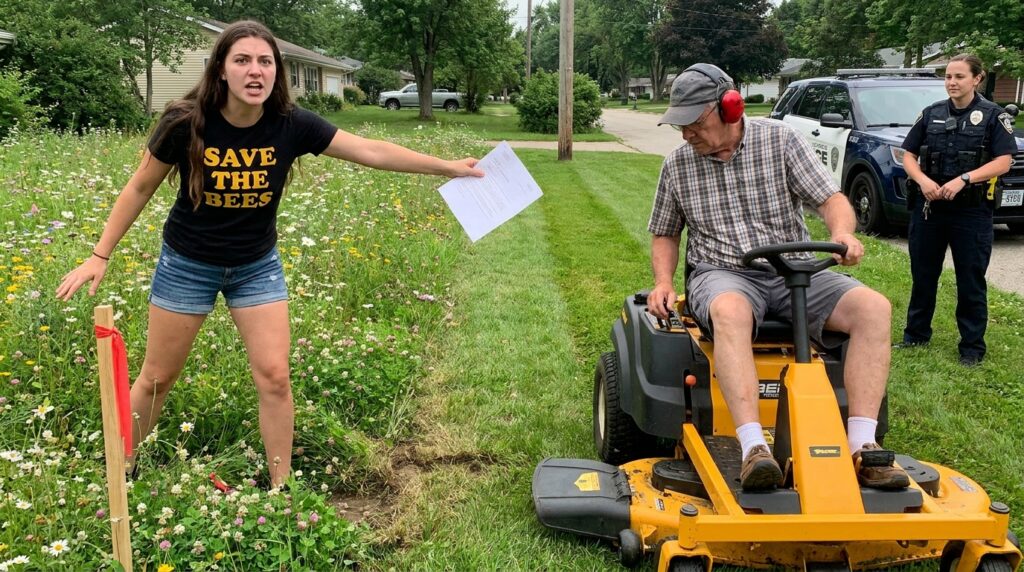
Across the line, the screen door of Harold’s garage slammed shut with a sharp, wooden crack. Harold walked down his pristine concrete path with a deliberate, slow stride, his boots crunching on the parched blades of fescue. He wasn’t carrying his pipe wrench this time. Instead, he held a faded manila folder with a rusted metal clasp, the edges of the cardstock frayed and yellowed into the color of old pine needles.
“You’re wasting your time with that rod, son,” Harold said, stopping exactly where his low-cut grass met Maya’s overgrown wild bergamot. He didn’t look at Maya; his focus remained fixed on the surveyor’s shovel. He tapped the manila folder against his thigh, a dry, rhythmic sound like a locust in the weeds. “The township didn’t drop that iron. The old developer did, back in eighty-four, before the drainage board signed off on the phase-two plat. There’s a restricted rider in here that gives the adjoining lot the right to maintain the overflow.”
“The county clerk said that rider doesn’t have an approved map attached, Harold,” Maya said, stepping across the fresh earth of the survey pit. Her sneakers sank an inch into the soft, damp crust that surrounded the buried concrete structure. “If it’s not mapped, it’s not a legal encumbrance on my title.”
Harold let out a dry, rattling laugh that sounded like gravel shifting in an empty iron bucket. He opened the folder, revealing a single sheet of blue-lined carbon paper with a faint, purple-ink signature at the bottom—the name of the previous homeowner who had sold the house to Maya’s father.
“The signature is legal enough,” Harold said, his voice dropping into a flat, raspy drawl that seemed to mimic the low hum of his mower. He pointed a grease-stained thumb toward the gray, calcified pipe surface peaking out through the torn roots of Maya’s clover. “This paper says the drainage lane has to remain clear of deep-rooted vegetation for three yards on either side of the iron pin. Your little bee project is lifting the joints down there. When the next heavy storm comes off the turnpike, that water is going straight through my basement brick because your weeds are blocking the throat.”
The surveyor knelt down, running the magnetic tube over the exposed iron seam again. The machine didn’t emit a steady tone; it clicked rhythmically, like a geiger counter near stone. He looked up at Maya, his expression guarded, his eyes narrowing as he noticed the dark, foul-smelling moisture pooling around the tip of his boot.
“He’s right about one thing, miss,” the surveyor said quietly, his voice pitched below the low rumble of Harold’s idling machine. “This isn’t a standard storm line. The moisture coming out of this joint is gray water. It’s warm. If this pipe belongs to the city, it shouldn’t be discharging here. And if it’s private…” He let the sentence hang, his eyes drifting toward the foundation vents of Harold’s house, where a small, newly installed plastic drain line emerged from the brickwork and vanished into the parched earth right along the property boundary.
Maya felt a sudden, cold weight settle in her chest. The decoy was clear—Harold wanted her to believe he was enforcing an old, forgotten easement to protect the neighborhood’s drainage. But as she stared at the dark, oily ring of subterranean fluid slowly darkening the roots of her dying clover, she realized the surveyor’s iron rod hadn’t just found a property line. It had struck the edge of a secret that Harold had been keeping buried under her soil long before she ever bought the house.
“Drive the stakes anyway,” Maya said, her voice turning sharp as iron filings. She stepped directly between Harold and the open pit, her stance blocking his view of the leaking seam. “Set the red ribbons exactly where the county coordinates say the land ends. Whatever is under this grass, Harold, it’s about to be on the wrong side of the law.”
Harold didn’t move. He slowly closed the manila folder, the rusted metal clasp scoring a deep, gray scratch into the yellowed paper. His face remained completely unreadable under the shadow of his cap, but his hand tightened on the folder until the carbon paper inside crumpled with a brittle, dry hiss.