CHAPTER 2: THE LETTER OF THE LAW
“The easement index doesn’t have a map attached, Maya. It just has a clerk’s docket number from 1984,” the county clerk’s voice sounded thin over the phone, competing with the low, dry rattle of an old air conditioning unit hummed in the background. “If there’s a rider, it’s in the dead storage vault downstairs. We don’t scan those unless someone pays the title extraction fee.”
Maya held the phone to her ear with her shoulder, her fingers tracing the stiff, yellowed edge of her original property deed spread across the kitchen table. The paper felt brittle, dry as onion skin, smelling of old basement dampness and dead ink. Outside, through the grease-filmed window, the yellow silhouette of Harold’s John Deere sat motionless on his perfect turf, its metal exhaust pipe ticking as the hot manifold cooled in the midday sun.
“How long to pull the physical folder?” Maya asked. Her thumb pressed against a faded purple stamp in the margin—Book 412, Page 88, Subject to Municipal Drainage Revision.
“Two days, maybe three,” the clerk sighed, a sound of heavy paper being shifted across a laminate desk. “But I’m telling you, those mid-eighties suburban plats are messy. Developers shifted utility lines three feet left or right depending on where they hit limestone. If your neighbor has a copy of the rider, he might actually have the legal right to clear the sightline.”
Maya disconnected without thanking her. She stood up, her joints popping slightly from the tension of sitting on the hard wooden chair. The floorboards under her sneakers felt warm; the heat was rising through the crawlspace now, baking the foundation of the old ranch house. She walked to the screen door, her eyes adjusting to the bright, overexposed glare of the yard.
Harold was sitting on a green webbing lawn chair beneath the shadow of his garage awning. He wasn’t working now. He was watching her house, a stained glass of iced tea balanced on his knee, his gray cap tilted back just enough to reveal the deep, white furrow of his brow where the sun never hit. Beside his boots lay a heavy steel pipe wrench, its iron jaws caked with dry, rust-colored mud that had flaked off onto his pristine concrete driveway.
She stepped through the door, the rusted spring screaming behind her before slamming shut with a flat wood-on-wood crack. She crossed the dry clover, the small purple flower heads crunching like dry paper under her soles.
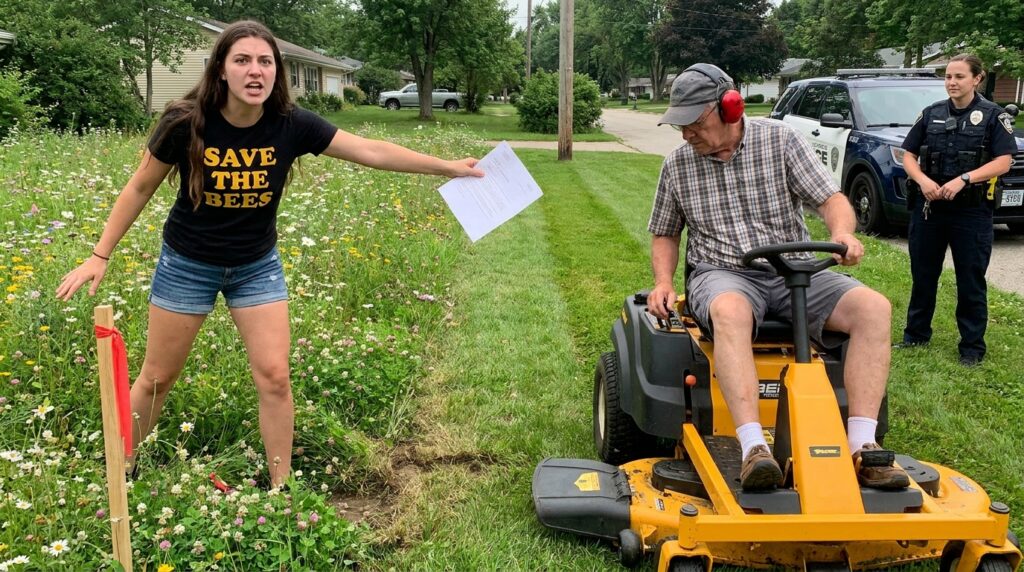
“You knew about the eighty-four rider,” Maya said, stopping two feet short of the red-ribboned stakes she had driven into the parched earth earlier that week.
Harold didn’t shift his weight. He took a slow sip of the tea, the ice cubes clinking with a heavy, leaden sound against the glass. When he lowered it, a thin line of condensation ran down his wrinkled forearm, cutting a clean path through the gray dust and iron filings that clung to his skin.
“Your father bought this place from an estate, girl. He didn’t look at the underbelly,” Harold said, his voice a low, raspy gravel that sounded like stones turning over in an iron bucket. He pointed a thick, sun-spotted finger toward the center of her pollinator garden, where the tall wild bergamot stalks were already drooping from the noon heat. “There’s a six-inch concrete throat under that patch of weeds. If it gets choked with roots, the back-pressure doesn’t stay on your side of the line. It backs up into my cellar.”
“The city engineers looked at the topsoil last month, Harold. They said the drainage is clear,” Maya replied, her hand tightening around the folded copy of her deed. The edges of the paper were sharp, digging into her palm until she could feel her own pulse ticking against the wood-pulp fiber. “There’s no municipal line on the master plat.”
“Master plats are for the tax assessors,” Harold muttered. He reached down, his calloused fingers wrapping around the greasy handle of the pipe wrench. He didn’t lift it; he just turned it over in the dirt, the heavy iron tool leaving a dark, oil-stained crescent in the parched grass. “The people who laid the pipe didn’t talk to the people in the courthouse. You think you’re saving the world with a patch of dandelions, but you’re just pooling water where it don’t belong. When the iron rots through, nobody’s looking at your survey papers.”
Maya looked down at the wrench. The mud dried on the teeth wasn’t the pale, sandy clay of the surface lot; it was dark, rich, and carried the gray, sulfurous tint of deep underground stagnation. A micro-discrepancy clicked in her mind—Harold hadn’t been clearing his gutters that morning. He had been digging somewhere near the easement line before the sun came up, his boots still bearing the dark, wet ring of subterranean moisture despite the ninety-degree heat.
“The surveyor will be here in twenty minutes,” Maya said, her voice dropping into a hard, defensive register. She stepped directly onto the boundary line, her foot flattening a patch of native clover right beside his fence post. “He’s pulling the original iron pins out of the easement lane. Whatever you think is down there, Harold, it’s going on the map.”
Harold stood up slowly, his knees grinding with a faint, audible click. He didn’t offer a villainous speech; he simply hoisted the heavy iron wrench by its throat and walked toward his garage door, his boots leaving dry, dusty prints on the concrete.
“Maps don’t hold back the grey water,” he said over his shoulder, his voice disappearing into the dark, oil-scented shadow of the garage bay. “Make sure your man brings a heavy spade. He’s gonna hit something harder than stone.”
Maya turned back to her garden, her eyes fixing on a small, depressed circle of earth near the center of the milkweed patch where the ground had sunk two inches lower than the surrounding turf. The wild clover there was greener, strangely lush, its roots drinking from something hidden deep within the dark, calcified dirt.