
CHAPTER 7: THE TENSION AT THE GATE
The mountain air at the county line was sharp, smelling of cold iron, wet pine needles, and the bitter sulfur of a diesel exhaust stack. Arthur didn’t slow his truck down until the rusted wire of the clearing gate scraped against his front bumper. The engine gave one final, oily backfire before he cut the ignition, leaving only the high, rhythmic scream of the mill saws a hundred yards into the timber. The sound ground against his teeth like sand.
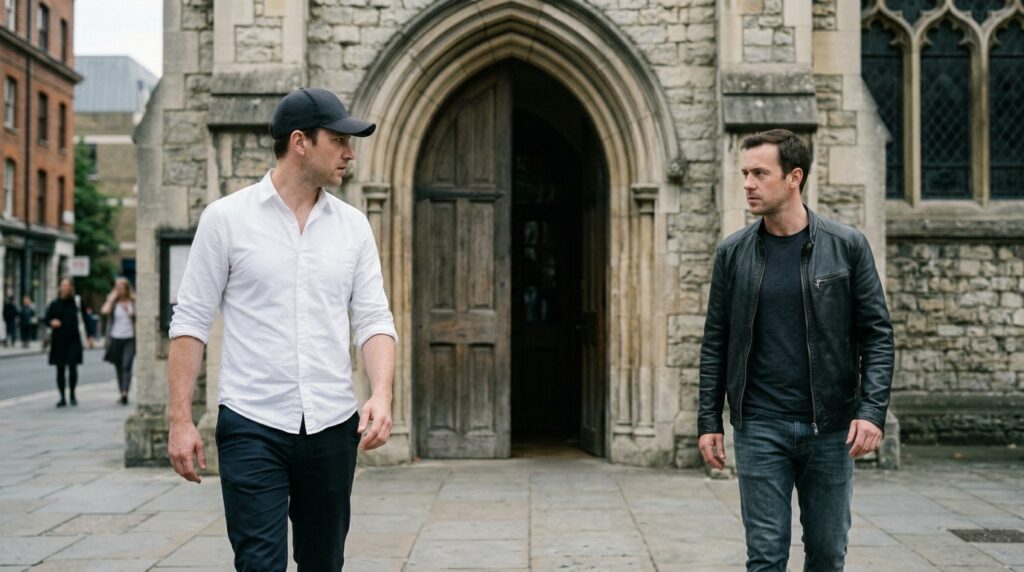
He didn’t take his black baseball cap off. He stepped into the gray mud, his boots sinking two inches into the churned earth where the heavy flatbeds had torn up the turf. Under his arm, the rotted canvas bundle felt cold, its mold-softened corners flattening against his ribs.
Miller was waiting by the iron winch. Beside him stood Sheriff Vance, leaning his lower back against the fender of his patrol car, his fingers hooked into his utility belt right next to the leather holster. Between them, jammed top-first into a pile of gravel to hold a makeshift surveyor’s string, was the missing brass candlestick from the church altar rail. Its polished face was scratched, covered in a thin skin of yellow mud and road grease. It looked small out here, stripped of the sanctuary light, just three pounds of junk metal holding up a nylon cord.
“You’re late, Artie,” Miller said. He didn’t drop the heavy iron pliers he was using to twist the boundary wire. “The saws already cleared the first stand behind the old creek bridge. The office wants the signed release before the crews cross into the parsonage lot.”
Arthur walked straight to the surveyor’s string, his shoes crunching on the wet shale. He didn’t look at Vance. He looked down at the brass candlestick, then at the thick stack of papers Miller had weighted down with a flat stone on the hood of the car.
“My father didn’t take the five thousand for himself, Miller,” Arthur said. His voice was lower than the whine of the saws, flat and dry as a winter drought. “He put it into the county road fund under the Garrick name so the state inspectors wouldn’t look at the insurance filings for the schoolhouse.”
Vance shifted his weight, his leather belt creaking in the cold. He didn’t look Arthur in the eye; he watched a logging truck shift gears down in the hollow, its blue smoke rising through the hemlocks. “It doesn’t change the ink on the grand jury sheet, Artie. The state tax folks don’t care where the money went. They care who signed for the delivery.”
“You did, Vance,” Arthur said.
The sheriff’s hand went still on his belt.
Arthur pulled the rotted logbook from the canvas wrap, the old twine dropping into the mud between his boots. He turned the page with his thumb, forcing the rotted board backing to split until the purple ink of nineteen eighty-eight was exposed to the flat gray sky. He didn’t read it aloud. He just held the paper three inches from Vance’s face, close enough for the sheriff to smell the basement rot on the fibers.
Beneath his father’s signature was a third name, written in the thin, scratching stroke of a fountain pen that had run dry twice before finishing the line: Vance, Deputy Recorder. Witnessed and verified.
“Your uncle didn’t have the saws, Tommy,” Arthur said, his head turning toward the cab of the truck where Tommy had stayed behind the glass, his swollen face pressed against the wet pane. “The sheriff’s family owned the mill debt before the diocese ever defaulted. This wasn’t an estate settlement. It was an extraction.”
Miller dropped the pliers into the gravel. The iron made a dull, wet splash. He looked at Vance, then back at Arthur’s shirt, where the gray lime dust from the foundation had dried into a hard white smear across his heart. “The release is still legal, Artie. The church board approved the transfer when the diocese closed the registry.”
“The board didn’t have the master key,” Arthur said.
He reached into his trouser pocket and pulled out the iron key—the real one, the heavy, square-bitted piece of blacksmith’s work that had locked the sanctuary doors for forty years. He didn’t hand it over. He walked to the pile of gravel, grabbed the mud-stained brass candlestick by its neck, and jerked it out of the dirt, snapping the surveyor’s string with a sharp thwack.
He dropped the iron key into the empty socket where the paschal candle should have sat. It fit with a dull, heavy clink, the rusted teeth of the key locking into the brass rim. He threw the whole piece into the back of his flatbed, where it hit the steel floor with a ring that cut through the noise of the machinery.
“The parsonage isn’t in the trust,” Arthur said, stepping back into the mud toward his cab. “My father took that acre out of the diocese boundary two days before he died. If your dozers cross the creek road, you’re breaking state timber laws, Vance. And the federal marshals won’t be looking at the church deeds when they get here. They’ll be looking at the road fund receipts from eighty-eight.”
Vance didn’t pull his hand away from his belt, but he didn’t unhook the strap either. He looked down at the broken nylon string trailing through the wet mud, its bright orange tail dissolving into the gray silt of the lane.
“You can’t keep the roof up by yourself, Artie,” Miller called out as Arthur slammed the truck door shut. The glass rattled in its channel, loose and dry. “The town’s going to leave that stone to rot by winter.”
“Then let it rot,” Arthur said to the dark dashboard.
He twisted the key, and the engine caught with a heavy, scraping roar that drowned out the saws in the timber. He backed the truck into the lane, his tires spinning once in the clay before catching the hard stone of the creek road, leaving the county line gate behind in the fog.








