
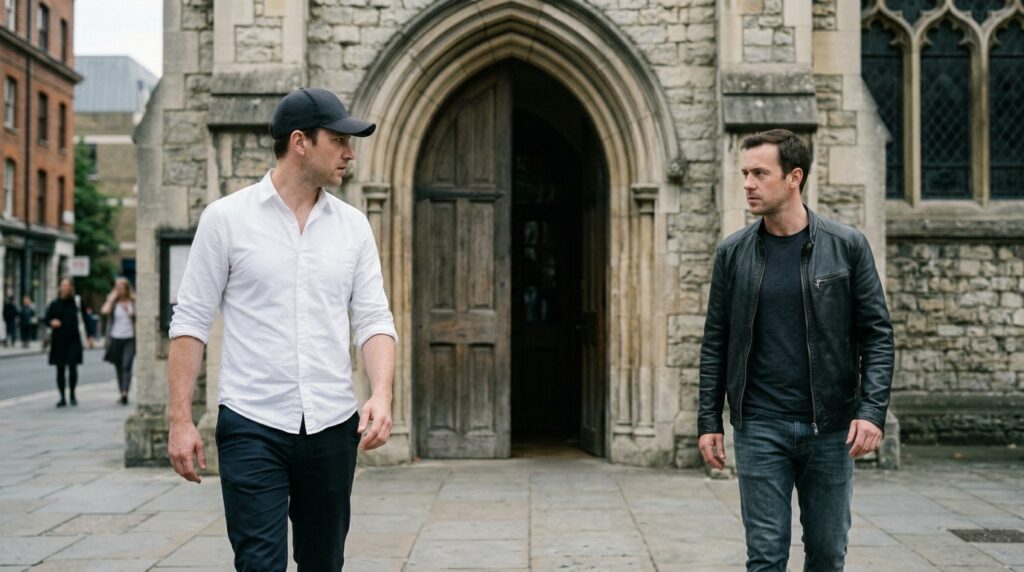
CHAPTER 3: THE VESTRY SHADOWS
The vibration traveled down the hand-hewn oak joists, dropping a fine skim of gray cobwebs across Arthur’s shoulder. He didn’t drop the papers. His fingers slipped the rusted paperclip back into place, the sharp wire scraping a crescent of dried orange scale under his thumbnail. He shoved the pages into the deep pocket of his trousers, right beside the heavy iron sanctuary key. The metal clinked—a single, bright note that felt as loud as the tower bell in the dead, dead quiet of the cellar.
Above him, the boots moved again. They didn’t have the heavy, dragging scrape of Miller’s leather work shoes. These steps were light, shifting from heel to toe with a restless, rhythmic click. Someone who didn’t want to be heard, but didn’t know which planks were soft.
Arthur moved toward the stairs. He didn’t use the handrail; his palms knew the rough stone face of the chimney by heart. He cleared the third step, then the second, his body staying low until his chin was level with the threshold of the vestry door.
The afternoon sun had moved, casting long, desaturated bars of white through the leaded glass windows. The room was thick with the smell of floor wax and old wool cassocks. Standing by the walnut cabinet where the communion silver was locked was Sheriff Vance. He didn’t have his hat on. His thin, sand-colored hair was combed flat against his skull, shiny with sweat despite the draft coming off the stone floor. His fingers were busy with an iron pry-bar, the flat edge already dug two inches into the old paneling of the cabinet frame.
“The church office handles the deeds, Vance,” Arthur said.
The sheriff didn’t jump. He froze, his shoulder blades bunching under his brown wool uniform coat. He left the pry-bar wedged in the splintering walnut, turning his head just enough to show the gray stubble along his jawline.
“The office doesn’t have what I’m looking for, Artie,” Vance said. His voice was transactional, flat as a gravel road. “And neither do the county archives. I checked the dead-files three times this morning before the sun cleared the pines.”
“You’re four miles outside your jurisdiction for an archive search,” Arthur said, stepping out of the cellar stairwell. He didn’t brush the lime dust from his white shirt. He let his hands hang loose at his sides, his right thumb hooking slightly into the pocket where the ledger pages lay flat against his thigh. “Tommy’s uncle doesn’t have the leverage to put you on my floor.”
Vance pulled his hand away from the pry-bar. The iron tool remained stuck in the wood, vibrating slightly like a knife thrown into a target. “Tommy’s uncle is a drunk who can’t find his own boots in the morning. But the state tax office called my house at dawn. They aren’t looking at Tommy, Artie. They’re looking at the church property lines. Every acre your father signed over to the parish between eighty-five and ninety-five.”
Arthur looked at the floorboards between them. Near the edge of the copper heating grate, a single brass casing—short, notched at the rim, and dark with corrosion—was jammed into the seam of the pine planks. It had been there so long the wood had grown around it, a metal tooth embedded in the church’s skin. A micro-mystery his father had left behind, one that Arthur had walked past a thousand times without looking down.
“The land belongs to the diocese,” Arthur said. “The signatures are legal.”
“The signatures are on paper that shouldn’t exist,” Vance countered. He stepped away from the cabinet, his boots clicking on the brass casing, forcing it deeper into the wood with a dull crunch. “Tommy’s grandfather didn’t default on a bank note. The bank didn’t even hold the paper. Your father bought the debt with money that came out of the county road fund while he was still sitting on the grand jury.”
The words hit the room with the dry, hollow weight of stone dropping into an empty well.
Arthur felt the skin across his forehead tighten. The ledger in his pocket—the decoy secret he’d just unearthed, the neat lines of financial leverage that he thought explained the town’s silent obedience—was fracturing under his feet. It wasn’t just a matter of the church holding a few local mortgages to protect the parish from a default. It was bigger. The foundations weren’t just cracked; they were laid in grease.
“My father didn’t touch the road fund,” Arthur said, though his own voice sounded thin to his ears, like paper tearing in another room.
“He didn’t have to,” Vance said, reaching down to pull the pry-bar free from the cabinet with a sharp, splintering groan. He didn’t point the iron at Arthur, but he didn’t drop it either. “He just had to look the other way while the diocese cleared the deficit for the bishop’s building project in the city. And now Tommy’s got the receipts from his grandfather’s old safe-deposit box. He isn’t looking for a settlement, Artie. He’s looking to burn the fence down.”
“Tommy doesn’t have the stomach for a fire,” Arthur said.
“He doesn’t need the stomach. He’s already given the copies to the federal marshals in the valley,” Vance said. He walked past Arthur toward the side exit, his coat brushing against the stenciled lettering on the vestry wall. “I give it until tomorrow noon before the cars show up at your gate. If I were you, I’d stop fixing the mortar. There won’t be enough left of this parish to hold a roof up by Sunday.”
The side door clicked shut, the latch dropping home with the finality of a spade hitting gravel.
Arthur stood alone in the fading light of the vestry. His hand went into his pocket, his fingers curling around the cold, rusted ledger pages. He had spent thirty years policing the boundary, throwing boys like Tommy into the dirt to keep the town’s ledger clean, believing he was the sovereign protector of something holy.
He looked down at his shoes. The gray lime dust from the foundation was tracked across the dark floorboards, every step he’d taken leaving a white, powdery scar on the old wood. He reached down and touched the notched brass casing near the grate, his fingers coming away black with ancient soot. The final truth wasn’t in the ledger. It was deeper under the floor, locked in a vault he hadn’t even found yet, and the timer was already running out.








