
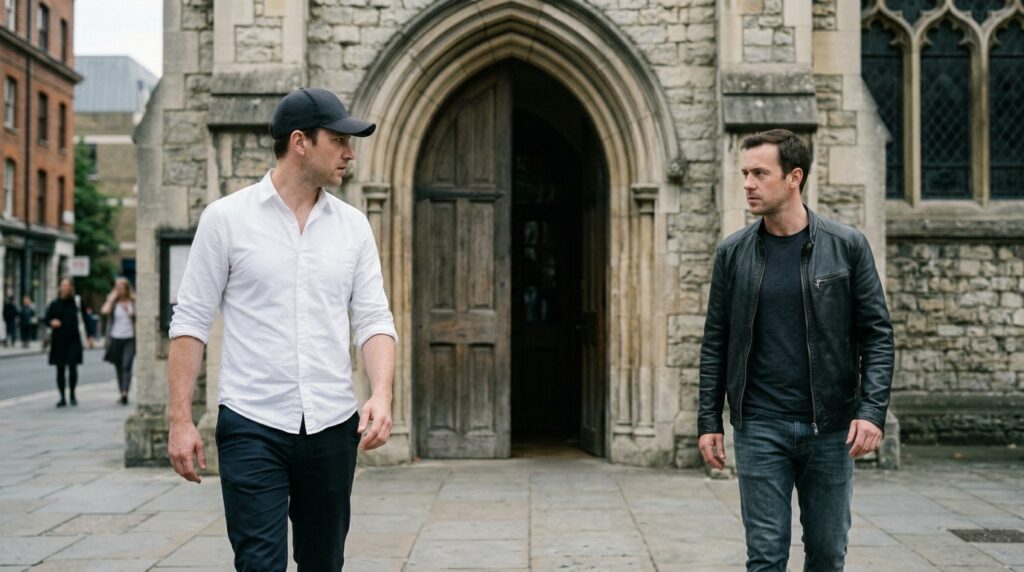
CHAPTER 5: THE ALTAR TRIAL
“Bring him up out of the hole, Tommy!”
The shout came from the center aisle, its edges ragged and flat as it bounced off the high timber rafter beams of the nave. It wasn’t the law. It was Miller’s voice, but the old sexton didn’t sound like a man who spent his mornings sweeping lime dust from the walks anymore. He sounded like a man who had finally seen the fence line go down.
Arthur didn’t drop the canvas wrap. He rose from the mud of the lower cellar chamber, his knees clicking in the dark like dry pine branches. The leather logbook was tucked tight beneath his left arm, the rotted cardboard cover crumbling under the pressure of his ribs. He didn’t use the flashlight. He climbed the three steps—the soft one, the cracked one, the stone one—his boots finding the center of each riser by the memory of the weight alone.
When he cleared the vestry door and stepped into the light of the sanctuary, the air was different. The smell of cold floor wax had been replaced by the wet, sharp reek of unwashed denim and the raw turpentine smell of cedar shavings from the hardware store lot.
Three men stood at the altar rail. Tommy was in the center, his leather jacket torn at the shoulder where Arthur had pinned him into the gravel an hour before. His face was swollen, a dark knot of purple rising under his left eye, but his hands were steady. He was holding the heavy iron crowbar Vance had left stuck in the cabinet. To his left stood Miller, his canvas coat open, revealing a rusted wire-cutter shoved into his belt. To his right was Old Man Garrick’s brother, Elias, his eyes milky with cataracts but his hand fixed tight on the arm of Tommy’s jacket.
“You’re done writing the book, Artie,” Elias said. He didn’t look at Arthur’s face; his blind gaze was fixed somewhere near the height of the brass cross behind the altar. “Your father’s dead and the diocese isn’t sending a lawyer down the valley to save your skin. Give Tommy the papers.”
Arthur walked past the walnut pulpit, his shoes silent on the green carpet runner. He stopped five paces from the rail, letting his right hand fall flat against the polished oak of the front pew. The wood felt cold, grease-filmed from forty winters of local palms.
“The papers don’t say what you think they say, Tommy,” Arthur said. His voice was flat, devoid of the authority he’d used on the steps. It was the voice of a man counting the remaining posts on a falling corral. “Your grandfather didn’t lose the creek lot to a bank default. He didn’t lose it to the church.”
“He lost it because your old man put his name in the red box!” Tommy shouted. He took a step forward, the iron crowbar scraping against the brass rail with a sound that made Arthur’s teeth ache. “My sister’s paying rent on land our people cleared before the county road had stone on it. I saw the tax maps at the station, Artie. I know what the parish did with the signatures.”
“The signatures were a shield,” Arthur said. He didn’t look at Tommy. He looked at Miller. The old sexton was watching the vestry door, his ears cocked toward the road outside where the afternoon log-trucks usually rumbled past. But the road was dead quiet. The state police hadn’t arrived, and the federal marshals Vance promised were still forty miles south in the county seat.
“Elias,” Arthur said, his eyes shifting to the old man. “Who bought the kerosene for the schoolhouse annex in eighty-eight?”
The blind man’s jaw went slack. The yellow skin around his mouth twitched once, his fingers tightening on Tommy’s sleeve until the leather bunched into a hard knot. “That’s buried, Artie. The state cleared that thirty years back. It was a bad flue.”
“It wasn’t the flue,” Arthur said, his voice dropping into the small, cold space between them. “Garrick signed the deeds over because he killed the rector’s boy in the annex. My father took the land into the parish trust so the state wouldn’t hang your name from the courthouse gate. He kept your family on the mountain, Elias. He spent thirty years letting this town call him a thief so you could keep your gardens.”
Tommy looked between his uncle and Arthur, the crowbar lowering an inch. The blood in his swollen eye made him squint, his face twisting into something small and confused. “Uncle? What’s he talking about?”
Elias didn’t answer. He reached out with his free hand, his liver-spotted fingers clawing through the air until they hit the brass upright of the altar rail. He didn’t look like a patriarch defending his clan anymore; he looked like a horse that had smelled the grease-fire before the barn door opened.
“He’s lying to save the house, Tommy,” Miller said from the shadow of the pillar. He hadn’t looked at Arthur once since the stairs. His hand was on the wire-cutters. “The old man’s always had a story for why the church needs the dirt. But the dirt’s worth three hundred an acre to the timber mill now, and the diocese is selling the paper whether Artie likes it or not.”
Arthur’s gaze locked on Miller. The sexton wasn’t surprised by the schoolhouse story. He didn’t look at the rotted diary under Arthur’s arm with fear; he looked at it with the cold, calculating eye of a man who had already cleared his own ledger.
Beside the altar rail, the heavy brass candlestick that usually held the paschal candle was gone. Only the dark circle in the velvet runner remained where the iron base had sat for twenty years. A micro-mystery that didn’t fit the financial maps or the old arson pact.
“Where’s the brass, Miller?” Arthur asked quietly.
Miller didn’t answer. He turned his head toward the side door as the sound of gravel crunching under heavy tires finally broke the silence of the lane outside. It wasn’t the federal marshals. It was the high, screaming rattle of a flatbed truck with its muffler gone—the mill truck from the valley, its headlights yellow and dim in the gray afternoon fog.








