
CHAPTER 2: THE CRACKED FOUNDATION
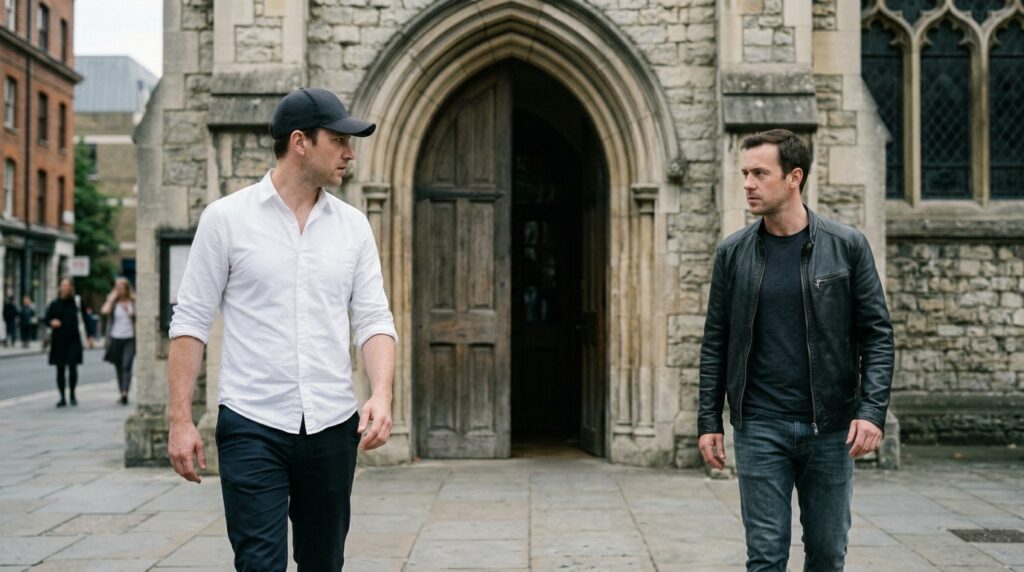
The noon light off the limestone was flat, white, and completely devoid of warmth. Arthur pulled the brush across the seam, the stiff wire bristles scraping a dry, high-pitched scream from the gray mortar. A fine cloud of powdered lime rose into his face, settling on his tongue with the taste of copper and dried earth. He didn’t turn around when the bell in the tower struck two, its heavy bronze vibration rattling the iron bucket of wet mix at his boots. He didn’t need to look at the road to know the hardware store’s rusted delivery truck had just pulled into its slot across the lane, its engine dieseling twice before dying with a wet, oily cough.
The town didn’t stop moving because Tommy had hit the dirt. It just moved slower, like grease thickening in a cold engine.
Arthur dipped his trowel into the bucket, the gray slurry slapping against the steel with a heavy, wet sound. He targeted the gap. The stone church was stable to anyone looking at it from a passing sedan, but up close, the mountain was giving way. A hairline fracture had started three feet up from the water table, cutting directly through the granite foundation blocks and snaking downward into the shadows of the basement air vent. It was fresh. The edges of the break were clean, not yet rounded by the rain or clogged with the black moss that grew on the north-facing masonry.
He pressed the mortar into the split, using his thumb to pack it tight. His knuckle caught the sharp edge of a flint protrusion, tearing a thin line through his skin. He didn’t wipe the blood. He watched it mix with the gray lime, turning the wet dust into a dark, rusty paste before it vanished under the steel blade of the tool.
“You’re using the wrong mix, Artie.”
The voice came from behind the boxwood hedge. It was Miller, the sexton, his boots dragging through the dry grass with the rhythmic, heavy rasp of a man whose knees had surrendered to the winter damp thirty years ago. He stopped at the edge of the gravel walk, his hands dug deep into the pockets of a grease-stained canvas coat that smelled of fuel oil and old wood.
Arthur didn’t drop the trowel. He smoothed the joint, his shoulder blades tight under the starch of his white shirt. “The mortar is three parts sand, one part lime. Same as the original build.”
“The original build didn’t have the county trucks hauling forty tons of gravel past the gate every twenty minutes,” Miller said. He spat a dark stream of tobacco juice into the weeds. “The vibration is shaking the shelf under the cellar. You can patch the skin all you want, but the bone’s splitting.”
Arthur turned slowly. He kept his cap low, his gaze fixing on the older man’s boots. “The bone is fine.”
“Tommy’s uncle was down at the station before the grease on his jacket was dry,” Miller said, his voice dropping into that quiet, transactional tone that passed for news in the county. “He wasn’t talking about the fight. He was talking about the ledger from ninety-two. The one your father kept in the lockbox behind the boiler.”
Arthur’s thumb tightened against the handle of the trowel until the wood groaned. The iron key in his pocket felt hot against his thigh, an anchor dragging him down into the dry earth. He looked past Miller’s shoulder, toward the hardware store. The screen door was propped open with a block of cedar, but the dark interior remained opaque, a square of pure oil-black shadow in the middle of the whitewashed storefront.
“The station has its own business,” Arthur said.
“They’re making it church business,” Miller replied. He reached into his coat, his thick fingers emerging with a small, brass-plated padlock that had been sheared clean through the shackle. The metal at the cut was bright, silver, and fresh. “Found this by the coal chute twenty minutes ago. Someone didn’t use a key, Artie. They used the long bars from the truck bed.”
Arthur looked at the broken lock. The weight of his authority, the quiet respect he’d spent thirty years cultivating like an orchard in dry soil, felt suddenly thin—a layer of paint over rotted timber. He didn’t ask if Tommy had gone inside. He knew the boy’s habits; he knew the desperation that came when a house was four weeks from the county gavel and the only name left on the deed was a ghost.
“Get the extra boards from the shed,” Arthur said, his hand dropping to his pocket, his fingers locking around the cold iron shape of the master key. “Nail the chute from the inside.”
“And if they’re already under the floor?” Miller asked.
“Then they’re sitting in the dark,” Arthur said.
He left the bucket by the wall, the lime already beginning to skin over with a dry, white crust. He walked around the corner of the transept, his boots silent on the packed earth where the grass refused to grow under the drip-line of the slate roof. The door to the basement was low, a heavy piece of rough-sawn pine that had swollen into its frame during the spring rains. He had to put his shoulder against the wood to force it, the hinges screaming as the rust ground against rust.
The air inside smelled of old sulfur, damp anthracite, and the specific, cold rot of paper that had stayed out of the sun since the turn of the century. It was an absolute darkness, save for the single gray finger of light that poked through the foundation vent he had just been patching from the outside.
Arthur didn’t light a lantern. He knew the three steps down—the first one soft, the second one cracked, the third one solid stone. He reached out into the blackness, his palm finding the rough stone of the chimney breast. His fingers traced the cold mortar until they hit something that didn’t belong—a gap where the stone should have met the flue, and the distinct, oily texture of fresh grease on a steel handle that hadn’t been turned since his father’s funeral.
His hand closed on the latch of the hidden iron plate behind the boiler. It didn’t take a key. The lock had been broken before he was born, held shut only by the weight of the soot and the town’s collective silence. He pulled, and the dark space opened with a long, dry hiss, like an intake of breath from a throat full of dust.
Inside, his fingers didn’t find the leather bound ledger of parish marriages. They closed on a stack of cold, smooth legal size sheets, bound with a rusted paperclip that left a brown smear across his thumb. He brought the first sheet into the thin pencil of light from the vent.
It wasn’t a record of tithes. It was a list of names—every farm along the creek road, each one followed by a date, a dollar figure in black ink, and a red cross drawn through the signature line. The top name on the sheet was Garrick, Tommy’s grandfather, dated October of nineteen eighty-eight. Beneath it, in his father’s precise, ledger-style handwriting, were the words: Title held in trust for diocese protection. Obligation permanent.
A floorboard creaked directly above his head—the slow, deliberate weight of someone moving through the altar rail in the sanctuary above.








