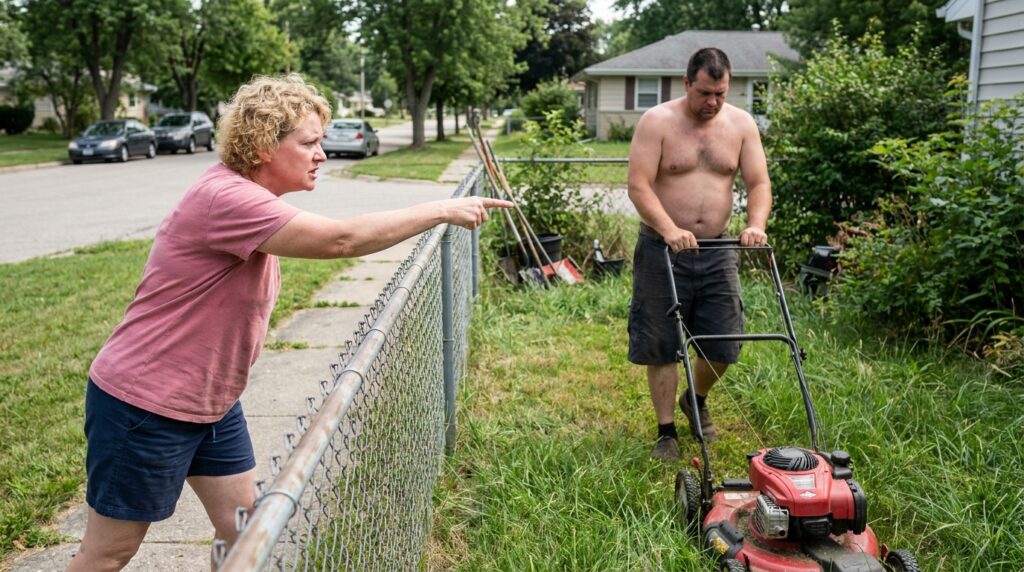
CHAPTER 7: THE TALL GRASS LINE
The door of the municipal sedan didn’t slam; it caught on a worn latch with a dry, plastic click that sounded loud against the low gurgle of the gravel ditch. The driver didn’t get out right away. He sat behind the dirty glass, his wipers sweeping once through a thin glaze of dried river dust before the engine dropped its idle and went silent.
Frank stood his ground by the dead Briggs mower, his bare chest slick with grit and the cold oil-haze drifting from the boundary line. He didn’t drop the roll of yellowed map parchment. The greasy black sludge had already crept three inches up the paper, turning the neat, hand-drawn layout lines of the 1982 survey into a dark, illegible blur. Under his boots, the tall grass felt spongy, the roots soaked through with the pungent, sulfurous muck that continued to bubble up around the base of the rusted iron post.
Evelyn hadn’t moved from her concrete step. Her hands were still flat against the sides of her pink shirt, her black-crusted sneakers leaving two identical greasy ovals on the clean masonry. Her eyes were wide, staring straight past Frank toward the dark sedan at the curb as if looking for the script she had spent thirty years rehearsing.
“They’re going to dig it all out, Frank,” she said. Her voice didn’t have the hiss left in it. It was flat, dry, and thin, like the paper tucked inside the post cap. “The whole front walk. The driveway. The foundation footings. They’ll drop the yellow tape right across the porch steps.”
“They’ll drop it where the soil is fouled, Evelyn,” Frank said. He didn’t raise his voice past a conversational murmur. He walked three steps toward the fence, his heavy boots crunching into the dry river stone she had laid down to hide the grade change. He reached over the top rail and set the rolled survey map flat on her abandoned clipboard. “The line on the map doesn’t matter anymore. The tank doesn’t care about the twenty-eight feet of frontage.”
The sedan door finally swung wide. An investigator from the state environmental division stepped onto the cracked asphalt, his boots heavy and solid as he carried a hard plastic sample case toward the ditch. He didn’t look at Frank, and he didn’t look at Evelyn. He knelt right by the exposed iron pin, his gloved fingers dipping a glass jar into the thick, iridescent film that was still rising through the turned clay.
The neighborhood remained perfectly still. Miller was still leaning over his porch rail three houses down, his grease-stained cap pulled low against the drop of the sun, his eyes tracking the way the dark stain was beginning to dry into a dull, asphalt-colored crust on the concrete gutter. Two more neighbors had stopped their trucks at the corner, their engines idling in the heat, watching the city car without a word. The performative outrage that had dominated the block for months had dissolved into the reality of a code violation that no amount of paperwork or shouting could erase.
Frank looked down at the handle of his mower. His palms were still vibrating from the four-hour run, the skin red and raw where the black foam padding had worn down to the bare steel bar. He reached down, caught the frayed nylon pull-cord, and wrapped it once around the deck housing to keep it from dragging in the dirt. The lawn was only half-finished, the tall shaggy blades of crabgrass standing sharp and green against the black, oiled perimeter he had been forced to leave behind.
“The yard still needs mowing, Evelyn,” Frank said, his voice dropping into the flat, final register of a man closing a ledger. He took hold of the handlebar and pivoted the heavy machine back toward the center of his property, away from the wire mesh and the bubbling ditch.
She didn’t answer him. She just watched the investigator lock the glass jar into his plastic case, her mouth opening slightly as the first yellow strip of municipal barrier tape was unrolled across the edge of her driveway. The false boundary she had used as a weapon for decades was gone, replaced by a thick plastic line that she didn’t control.
Frank pushed the machine toward the shade of his small wooden tool shed, his boots leaving clean green tracks in the high grass where the oil hadn’t reached. Some people only feel big when they’re making a racket at the gate, but the ground always keeps the real score.