CHAPTER 4: THE THIN WIRE GATE
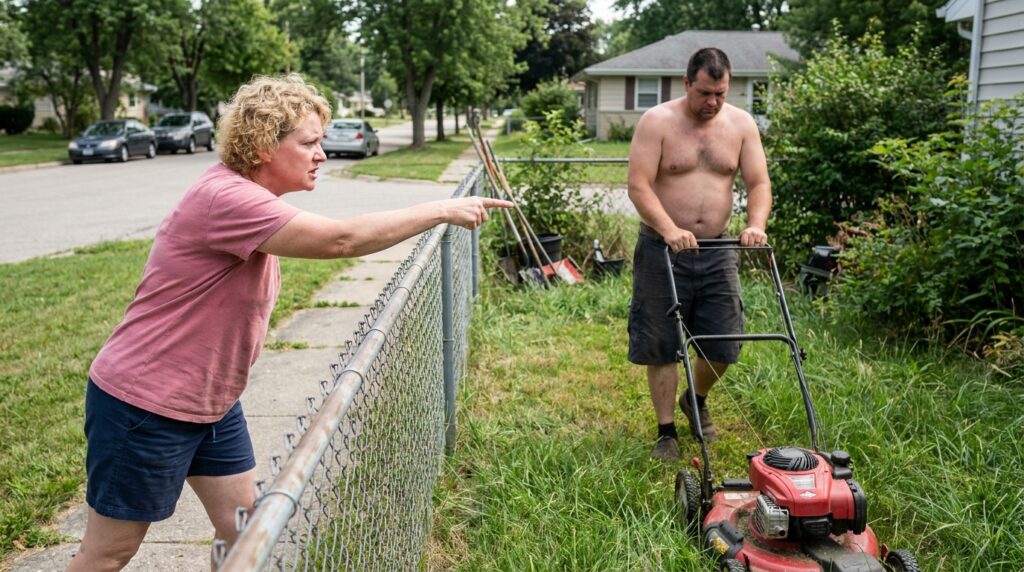
The chemical odor didn’t dissolve in the heat; it went greasy, hanging over the top rail of the fence like a wet blanket. Evelyn took one more step forward, her white tennis shoes sliding an inch into the loose river stone until her dark shorts pressed directly against the galvanized wire mesh. The links groaned, a thin, metallic screech of steel twisting against steel that vibrated straight through Frank’s forearms where his hands were still locked onto the mower’s foam handle.
She snapped her arm up into a sharp, rigid line. Her index finger breached the vertical plane of the fence, pointing straight at his bare, sweat-streaked chest. The shadow of her hand fell over the vibrating steel deck of the Briggs engine.
“You don’t get to act like you know my situation!”
Her scream came out thin, cracking at the edge under the flat weight of the noon sun. She had to throw her head back to project past the steady mechanical rattle of the blades slicing through the crabgrass near her feet. Behind her oversized plastic lenses, her cheeks had gone the color of a wet brick, the skin around her mouth pinched into a grey circle.
Frank didn’t drop the drive safety. He kept his feet planted in the shaggy sod, his back arched slightly to take the strain of the engine’s pull. His gaze stayed fixed on the lower lip of the mower’s steel deck, watching a green slurry of ground dandelion leaves and dry gray soil spill out against the bottom of the wire barrier. He didn’t blink. He didn’t match the hitch in her breath. He treated her voice like a broken fan belt on the truck—something that made noise but didn’t alter the route.
“The situation is twenty-eight feet of legal frontage, Evelyn,” he said, keeping the words clipped and flat inside the lower register of the mechanical hum. “And the front left tire of that unbadged dually in your alley is currently sitting on three inches of my culvert tile.”
“You have no right to talk about what’s in my alley!” Her hand shook, the pointed finger dropping to aim at the rusted square pin in the clay ditch between them. “My husband spent forty years making sure this ground stayed clean. You think you can just run your heavy machinery right up to the line and rattle everything loose? Look at it! Look at what you’re doing to the stone!”
She wasn’t looking at the stone. She was looking over her shoulder toward the corner of her garage where the dark ruts in the gravel led back to the alleyway. The sulfurous, heavy stink of old bottom-tank sludge was growing thicker now, drifting out from the kitchen screen door in regular, hot drafts as if someone inside had opened an access hatch. It was the smell of a terminal cleanout—the kind of black, toxic muck that settled at the bottom of a home heating reservoir after thirty years of slow condensation.
Frank shifted his grip by a fraction of an inch, his thumbs numbing under the steady pulse of the handle. He saw her glance back toward the vinyl blinds. They were still drawn, but one of the slats had been broken entirely, leaving a one-inch gap of dark glass where the thick, grease-stained fingers had parted the plastic. Whoever was inside wasn’t moving. They were waiting for her to finish the scene at the curb.
“I’m finishing the line,” Frank said. He eased the mower six inches forward, the steel deck scraping against a protruding knot of chain-link wire with a dry, screeching slide.
“You aren’t finishing anything!” Evelyn’s voice went wide, her torso pivoting away from the fence with a sudden, violent twist that pulled her shirt tight across her shoulder blades. She threw her right hand down the length of the concrete sidewalk, her open palm sweeping toward the empty, sun-bleached street as if addressing a courtroom of empty parked cars and silent asphalt. “You have no idea what I deal with here! None of you do!”
She was shouting at the empty porches down the block now, her face turned toward the glare of the street while her heel remained locked against his property marker. The performance was too big for the yard; she was begging for a window to open or a screen door to slam somewhere across the street—anything to give her an audience that would turn her private panic into a neighborhood emergency.
But the block stayed dead. The only movement was the heat shimmer rising off the roofs of the sedans parked along the curb and the low, heavy thrum of the engine between Frank’s hands. She stood there with her arm extended toward the empty concrete, her breath coming in short, rattling gasps that smelled of stale coffee and mints, completely isolated in the middle of her own drama.
Frank watched the way her shoulder dropped when the silence didn’t break. The performative stiffness left her spine first, her arm sinking six inches until her hand was just hovering over the dry river rock. She was running out of script.
He let his fingers slacken on the deadman lever. The ignition wire grounded out instantly, and the loud mechanical roar of the Briggs engine died in a succession of three heavy, metallic coughs. The sudden drop in sound left her last word hanging in the air like dust—unsupported, loud, and entirely too raw for a Saturday afternoon.
Frank lifted his head all the way, the brim of his greasy cap clearing his eyes. He looked straight through her dark lenses, his face expressionless under the white light.
“Alright,” he said, his voice flat and unbothered as an invoice. “I hear you.”