CHAPTER 2: THE UNCOVERED STAKE
“You’re tracking that grease right up to the post, Frank.”
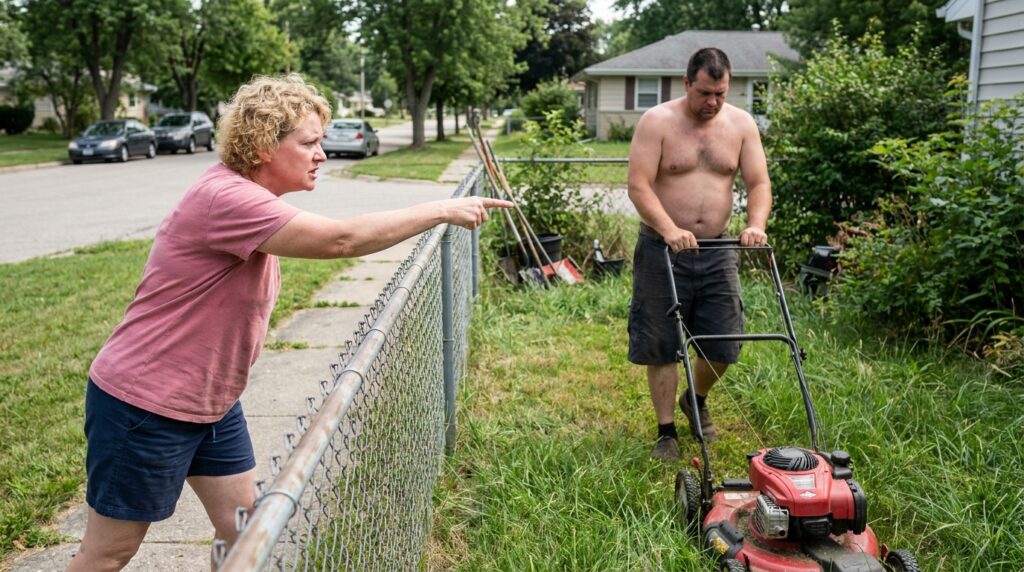
The voice didn’t come from the sidewalk; it came from the shadow of the garage overhang where the light didn’t hit the siding. Evelyn hadn’t moved three inches from the corner of her property line, but her arm was already lifting, the sleeve of her pink shirt rustling with a dry, synthetic sound like a dead leaf dragging across concrete. Her oversized sunglasses caught the white glare of the afternoon sky, turning her eyes into two flat, dark discs that reflected the outline of the lawnmower.
Frank kept his thumb clamped down on the safety bar. The engine hummed at a low, laboring idle, the deck vibrating against his boots until his shins felt numb. He didn’t lift his head all the way—just enough to clear the brim of his greasy cap. “The post is on my side of the ditch, Evelyn. Three inches inside the zinc line.”
“It was,” she said. Her voice had the thin, scraped quality of someone who had spent the morning talking to a city recorder over a bad landline. “Until you ran the heavy truck over the culvert back in April. You shifted the grade. The surveyor’s marker doesn’t lie, even if the person holding the title does.”
She stepped forward, her white tennis sneakers crunching into the dry, decorative river rock she’d dumped along the chain-link barrier to keep his dandelions from creeping across. In her right hand, she wasn’t holding a phone or a notice; she had a short, heavy length of broken rebar she used for staking her hydrangeas. She used it now to point down into the yellowed ditch where the grass met the gravel.
Frank looked where the iron pointed. Ten feet down the line, near the rotten base of the corner post, the earth had been freshly disturbed. Someone had taken a garden trowel to the sod, peeling back a three-inch square of crabgrass to expose the grey clay beneath. In the center of the small clearance, a square iron stake—rusted down to a dark, flaky orange—shone where something hard had recently struck it. The top of the metal was scarred with bright, silver grooves, the kind left by a structural hammer or a pry bar trying to force a wedge between the property boundaries.
“The city didn’t do that,” Frank said, his voice flat as a grease-plank.
“The city doesn’t have to,” Evelyn snapped, her posture tightening until her shoulders rose toward her ears. She leaned her hip against the top rail of the chain-link, her weight causing the wire mesh to groan against its aluminum ties. The heat between them smelled of scorched cylinder oil and the stagnant water sitting at the bottom of the culvert ditch. “The city takes the report and they look at the map. I know what’s under this dirt, Frank. My husband set those pins when the foundation here was still wet. You think because you own a truck you can just push three feet into the gravel whenever you have a delivery?”
Frank felt the small of his back ache from the five-hour haul he’d finished at dawn. He looked at the silver scars on the ancient iron stake. They were fresh—no rust had formed in the grooves yet, and the loose clay around the metal was still damp from being turned over within the hour. A real surveyor didn’t leave a stake look like it had been beaten with a tire iron. Someone had been looking for the true corner marker, and they hadn’t been careful about what they used to find it.
“The gravel hasn’t moved,” Frank said, his knuckles locking tighter around the black foam handlebar. “And your driveway is exactly where it was when the bank signed the papers.”
Evelyn let out a short, dry laugh that didn’t change the expression behind her dark lenses. She raised the rebar three inches, her index finger extending along the rusted steel like a barrel. “The bank doesn’t live here. I do. And you’re going to find out exactly how much this street costs if you keep that machine running against my fence.”
She turned her back to him before he could answer, her short blonde curls catching the harsh light as she marched three steps up her concrete walkway. But she didn’t go inside. She stopped on the top step, her clipboard resting against her hip, her fingers tapping a rhythmic, impatient beat against the yellow paper tucked under the clip.
Frank shifted his weight, his boots digging into the cut grass. The engine gave a short, sputtering rattle as a clump of wet clover jammed the chute, but he didn’t clear it. He looked back down at the exposed orange iron in the ditch. The tool marks were deep. Whoever had struck that pin wasn’t trying to measure the property—they were trying to verify how far down the metal went before it hit something solid beneath the dirt. He could see the pale white edge of an old plastic sheet sticking out from the side of the hole she had dug, its synthetic corner buried deep under the gravel lane where her husband had parked his old station wagon twenty years ago.
The white blind in her side window twitched again. Frank looked up, catching the briefest glimpse of a second pair of hands smoothing the vinyl slats back into place. They weren’t Evelyn’s hands; the fingers were thick, blunt-tipped, and gray with the kind of grease that didn’t come off without volcanic soap.