CHAPTER 5: THE VACUUM SEAM
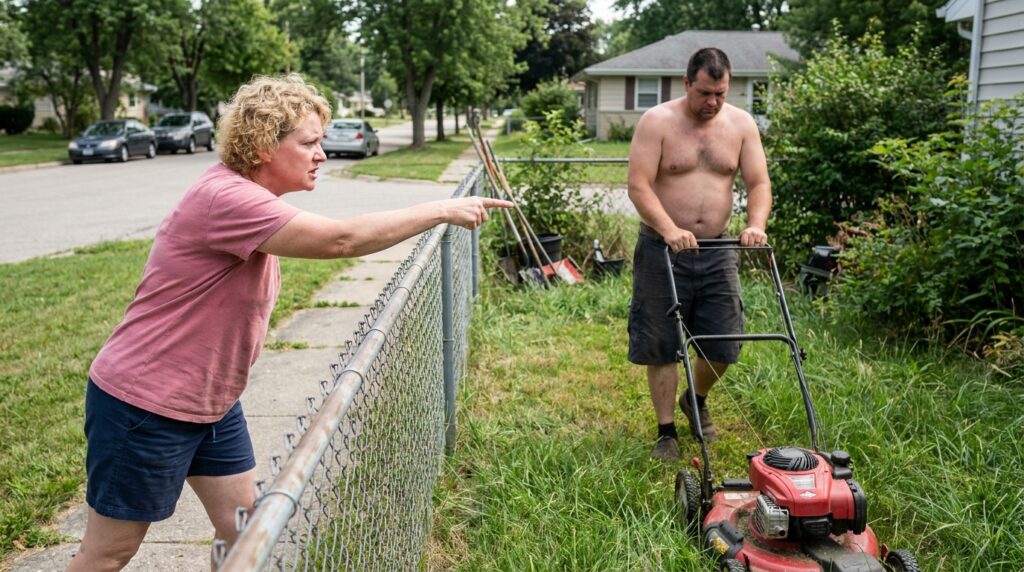
The silence didn’t settle smoothly; it dropped onto the block like a slab of wet concrete. Evelyn’s hand stayed frozen in the empty air, her fingers hooked slightly as if she were still trying to clamp onto the tail end of the scream that Frank had cut short. Her shoulders dropped three inches, the cheap pink polyester of her shirt wrinkling around the collar under the flat glare of the sky.
“You don’t listen,” she said. Her voice didn’t have the volume anymore; it was down to a gravelly rasp that barely cleared the zinc links between them. “You never did. Your father was the same way when he put the gravel in. Just took what he wanted and let the rest of us look at the fence.”
Frank didn’t shift his boots from the grass. He reached down, his fingers catching the zinc-coated cap of the corner post right above the excavated iron stake. The metal was burning hot from four hours of unshaded sun, the rough protective coating biting into the callus of his palm. As he braced his weight against the pipe to stand up straight, the top cap spun loosely under his hand. It wasn’t welded. It wasn’t even pinned.
He lifted the metal disk two inches. Inside the hollow core of the galvanized pipe, jammed tight against the inner rust scale, was a cylinder of yellowed paper protected by a sleeve of heavy, transparent fuel-line plastic. The edges of the roll were charred dark, down to a brittle, flaking charcoal color where the heat of the summer pipe had baked the paper for decades.
Before he could pull the plastic sleeve from the post, a heavy mechanical thud rattled the gravel lane behind Evelyn’s garage. It was the distinct iron-on-iron clang of a truck tailgate being dropped without its chains, followed immediately by the wet, rhythmic thumping of a high-pressure diaphragm pump cutting into gear.
Evelyn didn’t look back toward the noise. Her jaw went completely rigid, her teeth clicking together behind her lips with a fast, nervous snap. She leaned her entire weight against the top rail of the chain-link, her fingers hooking through the mesh until the wire pinched her skin into pale white diamonds.
“That’s enough for today, Frank,” she said, her voice dropping into a desperate, hurried hiss that didn’t match the performative outrage from two minutes before. She reached across the top rail, her fingers swatting at his forearm with a dry, frantic slap. “Go inside. The hour’s up. You got what you wanted. Just take the machine back to the shed.”
Frank didn’t drop his hand from the loose post cap. Through the hollow core of the pipe, the vibration of the diaphragm pump in the alley traveled straight into his fingers—a heavy, irregular pulse that meant the suction line was pulling sludge, not liquid. The bitter, rotten-egg stench of old iron sulfide and tank bottom-sediment rolled out from the gap between her garage and the fence line, so thick it left a greasy sheen on the grass blades.
“That’s a vacuum truck, Evelyn,” Frank said. His voice stayed low, locked into the flat cadence of a man reading a freight manifest. “A six-inch intake. The county doesn’t run those on residential lines without a yellow permit on the main pole.”
“It’s a private contractor,” she snapped. Her sunglasses slipped half an inch down the bridge of her nose, revealing the small, red-rimmed eyes behind them. They weren’t angry anymore; they were wide and glossy with a cold, frantic terror that looked straight past his shoulder toward the empty street. “He’s cleaning the floor drain. The old grease trap from the refinery days. It’s my property.”
“The grease traps were all filled with limestone slurry in ninety-two,” Frank said. He reached down into the hollow post, his thumb and forefinger clamping onto the edge of the plastic sleeve. The paper inside was thick, official parchment, the top border showing the faded blue seal of the County Recorder’s Office from the winter of 1982. He could see the bold black lines of a surveyor’s grid map through the plastic, but the red ink used to mark the property offsets didn’t stop at the chain-link fence. The red line sliced three feet directly through her concrete walkway, cutting her driveway in half.
A loud, hydraulic hiss cut through the air behind the green house, followed by the sound of a heavy rubber hose collapsing against itself as the pump choked on something solid. A man’s voice—rough, thick, and muffled by the garage wall—shouted a string of curses into the open alley.
“Shut it down! The bottom’s gone out! It’s leaking back into the ditch!”
Evelyn’s head snapped toward her walkway, her fingers tearing away from the chain-link fence with a sharp rasp of sliding skin. She didn’t look at Frank again. She started down her path, her white sneakers skimming over the concrete as she ran toward the side gate, her clipboard dropping face-down into the dry river rock.
Frank didn’t follow her. He pulled the yellowed map out of the post cap, the ancient paper crackling like dry bark between his greasy fingers. As he unrolled the first six inches, a gray, oily stain began to spread across the bottom of the sheet, soaking through the parchment from the very soil beneath his boots. The clay around the rusted iron stake was turning black, a thin, iridescent film of fuel oil bubbling up through the turned sod where she had dug her trowel.
Across the street, a front door finally clicked open. A retired machinist named Miller stepped out onto his porch, his hand shading his eyes as he looked down at the dark, oily puddle starting to seep out from under the gravel lane and into the public concrete gutter.