CHAPTER 3: THE CALLED MARCH
The blinds snapped shut before the grease-coated fingers could retreat fully into the dark of the kitchen. A heavy wooden frame dropped against the sill inside her house, a solid, blunt sound that didn’t carry past the low vibration of the Briggs cylinder but reached Frank through the soles of his boots.
Evelyn was still standing on her top step, her back to him, her fingers performing that same small, nervous dance against the corner of her aluminum clipboard. She hadn’t heard the drop of the frame inside, or if she had, she was pretending the noise belonged to the wind chimes hanging from her porch rail. The sun caught the back of her pink shirt, turning the cheap polyester into a glaring shield that forced Frank to keep his eyes fixed on the graying wood of his own gatepost.
“You’ve got company, Evelyn,” Frank said. He didn’t raise his voice. He let the flat weight of the vowels ride under the mechanical hum of the mower, steady enough to reach her but low enough that the passing mail truck wouldn’t catch it.
She didn’t turn around immediately. She took her time, adjusting the sunglasses until the wide rims were perfectly aligned with the line of her jaw. When she did look back over her shoulder, her heels didn’t shift from the lip of the concrete step. “The people who come to this house are none of your concern, Frank. Not until they’re legal representatives of the municipality. And they will be.”
“The city doesn’t usually wear eight-inch mechanic’s boots,” Frank said. He looked down at the gravel lane that ran between their properties, tracing the tire tracks left by a vehicle heavier than her old four-cylinder compact. The stone was deeply rutted near the rear of her garage, the gray gravel pushed aside to reveal the oily black soil beneath. “And they don’t usually park an unbadged dually truck in the alley with the plates scraped down to the zinc.”
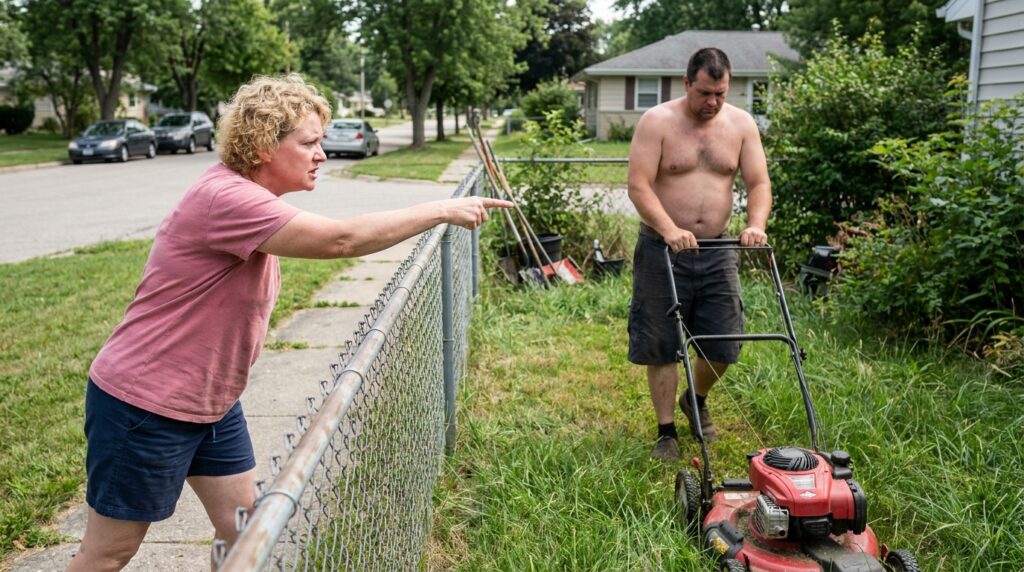
A slight twitch caught the corner of her mouth, the tight muscle pulling her lip thin against her teeth. She dropped her clipboard to her side, her thumb hooking into the metal clip with enough force to turn the knuckle white. “I told you to turn that machine off, Frank. The ordinance says noon until five on weekends, and you’re five minutes past the line.”
Frank checked the heavy steel watch on his wrist. The crystal was scratched from three years of scraping against truck frames, but the numbers were clear under the glare. It was four in the afternoon. She was cutting an hour off the clock because she needed the quiet to hear whatever was happening inside her kitchen.
Instead of letting go of the throttle, he pushed the machine three feet forward, the front wheels crunching into the dry river rock she had laid out. The blade hit a stray piece of limestone, spitting a gray puff of pulverized mineral out the side chute. The small rock struck the lower wire of the chain-link fence with a sharp ping that made her jump.
“You’re destroying property now,” she said, her voice rising an octave as she took two fast, calculated steps down her walkway. Her sneakers clicked hard against the concrete, her body leaning forward until her silhouette broke the clean horizontal line of the fence. “I have a camera on the corner of the eave, Frank. I have every single time you’ve let your weeds touch my wire recorded on a hard drive.”
“The camera’s missing its lens, Evelyn,” Frank said. He leaned his weight back against the handlebar, stopping the machine exactly two inches short of the rusted iron stake she had uncovered. “It’s been dead since the ice storm two winters back. The housing is full of mud-wasp nests. We both know it.”
She stopped on the sidewalk edge, her toes right against the zinc links. Her face was less than four feet from his now, the heat radiating off her pink shirt carrying the sharp, sweet smell of floral detergent and sour sweat. She looked down at the square iron pin in the dirt, then up at his chest, her pointed finger rising until the tip of her nail was aligned with the center of his collarbone.
“You think you’re smart because you drive a truck for the county,” she whispered. The shouting tone was gone, replaced by a tight, rattling hiss that barely cleared the fence. “You think you can just look at a man’s yard and decide where the town ends. My husband gave forty years to the refinery down the river. He knew exactly what this ground could take before it gave out. You keep running that blade over his stakes, and you’re going to pull up something you can’t afford to bury.”
Frank didn’t move his hands from the foam grip. He let his thumbs stay locked over the bar, his eyes dropping from her sunglasses down to the small square of exposed gray clay around the rusted marker. The white edge of the buried plastic sheet was wider now, exposed by the stone he had displaced. It wasn’t a garbage bag. It had a heavy, woven texture like the reinforced tarp they used to cover fuel tanks during a winter teardown.
From inside her house, the sound of a heavy metal latch clicking into place echoed through the side window. A second later, the scent of stale diesel oil and old tank bottom—thick, sulfurous, and chemical—drifted out through the loose screen, overriding the smell of the cut grass.