CHAPTER 6: THE SLUDGE BREAK
The oil didn’t seep; it pulsed. Every stroke of the hidden diaphragm pump in the alley sent a fresh wave of black, sulfurous muck bubbling up through the square hole Evelyn had dug around the old iron stake. The iridescent sheen caught the overhead glare, turning the turned clay into a wet, dark grease trap that slowly ate the bottom of the zinc fence line.
Frank let go of the hollow post cap. His fingers left dry, gray dust prints on the hot metal, but his eyes were fixed on the map unrolled across his palm. The gray stain had already claimed the lower corner of the parchment, turning the faded blue ink of the 1982 recorder’s seal into a blurred, translucent smudge. The lines didn’t lie, but the ground beneath them was failing. The three-foot encroachment shown on the survey map—the decoy paper that made it look like a simple matter of driveway concrete—was being drowned by a much larger liability.
“Frank! Get away from the wire!”
Miller’s voice came from three houses down, flat and gravelly from years of breathing shop air. The retired machinist was leaning over his porch rail, his hand shielding his eyes as he watched the black line creep across the public concrete gutter toward his own curb. “That stuff smells like a terminal leak, Frank! Don’t touch the sod!”
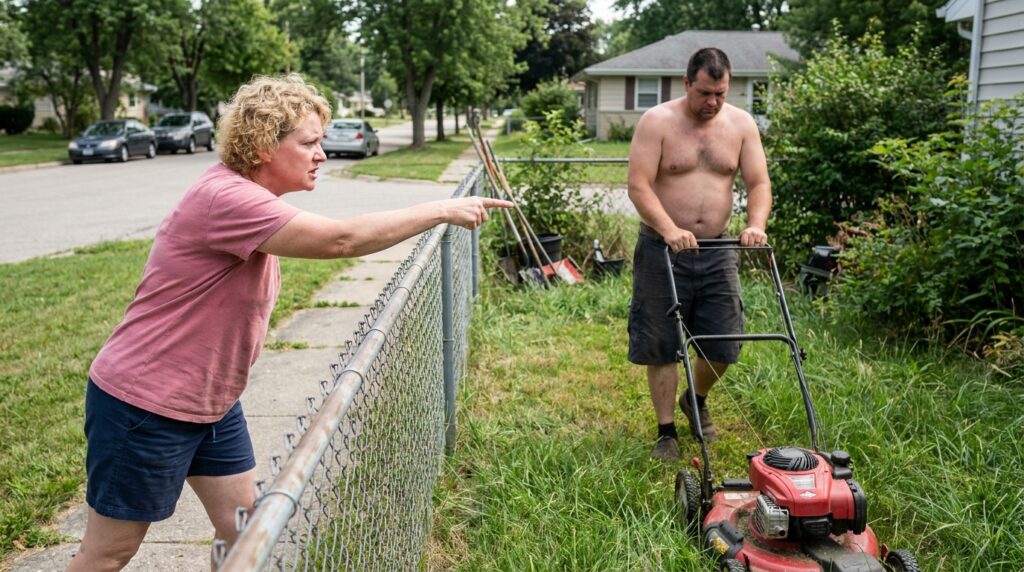
Frank didn’t move back. He stepped directly onto the low pipe rail of the chain-link, his work boot sinking an inch into the shaggy crabgrass near the engine deck. The old Briggs motor was hot, the smell of scorched oil from the cylinder head mixing with the heavier, chemical stench of the tank bottom. He could see the white corner of the buried woven tarp clearly now; the rising oil was lifting the synthetic fabric, exposing the curved, rusted flank of an old residential fuel tank buried directly beneath the gravel strip where Evelyn’s husband used to park his wagon.
It wasn’t a grease trap. It was a five-hundred-gallon storage reservoir that had been filled with bootleg industrial fuel during the refinery layoffs forty years ago, then deliberately walled in with river rock and false property markers when the environmental codes changed. The tool marks on the iron stake hadn’t been an attempt to measure the lawn; the guy in the alley had been probing with a pry bar to see if the tank casing was still thick enough to hold the vacuum pressure while they sucked it dry in secret.
From behind the green garage, a loud, metallic screech shattered the rhythm of the pump. It was the sound of a structural valve assembly splitting under suction, followed instantly by the heavy, wet slosh of two hundred gallons of emulsified crude hitting the gravel floor.
“Cut the line! Cut the line!”
The man’s voice in the alley was frantic now, his heavy boots clattering against the aluminum side-rails of his truck as he scrambled to hit the master breaker. The diaphragm pump gave one final, choking rattle and went dead, leaving only the sound of liquid dripping onto the dry gravel strip behind the fence.
Evelyn came around the corner of her kitchen path, her white sneakers completely blackened around the soles by the thick sludge. She had lost her sunglasses; her eyes were small, watery, and fixed entirely on the black pool spreading into Frank’s tall grass. Her clipboard was gone, her hands empty and shaking against the sides of her pink shirt.
“It wasn’t supposed to do this,” she whispered, her voice dropping all the way down into the gray clay. She stopped three feet from the fence line, her posture completely collapsed, the performance of neighborhood authority entirely gone. She looked at the yellowed paper in Frank’s hand, then down at the bubbling iron stake. “The papers said it was empty. My husband told the town it was filled with slurry back in ninety-two. He signed the affidavit.”
“He signed the map, Evelyn,” Frank said. He didn’t drop the unrolled parchment. He held it out over the top rail of the chain-link, the black fluid slowly tracing the boundary lines toward his own thumbs. “He used the three-foot easement to hide the tank line from the city recorders. If the fence stays here, the liability belongs to whoever holds the deeds to the grass.”
She looked up at him through the heat shimmer, her face pale under the white light of the valley sun. The silent neighborhood audience—Miller on his porch, two other watchers standing by their mailboxes down the block—was dead still, their eyes locked on the old woman stranded on her own walk. Her claim to the territory had broken wide open, not because of a lawnmower, but because the secret beneath her driveway had finally rotted through its casing.
Frank rolled the map back into a tight cylinder, the oily parchment sticking to his palm with a cold, greasy suction. He checked his heavy watch one last time. The four o’clock sun was dropping toward the rooflines of the refinery down the river, casting long, dark shadows across the fouled grass. The yard still needed mowing, but the blade wouldn’t touch this corner again.
A dark sedan with city municipal plates turned the corner at the end of the block, its tires crunching slowly over the gravel toward the black pool at the curb.