CHAPTER 7: THE SETTING OF THE SURVEY ANCHORS
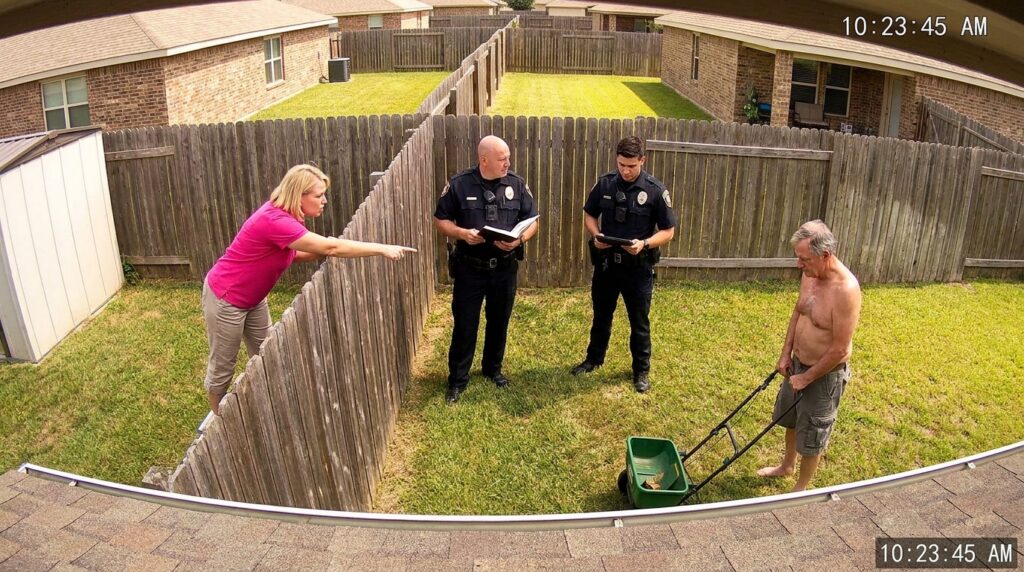
The wire stem of the third orange flag vibrated with a long, microscopic rattle as Officer Miller drove his heel into the top loop, burying the metal guide deep into the cracked clay. The thin rod didn’t slide smoothly; it scraped hard against the buried shoulder of the 1979 railroad track, sending a dry, hollow echo through the dirt beneath Arthur’s work boots.
Arthur reached down and lifted the heavy iron sledgehammer from the threshold of his corrugated tin shed. The hickory handle was dark, greased by decades of his own palm sweat, the forged steel head showing a deep, cross-hatched pattern of scars from striking frozen pipe joints and industrial lathe anchors. The metal was burning hot from sitting in the afternoon sun, the heat radiating straight into the dry skin of his fingers as he wrapped his hand around the throat of the tool.
“Step back an inch, son,” Arthur said. His voice was steady, retaining that slow, deliberate register of a man who measured his life by thousands of an inch rather than digital coordinates.
He swung the sledge in a short, vertical arc. The heavy iron head struck the top of the permanent steel surveyor’s spike Miller had set into the sod. The impact was a loud, flat clank that cut right through the mid-afternoon hum of the highway, dropping a clean, ringing silence over the neighboring yards. The steel rod sank three inches into the hardpan. Arthur didn’t pause. He swung again, his shoulders rising and falling in an unbroken, rhythmic motion that felt exactly like the mechanical stroking of the heavy shaper machines he used to run at the plant.
Clank.
With every blow, the orange flag fluttered against the weathered gray slats of the fence. Across the boundary, behind the dark, heat-reflective tint of the sliding glass door, Shannon’s silhouette didn’t move. She remained standing by her white kitchen island, her phone held level at her waist, watching the steel pins go down into the earth one by one. The calculations she had spent sixteen months constructing—the digital vectors, the satellite overlays, the clean, automated lines of her deed warranty—were being driven straight into the clay by eight pounds of unyielding iron.
Arthur felt the vibration travel up through the hickory handle, into his wrists, and settle deep into his shoulder joints. It was the specific, dead resistance of the earth when it refused to give any more ground. This wasn’t just about a fence anymore. The final pin was down, and as it locked into the subsoil, it anchored something much larger than a twelve-inch strip of rye grass. The 1994 road expansion error was permanently buried under this turf; the three-inch shift that had displaced the entire block’s legal foundation was now a fixed, unmovable reality, protected by a sixty-dollar county clerk variance document signed before Shannon’s colonial house had even been dug out of the mud.
He rested the head of the sledgehammer on the ground, his chest rising and falling in slow, controlled breaths. A fine film of grey dust had settled over his bare shoulders, turning the sweat into a dry, chalky paste that smelled of iron scale and baked silt.
Officer Miller wiped his brow with the back of his dark uniform sleeve, his ruggedized digital tablet already tucked into its side holster. He looked at the row of orange flags sitting flush against the cedar rail, their straight, uniform line cutting a clean boundary down the length of the properties. The plastic markers didn’t waver in the dead air.
“That’s the limit, Arthur,” Miller said softly, his voice dropping below the distant rattle of the highway traffic. “The report is logged. The coordinate system won’t change this line again.”
Arthur didn’t answer. He looked at his old green Sears craftsman mower, resting quiet in the grass strip, its rubber tires dusted with the grey earth they had spent twenty-six years maintaining. He reached down, picked up the broken tip of the black breaker bar Shannon had left behind in the dirt, and tossed it into the rusted scrap bin near his tool shed door. The metal hit the bottom of the tin barrel with a short, heavy clatter that signaled the end of the long day’s labor.
He turned his back on the white colonial next door, grabbed the starter cord of the mower, and gave it one final, smooth pull. The old engine caught instantly, its heavy, mechanical drone filling the backyard with the familiar, predictable song of a home that had finally found its true measure.