CHAPTER 5: THE COLLAPSE OF THE BOUNDARY VECTORS
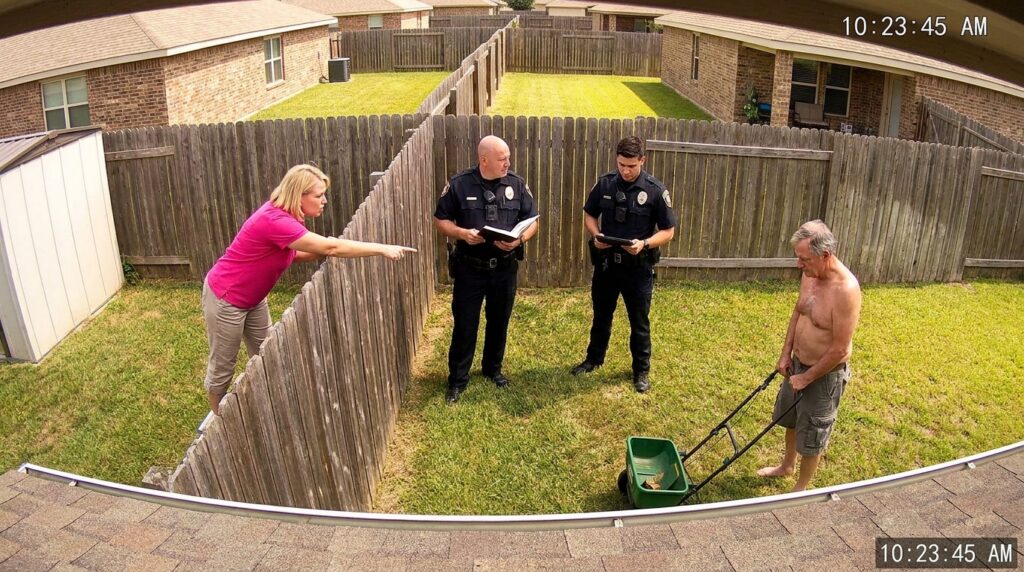
The word structure seemed to hang in the humid air like the thick smell of upcoming grease smoke from a bad bearing. Officer Miller didn’t shift his gaze from his tablet; the blue glare reflected off his sunglasses, fracturing into clean, technological shards against his uniform collar. The steel measuring tape stretched across the clover let out a low, vibrant whine as the tension from the spool increased, cutting a razor-thin line through the dry dandelions.
“Let me look at that,” Shannon said. She didn’t shout. Her voice had dropped into a flat, dangerously quiet drone that Arthur had heard only once before—when the commercial utility crew had tried to trim the low-hanging oak limbs near her concrete driveway. She unlatched the cedar gate with a single, aggressive jerk of her wrist, her khaki capris brushing against the rough splinters as she stepped straight into the neutral dirt of the grass strip. “The 1998 settlement was executed before the county integrated the satellite coordinates. It lacks a valid geographic anchor. You cannot invalidate a modern property deed with an unindexed piece of dead microfiche.”
Officer Vance didn’t yield the ground. His stocky, dark-clothed frame remained planted directly between the green push mower and the open pages of the ordinance book. He slowly closed the heavy leather volume, the thick linen sheets snapping together with a sound like a small pistol shot in the quiet neighborhood.
“Ma’am,” Vance said, his voice retaining that heavy, transactional rasp that carried the absolute finality of a county magistrate. “The code is explicit under Chapter Nine, Section Two. A physical barrier, when accompanied by a recorded, court-clerk-certified variance and maintained continuously for a period exceeding twenty-five years, establishes the absolute legal boundary regardless of subsequent subdivision grid shifts. The curb spike doesn’t matter anymore. Your title company missed the baseline adjustment because they only searched back through the 2004 digital migration. But the dirt remembers.”
Arthur watched Shannon’s hand drop to her side. The smartphone was still clutched in her white-knuckled fingers, its glass screen reflecting the parched, yellowed earth beneath her work shoes. Her fingernails were pressed so hard into the plastic casing that the cheap composite material let out a faint, structural groan. For twelve months, she had built her authority on the absolute precision of her digital maps, tracking Arthur’s tire tracks down to the millimeter, convinced that the weight of the city bureaucracy would grind his old tin shed into the dirt.
Now, the very book she had called to the scene was pinning her to the fence line.
“This is an administrative failure,” she whispered, her chest tightening beneath the hot pink cotton of her polo shirt. Her chin rose, her eyes scanning the windows of the neighboring houses—the silent porch watchers who had spent the last hour tracking the flashing blue lights of the cruiser through their blinds. “The county clerk’s office will have a record of the original pre-expansion baseline. I’m calling the zoning director directly. This line is shifted. The whole block is shifted.”
“The whole block is shifted, Shannon,” Arthur said softly. He finally took his hands off the mower handle, his boots making a dry, crunching sound as he stepped closer to the cedar divider. He reached down and touched the base rail, his fingers running over the rough, silvered grain of the wood right where the heavy iron pry bar had gouged the fibers. “That’s what you didn’t see when you were looking at your satellite maps. When the road crew put the cul-de-sac in back in ninety-four, they moved the entire asphalt arc three inches to the east to clear the county water main. If you move my fence, you have to move the fence on Lot Forty-Three, and Lot Forty-Four, and the concrete garage footings at the end of the lane. You’re trying to pull a single thread out of a finished coat.”
Shannon didn’t answer him. Her eyes darted toward Officer Miller, who was already reeling the steel measuring tape back into its orange housing. The thin blade of metal clattered against the dry earth, dragging a small track of orange-red iron dust from the base of the shed panel with it. The micro-mystery of her late-night digging was exposed; she hadn’t been looking for her property line. She had been trying to find the old iron monument spike to prove the road expansion error before the police arrived, and her pry bar had hit forty pounds of unyielding, forgotten railroad steel instead.
“We’re clearing the scene, ma’am,” Officer Vance said, his hand resting on the latch of his cruiser door with an administrative finality that signaled the end of the Saturday intervention. “The report will reflect that the neighbor was operating within an established, court-settled variance. If you want to challenge the 1998 text, you’ll have to file a formal petition with the county circuit court. Until then, the fence stands exactly where it sits. Keep your tools and your cameras on your side of the cedar.”
Shannon stood perfectly rigid on the dry grass strip, her figure framed by the clean, sharp angles of her pristine colonial house. Her performative authority had cracked down the center, leaving her exposed to the very neighborhood she had tried to regulate. She didn’t look at Arthur, and she didn’t look at the officers. She turned back toward her gate, her movements stiff, her shoulders locked under the hot afternoon sun as the cruiser’s engine roared back to life, spitting a fine spray of gray gravel against the bottom rail of the fence.
Arthur watched her go, then turned back to the Sears craftsman. His hands were steady as he reached for the starter cord again, the old engine waiting for the next pull in the heavy, dry dust.