CHAPTER 6: THE RETREAT FROM THE PARCHED STRIP
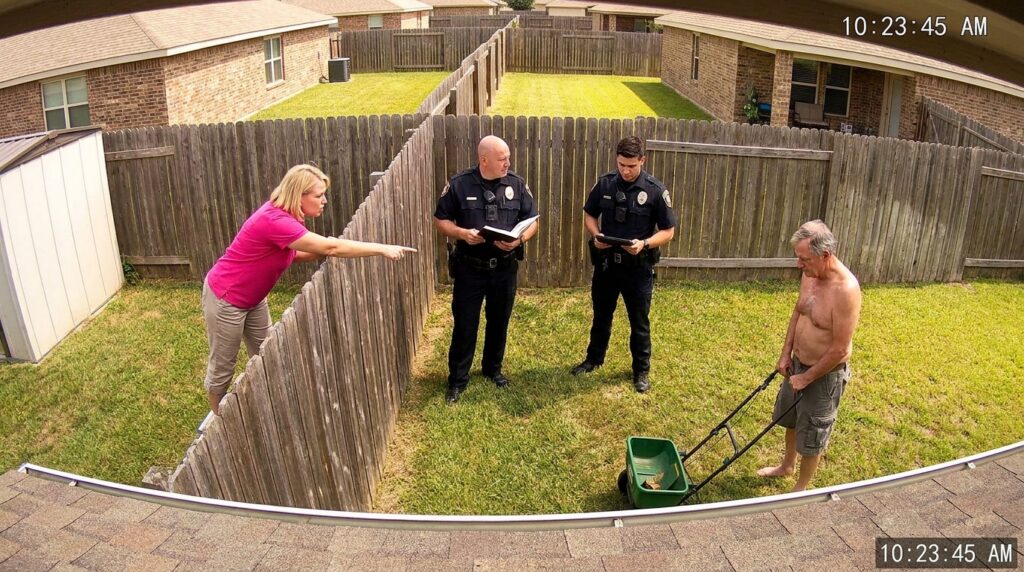
The gray gravel dust kicked up by the cruiser’s rear tires hung in the hot air like the smoke from a dead engine, settling slowly onto the yellowed grass stems between the properties. Arthur didn’t reach for the rubber starter pull immediately. He stood motionless in his oil-stained work shoes, watching the back of Shannon’s hot pink polo shirt recede toward her kitchen porch. Her gate didn’t just swing closed; she latched it with a sudden, metallic click that vibrated down the entire length of the cedar panels.
Through the glass of her double-paned sliding door, her silhouette remained rigid, a dark vertical shape against the sterile white kitchen tile inside. She didn’t drop the smartphone. Even from fifty feet away, Arthur could see the faint blue glow of the screen illuminating her face as she stood behind the reflective tint of the windowpane, her thumb already working the glass with a slow, defensive deliberation.
Arthur walked back to the edge of his corrugated tin tool shed, his boots leaves crushing the dry clover with a crisp, hollow crackle. The metal of the siding was baking under the three o’clock glare, the old zinc coating emitting a faint, metallic odor that smelled of hot machinery and long-settled grit. He knelt down in the shade of the low oak limbs, his arthritic knees popping under the weight of his frame. Right at the corner footing where the cedar post met the earth, he reached his hand into the loose, dry soil.
His fingers brushed against the iron deadman anchor he and Higgins had buried thirty-four years ago. The surface of the old railroad track was rough, covered in thick plates of dark brown oxidation that flaked off under his fingernails like dry slate. But right next to the iron flank, the dirt was loose, cleared out by a tool that didn’t belong to his workshop. He reached down further, his knuckles striking something small and hard wedged between the rusted metal and the foundation stone.
He pulled it out. It was a broken corner of hardened black tool steel—the flat, chiseled tip of an industrial breaker bar, snapped off clean by the sheer weight of the unyielding railroad iron beneath. The edge of the steel fracture was bright silver, completely unweathered, showing that the tool had broken only hours before Shannon made her call to the station.
She hadn’t just been checking the digital overlays from her desktop. She had been down here in the dark, using her own hands and forty pounds of forged steel to locate the original property marker spike, desperate to prove her coordinate map correct before the county surveyors could arrive with their physical transits. She had hit the deadman instead, her tool shattering against the forgotten industrial iron Arthur had driven into the subsoil before her house was even an architect’s sketch.
“Arthur.”
The voice came from the gravel driveway behind him. It was Miller, the junior officer. He hadn’t gotten back into the cruiser with Vance; he had stayed behind near the utility box, his dark uniform cap pushed back an inch on his forehead to let the dry air hit his skin. He was carrying a small bundle of orange surveyor flags under his stocky arm, the thin wire stems clinking together with a light, metallic ring as he walked down the grass strip.
“Vance wants me to drop these markers before the city office closes out the log,” Miller said, his boots tracking a fresh line of gray dust across the parched clover. He stopped three feet short of the cedar post, looking down at the broken steel tip resting in Arthur’s palm. “He says if we don’t set the physical anchors right now, she’ll be back out here with a private contractor before the morning shift starts.”
Arthur rose slowly, wiping his stained hands on his cargo shorts. “She knows about the ninety-four shift, doesn’t she?”
Miller didn’t answer right away. He dropped to one knee, his utility belt letting out a dry leather creak as he pushed the first orange flag into the hard, sun-baked clay right against the cedar post line. The wire stem vibrated as it met the resistance of the earth.
“She’s got the whole block mapped, Arthur,” Miller muttered, his eyes remaining fixed on the ground as he cleared a patch of dry thistle. “The GIS layer she pulled from the relocation company wasn’t just a standard title print. It was a preliminary re-platting map from the state highway office. They’ve been looking at widening the cul-de-sac radius for the new drainage line next spring. If she moves this fence three inches west, her kitchen deck clears the city utility setback by exactly two centimeters. If the fence stays where it is, her insurance company hits her with a non-compliance penalty the second the city inspector signs the work order on Monday.”
Arthur looked back at the house across the fence. The blue glow behind the glass pane had vanished, replaced by the dark, dead reflection of the afternoon sky. The real pressure wasn’t about his mower tracks or Higgins’s old handshake agreements. She was running a calculation against a municipal clock, trying to push her legal boundary onto his grass before the city’s civil engineering team arrived to lock the block’s infrastructure into place. Her precision wasn’t an obsession; it was a shield against a massive financial liability she had inherited from the Charlotte firm.
“The wire’s hitting something hard down here,” Miller said, his thumb forcing the second flag stem into the dirt near the tin corner of the shed. The metal rod bent with a sharp, springy click as it struck the buried railroad iron. “It feels like solid plate.”
“That’s forty pounds of steel that doesn’t move, son,” Arthur said softly, his voice matching the heavy, flat hum of the July heat. He looked down at the orange plastic flag fluttering against the gray cedar slats. “And it’s been holding this dirt together longer than she’s been alive.”
Miller pulled his hand back, his fingers coated in the same dark, orange-red iron flakes that had been scraped off the fence rail. He stood up, looking at the long row of cedar panels that divided the yards, their vertical edges showing the true, uneven warp of thirty years of exposure to the weather. The line was locked, but the air between the houses remained thick, heavy with the silent, unresolved weight of a neighborhood grid that had been built on an unrecorded human error.