CHAPTER 4: THE MEASURED ANCHOR
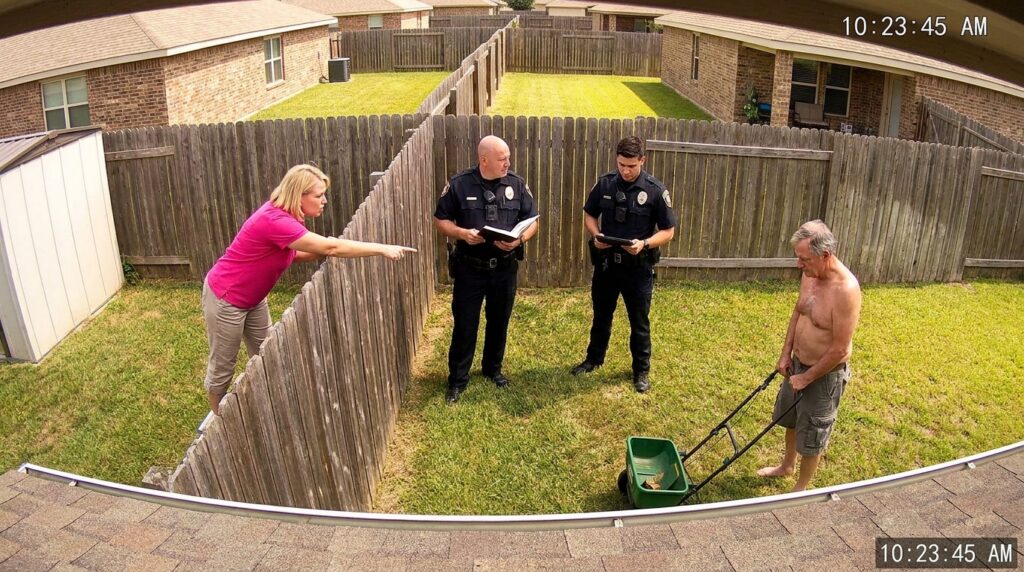
The dry heat seemed to drop another ten pounds of pressure onto the yard as Officer Vance reached into the rear window of the cruiser. His large, salt-ringed shoulder blade brushed against the door frame, producing a sharp, metallic ping from the car’s radio antenna. When he turned back toward the property line, he wasn’t carrying a light citation pad. He had a heavy, leather-bound volume wedged under his short elbow—the official municipal code book for the county, its canvas spine stained with greasy thumbprints from years of courthouse basement storage.
“Miller,” Vance called out, his gravelly voice flat as he stepped directly onto the parched grass strip between the yards. “Get the tape out of the gear well. The thirty-meter steel one, not the nylon.”
Arthur didn’t move. He kept his palms resting on the plastic-capped kill switch of the Sears craftsman, his thumb feeling the grit embedded in the rubber grip. The green paint on the deck was hot enough to warp water, sending up a faint, sharp reek of scorched weed juice and old internal gear oil. He watched the younger officer, Miller, yank a heavy orange spool from the back utility trunk. The steel tape let out a high, metallic shriek as Miller pulled the lead ring free, the thin blade of metal flashing silver against the yellowed thatch of the lawn.
“We don’t need a manual measure, Officer,” Shannon said. She didn’t step back from the cedar slats. Her smartphone was held flat at chest height now, her thumb hovering over the screen like a mortar fuse. “The digital GIS survey layer is calibrated to the state plane coordinate system within two centimeters. The variance Miller mentioned is an unindexed artifact. It has no legal standing against a modern deed warranty.”
Vance didn’t answer her. He let the heavy book drop onto the flat top of a cedar post with a hollow, wooden thud that sent a small puff of grey dust into the air. He flipped the pages with his thick thumb, the heavy linen paper making a dry, scraping sound like old leaves being swept across concrete.
“Section Twelve, Paragraph Four,” Vance muttered, his finger tracing a line of small, dense print. “Regarding established boundary markers and continuous maintenance. Ma’am, you bought this lot sixteen months ago from a relocation company out of Charlotte. Is that right?”
“Sixteen months and three days,” Shannon replied, her posture freezing into a rigid, defensive angle under the hot pink polo shirt. “And my title insurance clear-search was certified up to the closing hour. Prior occupancy doesn’t create a prescriptive easement in this subdivision. The covenants are explicit.”
“Covenants don’t override a court clerk’s indexed estate settlement from ninety-eight,” Vance said, his eyes still fixed on the dense text of the volume. He didn’t look up at her. He pointed his left hand toward the base of Arthur’s tin tool shed, where the concrete footer stones were buried deep in the crabgrass. “Miller, hook the zero-ring to the iron corner pin at the curb line. Let’s run the line straight back down the fence rail.”
Arthur watched the young officer drop to one knee near the asphalt edge, his utility belt clicking against the curb stone as he secured the tape’s brass hook to the old rusted surveyor’s spike driven into the road grade. The steel line pulled taut, humming a low, vibrating note as it sliced through the wild clover along the boundary. It sat exactly three inches to the left of Arthur’s mower wheels—not on Shannon’s side, but directly on the line of the old cedar posts.
“Hold it right there,” Vance commanded. He leaned his stocky frame over the book, his bald head glistening with a fresh bead of sweat that dropped straight down onto the open page. He reached out with a blunt finger and touched the bottom rail of the fence—right where the deep white gouge was torn into the wood, right where the fresh orange-red iron rust sat on the stone. “Ma’am, look down here.”
Shannon tilted her head, her dark sunglasses slipping an inch down her nose, revealing her eyes for the first time. They were wide, pale blue, and hyper-focused, the pupils tiny pins under the white midday glare. “I am looking at a damaged fence rail. It’s another example of his careless equipment operation.”
“This isn’t mower damage,” Vance said, his voice dropping into that quiet, transactional drone that carried the weight of thirty years of civil boundary arbitration. “A spinning blade doesn’t scoop wood upward from the grass line. And it doesn’t leave forged iron slag behind. Someone took a five-foot digging bar to the base of this corner post within the last forty-eight hours. They were trying to lift the alignment shoe out of the subsoil.”
Arthur turned his gaze slowly toward the foundation of his tin shed. He knew what was buried under that foundation corner. When he and Higgins had set the shed in seventy-nine, they hadn’t just poured concrete blocks. They had driven a four-foot piece of rusted railroad track deep into the earth to act as a deadman anchor for the old fence line. If someone had jammed a pry bar down there trying to find the legal lot pin, they wouldn’t have found an official county marker. They would have hit forty pounds of solid, scale-rusted steel that didn’t belong on any modern subdivision map.
Shannon’s mouth tightened until her lips were nothing but a thin, bloodless line across her face. Her thumb stopped swiping. She slowly lowered the smartphone to her side, the digital screen going dark as the shadow of the cedar post fell across the lens.
“The county survey map is wrong, Officer,” she said. Her voice didn’t rise; it grew quieter, dropping into a cold, flat cadence that made Officer Miller look up from his steel tape with a sudden, sharp attention. “The entire section line for this block was shifted three inches to the east during the ninety-four road expansion. If you use the curb spike, you’re measuring from a corrupted baseline. And Arthur knows it.”
Arthur caught the look in her eye—the same look he’d seen in old foremen back at the machine shop when a micrometer calibration came back bad from the lab. She wasn’t guessing anymore. She had already dug into the old grid records. She knew about the shift.
“Miller,” Vance said, his hand remaining steady on the open code book. “What’s the digital readout on that microfiche overlay?”
The young officer tapped his screen twice, his stylus making a small, hollow click against the glass. He didn’t look at Shannon, and he didn’t look at Arthur. His eyes stayed on the blue vector lines cutting across his screen. “The court clerk file from ninety-eight isn’t just a variance, sir. It’s a recorded boundary settlement. Higgins paid the county clerk sixty dollars to lock the fence coordinates after the road crew moved the curb. According to this text, the legal lot line isn’t the coordinate grid. It’s the physical wood structure.”