CHAPTER 2: THE MEASURE OF FRICTION
The white driver’s side door of the Ford Explorer bore the matte-black emblem of the county sheriff, the paint around the door handle pitted with small, rusty flecks from winter road salt. The engine didn’t die immediately; it remained idling with a heavy, mechanical vibration that rattled the loose gravel beneath its exhaust pipe. Arthur didn’t move his boots from the dry thatch. He watched the front tire of the cruiser compress the fringe of his lawn, the heavy rubber treading down the dandelion heads with a dry, crunching finality.
Before the officer’s boots even hit the dust, Shannon’s phone cleared the top rail of the cedar fence again. The plastic casing of her device was scratched along the edges, worn down from being slipped in and out of her pocket during her daily perimeter checks.
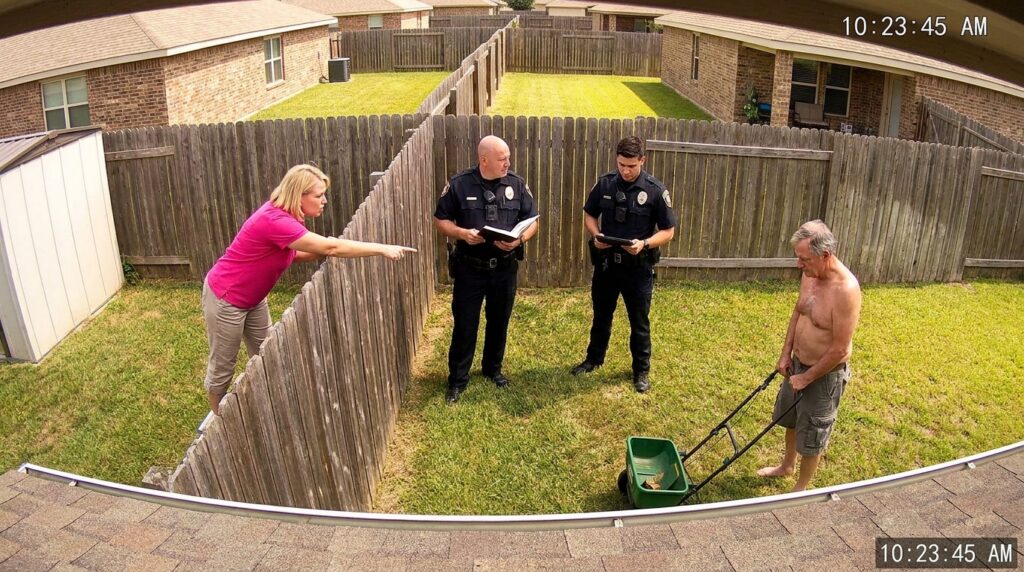
“Look at the timestamp, Officer,” Shannon called out, her voice rising above the low rumble of the cruiser’s block. She wasn’t looking at Arthur anymore; her focus had shifted entirely to the vehicle. She swiped her thumb across the glass screen with a frantic, rhythmic intensity, her manicured nail clicking against the surface like a beetle trapped in a jar. “I have June fourteenth logged at 08:00. I have July first logged at 14:30. Every single time he brings this old machine out, the left wheel track crosses the property line by at least ninety millimeters. It is a persistent, documented trespass.”
Arthur let his hands drop slowly from the mower’s rubber grip, though he stayed close to the chassis. The metal of the deck was hot, smelling of old grease and scorched grass clippings. He looked at Shannon’s phone screen from across the five-foot divide. Even in the shifting glare of the afternoon sun, he could see the grid lines she had digitally overlaid onto the photographs—bright red, computerized vectors cutting through the natural, uneven spread of his clover. She had a folder open, its title typed in clean, cold capital letters: LOT 42 – ENCROACHMENTS.
“Let’s take a breath before we start measuring the grass, ma’am,” Officer Vance said. His boots made a rhythmic, heavy scratching sound against the gravel as he rounded the hood of the utility vehicle. He was a broad man, his utility belt creaking with the weight of iron cuffs, a Glock, and the heavy plastic housing of his body camera. His dark uniform shirt showed salt rings under the arms from a long shift in the July heat, and his bald head caught the direct white light of the sky. Behind him came the younger one, Miller, holding a ruggedized tablet with a thick rubber bumper, his thumb hovering over the stylus slot.
Shannon straightened her spine, her hot pink polo stretching taut over her shoulders as she gestured down at the turf. “I am not measuring grass, Officer Vance. I am protecting my deeded boundary. This man has been told repeatedly that his routine maintenance constitutes a civil violation. I have the county subdivision plat pulled up right here.”
She thrust the phone forward, almost pressing the glass against Officer Vance’s chest. Arthur watched the interaction with the quiet patience of a man who had spent forty years working lathe chucks and rusted pipe joints. You didn’t force a rusted bolt; you applied oil, you felt the resistance, and you waited for the metal to tell you where the stress was.
Arthur looked down at the bottom rail of the cedar fence again. The white gouge he had noticed earlier was deeper than he’d realized. It wasn’t just a scratch from a lawn tool; the wood fibers were torn upward, and right beneath the wound in the wood, a tiny pile of fresh, orange-red iron flakes rested on a flat stone. It was rust from a heavy iron tool—not his mower, which was painted green, and not Shannon’s aluminum gardening trowels. It was the specific, heavy flake that came off old forged iron when it was forced against stone or wood.
“Arthur,” Vance said, turning his stocky frame toward the mower. The officer didn’t look angry; he looked tired, his eyes squinting against the glare rising from the dry earth. “She says you’re cutting into her dirt. What do you say?”
“I say the fence went up when the posts were set in ninety-eight, Officer,” Arthur replied. He reached into his cargo shorts and pulled out a faded red handkerchief, wiping the gray dust from his palms. “The old owner, Higgins, and I dug the holes ourselves. We used a standard string line from the iron pin at the curb. I’ve been running this Sears craftsman down this exact same line for twenty-six years. Never had a complaint until the colonial next door got sold last spring.”
“The previous owner’s casual negligence doesn’t alter my title insurance,” Shannon countered sharply. Her voice had a hard, metallic ring that seemed to cut right through the humid air. She tapped a specific image on her screen, zooming into a close-up of Arthur’s left rear tire. “Look at the tread compression, Officer Miller. Look at the tablet. You can see his tire is resting on the root system of my perennial rye. That is my side of the line, regardless of where the wood panels sit.”
Miller didn’t look up from his screen, his stylus making a faint, plastic clicking sound as he logged her statement. The neighborhood was dead silent now; the usual Saturday sounds of power washers and tricycles had vanished, replaced by the heavy, watchful presence of three pairs of eyes fixed on a twelve-inch strip of dry dirt.
Arthur took a slow step backward, his work shoes kicking up a small cloud of grey dust that settled onto the rusted deck of the mower. His shoulder brushed against the corner of his old corrugated tin tool shed—a structure that had stood in the shade of the oak tree since the days when this entire development was nothing but gravel pits and scrub pine. As his weight pressed against the metal siding, the old structure gave a long, hollow groan, the rusty screws holding the corner panel together groaning under the strain.
Shannon’s eyes darted instantly to the sound, her smartphone lens tilting downward toward the foundation of the shed. A cold, triumphant smile twitched at the corner of her mouth, her thumb freezing mid-scroll over her digital records.
“In fact, Officer,” Shannon said, her voice dropping into a low, predatory whisper that made Arthur’s grip tighten on his red handkerchief, “while you’re pulling the official municipal map, we need to talk about what’s sitting inside that old tin shed of his. Because I didn’t just take pictures of the lawn.”