CHAPTER 3: THE PERIMETER DATABASE
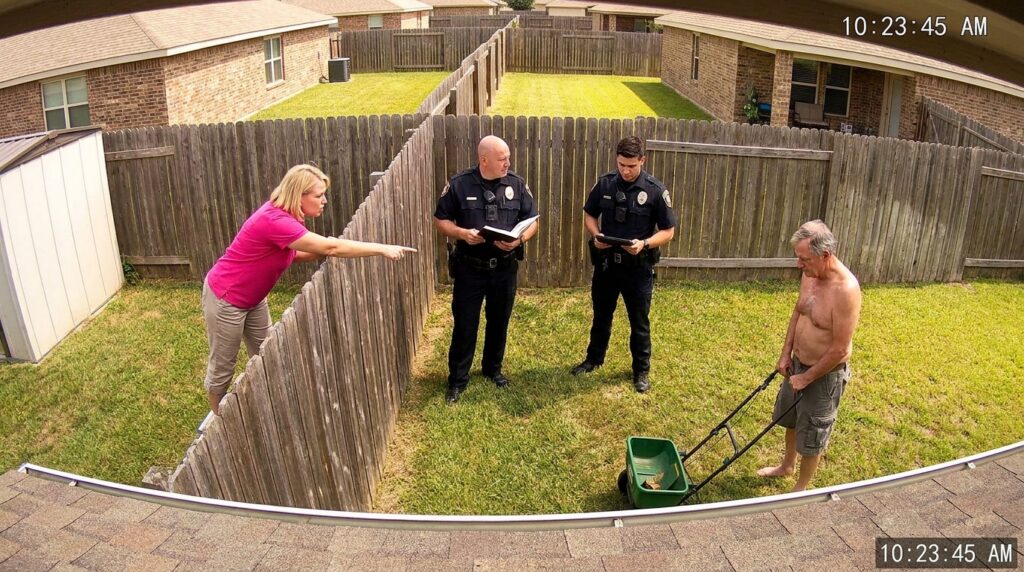
The corrugated tin panel behind Arthur’s shoulder vibrated with a faint, hollow rattle as the wind from the highway died down. Shannon’s smartphone didn’t drop; she held it at a precise forty-five-degree angle, her thumb twitching over a new subfolder on her interface. The glare from the screen caught the tight, clean lines of her jawline as she glared over the cedar posts.
“I have the county building compliance portal open right here, Officer Vance,” she said, her fingernail clicking with an intense, mechanical cadence against the glass pane. “Section 404, Paragraph B. Clear as day. Detached auxiliary structures must maintain a minimum forty-eight-inch setback from the primary residential plat boundary. Look at that tin wall. It’s sitting exactly nine inches from the cedar framework. He’s housing hazardous materials—two-cycle engine fuel, petroleum distillates, rusted iron scrap—right against my line of sight.”
Arthur let out a slow, controlled breath through his nose, his thumb rubbing the rough, calloused edge of his red pocket handkerchief. The heat coming off the metal siding of the shed was heavy, carrying the stale, greasy scent of forty-year-old machine oil and damp burlap.
“That shed’s been anchored to those concrete blocks since Jimmy Carter was in office, Shannon,” Arthur said, his voice flat, retaining the slow, rhythmic cadence of a retired machinist who refused to be hurried. “The concrete was poured before your house was even a tractor tire track in the mud. Higgins and I checked the easement clearings before we set the anchor bolts.”
“Higgins is dead, Arthur,” she countered instantly, her voice dropping into that razor-sharp, bureaucratic register that had turned the last three months into an endless series of certified letters and code-enforcement notices. “And his unrecorded handshake agreements don’t transfer through a modern title registration. The law doesn’t recognize old neighborly understandings; it recognizes the deeded survey grid. Officer Miller, look at the satellite overlay on your screen. You can see the roof protrusion cuts right through the municipal clear zone.”
Officer Vance shifted his weight, his heavy leather utility belt letting out a long, dry groan as the iron links of his handcuffs pressed against his side holster. He didn’t look at the phone Shannon was thrusting through the slats. His eyes stayed on the ground, scanning the small pile of fresh, orange-red iron flakes Arthur had noticed earlier at the base of the fence rail. With the toe of his heavy, dust-coated work boot, Vance nudged a patch of clover aside, revealing a shallow, fresh indentation in the dry dirt directly beneath the fence—the exact shape of an industrial pry bar’s heel.
“Ma’am,” Vance said, his voice dropping into a low, gravelly drone that had defused a thousand domestic line disputes across the county. “We’re out here because you reported an active criminal trespass regarding a lawn mower wheel. Now we’re talking about the permanent footings of an auxiliary structure that’s older than my department seniority. This isn’t a criminal matter. This is a civil boundary dispute, and my office doesn’t enforce municipal zoning setbacks on a Saturday afternoon.”
“It becomes a criminal matter when there’s intentional non-compliance and property damage,” Shannon said, her fingers swiping aggressively across her screen to pull up a fresh sequence of high-resolution images. “Look at this file from July fourth. Three weeks ago. I captured him coming out from behind that tin panel with a hand tool. He was clearing the brush on my side of the cedar posts. That’s destruction of natural perimeter landscaping. I have thirty-four separate entries of him performing unauthorized physical adjustments within the utility easement.”
Arthur looked at the screen she was tilting toward the officer. The photograph was clear—taken from a high wide angle, down from the eaves of her house. It was the exact perspective of a fixed security lens. But what caught his eye wasn’t his own reflection in the image; it was the reflection in the smartphone’s glass. In the bright white glare of the afternoon sky, he could see the digital tablet in Officer Miller’s hands. Miller wasn’t just logging Shannon’s words; he was cross-referencing her digital files with the county’s live geographic information system map.
The rookie officer stopped tapping, his stylus remaining frozen over the blue-hued interface. He looked up, his young, clean-shaven face clouding with a sudden, quiet uncertainty as he caught Vance’s eye.
“Sir,” Miller said, his voice quiet, dropping below the heavy thrum of the midday heat. “I’m looking at the historical property layer on the registry. There’s a note attached to the 1998 fence permit for this address. It’s an approved variance. It looks like the original survey line wasn’t standard. There’s an unindexed variance document from the county court clerk filed under the previous owner’s estate.”
Shannon’s hand froze mid-air, her finger remaining pressed against her phone screen. Her posture didn’t soften; it became more rigid, her shoulders squaring under the hot pink cotton of her polo shirt until the seams looked ready to snap. “That’s impossible. I completed a full title search before closing. My title company certified that the lot was unencumbered by prior variances.”
“Title companies miss old county clerk paper filings all the time, ma’am, especially if they were logged before the county digitized the grid in 2004,” Vance said, his stocky frame turning away from the fence line toward the cruiser. He reached into his pocket and pulled out a heavy set of keys, the iron rings clinking together with a dull, administrative finality. “Miller, pull the original deed image from the microfiche index on the system. Let’s see what Higgins actually signed away before he sold the lot.”
Arthur stood perfectly still, his calloused palms resting on the hot green paint of his mower handle. He knew exactly what was inside that tin shed. In the far back corner, beneath a stack of rusted oil cans and a dry-rotted canvas tarp, sat Higgins’s old metal filing locker. And inside that locker was a yellowed piece of carbon paper, signed in ink that had turned the color of dried blood thirty years ago. He had forgotten it even existed until the sound of Miller’s tablet brought the past back into the dry afternoon air.
Shannon didn’t step back from the fence. Her eyes narrowed into tiny, hostile slits as she watched Officer Miller tap the screen, her grip tightening on her phone until the plastic frame began to creak against her palm. She wasn’t just angry; she was calculating her next administrative move.
“Even if there’s an old variance,” Shannon whispered, her voice carrying a cold, rhythmic venom that rattled through the quiet yard, “it doesn’t account for what’s buried under the foundation stone of that shed, Arthur. And I think the city inspector is going to find that very interesting when he opens the ground on Monday morning.”