
CHAPTER 5: THE WATCH AND THE UNBROKEN HORIZON
“He didn’t die a monster, Sergeant.”
Thomas’s voice was barely a whisper against the dry rustle of the evening wind, but it carried across the small porch, settling over the gravel driveway like a heavy mantle. The sun was dipping below the tree line, casting long, bruised shadows across the boards. Clara sat in the low wicker chair near the railing, her hands clasped tightly over her knees, her eyes fixed on the two silver pocket watches resting side by side on the small wooden side table.
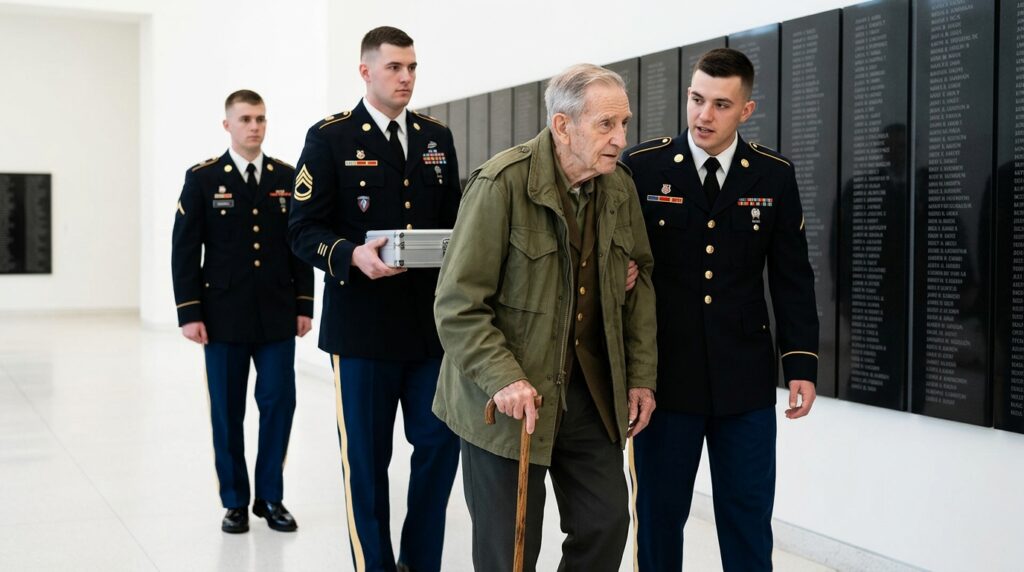
Miller stood at the bottom of the porch steps, his dark dress jacket long gone, the collar of his white shirt unbuttoned to reveal the pale operational scar near his earlobe. He looked small under the vast expanse of the darkening sky, stripped of his military rank and the institutional armor of his uniform. The silence between them wasn’t the defensive fortress Thomas had spent fifty years maintaining; it was the fragile, aching quiet of an open wound that had finally stopped bleeding.
“He spent thirty years trying to buy back the seconds he took from that ridge,” Thomas continued, his calloused thumb tracing the worn silver casing of his own dead watch. “He sent me this timepiece three weeks before I was discharged. No letter. No return address. Just a postmark from Independence and a mechanism that had been frozen with a solder bead inside the mainspring. I thought it was an insult. A warning to keep my mouth shut about the logging trucks.”
He reached out and picked up Miller’s watch—the identical twin that still ticked with a smooth, relentless rhythm. The tiny clicks felt like a heartbeat passing through the tips of his fingers, a physical vibration that seemed to pull the cold marble of the memorial wall right into the warm wood of the porch.
“It wasn’t a warning,” Miller said, his voice raw, his eyes reflecting the desaturated amber of the sunset. “He disabled his own watch the night the captain died. He told my father that time stopped for the family when the operational log was torn. The ticking one… he kept that hidden in the cedar chest until the day he died, waiting for someone to match the bloodline to the record.”
Clara leaned forward, the wicker chair groaning under her movement. The light caught the fine lines around her eyes—lines Thomas had never truly looked at because they reminded him too much of the years he had spent looking past her, into the middle distance of his own survival. “Dad,” she murmured, her voice trembling but clear. “The captain… he was the one who gave you the jacket, wasn’t he?”
Thomas looked down at his chest, at the frayed olive field jacket draped over his shoulders. The fabric was thin, smelling of cedar and old age, but the seams were still holding. “He gave it to me three hours before the air support didn’t show,” Thomas said. He didn’t look away from her this time. He let her see the wetness in the creases of his cheeks, the pale, unprotected truth he had guarded behind his teeth for half a century. “He told me to take the radio back to the secondary line. He said his brother would have the gunships in the air by dawn.”
He turned to Miller, extending his arm to hand back the ticking watch. The metal caught the last ray of sun, a brilliant, golden flash before the horizon claimed the light. “Your grandfather didn’t run out of time, son. He ran out of options. The concession belonged to the regional command, not him. He was just the pen man who had to sign the operational lie to keep the rest of us from being buried as deserters.”
Miller took the watch, his large hand closing over the silver crown with a slow, disciplined reverence. He didn’t speak. He simply bowed his head—a single, respectful nod that acknowledged the debt had been recognized, if not entirely paid. He turned and walked down the gravel driveway, his shadow stretching long and thin behind him until he dissolved into the gray dusk of Highway 61.
Thomas sat back in his chair, the wooden cane resting across his lap like a boundary marker that had outlived its purpose. The evening air felt thick, carrying the scent of damp earth and the first hint of summer clover. He turned his head toward his daughter, his eyes tracing the silhouette of her face against the dim light of the kitchen window.
“Clara,” he said, his hand reaching for the dead pocket watch on the table, his fingers slipping into the small groove of the winding crown. “Sit closer. I want to tell you about the valley before the dark sets in.”
Clara didn’t hesitate. She pulled her chair across the worn floorboards until her shoulder touched his sleeve, her hand reaching down to cover his old, calloused knuckles. For the first time in forty years, the silence on the porch didn’t feel like a wall; it felt like a clearing.








