
CHAPTER 4: THE DINER AND THE CONFESSION
The neon sign outside the Highway 61 diner hummed with a low, irregular flicker that bled an sickly pink glow across the Formica table. Inside, the air smelled of stale lard, scorched coffee beans, and the damp wool of Thomas’s olive field jacket. He sat unmoving, his thick hands folded over the curved handle of his wooden cane, eyes locked onto the far booth. Clara was still in the car, waiting under the rhythmic stroke of the windshield wipers, but Thomas had gone in alone. He didn’t need a witness for this.
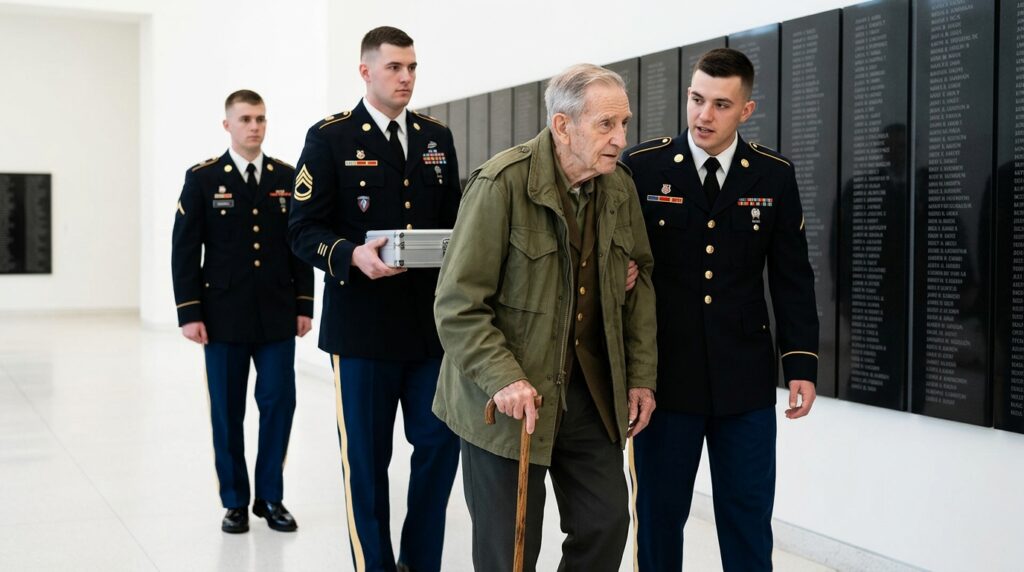
Sergeant Miller—the broad-shouldered box carrier from the memorial wall—sat by the window. His dark dress jacket was draped neatly over the back of the vinyl booth, leaving him in his crisp white shirt, the sharp creases along his sleeves looking strangely vulnerable against the stained backdrop of the diner. He wasn’t eating. His large hands were clasped around a heavy ceramic mug, watching the steam rise into the dim light.
Thomas slid into the booth opposite him without asking. The vinyl groaned under his weight, the cold friction of the seat biting through his trousers. He didn’t offer a greeting. He simply reached into the deep pocket of his jacket and placed the yellowed sheet of onionskin paper flat on the table between them, right next to the salt shaker.
Miller’s gaze dropped to the translucent page. His expression didn’t break, but his fingers tightened around the mug until his knuckles went the color of lard. He didn’t look surprised.
“The brads on the folder were scratched,” Thomas said, his voice flat, stripped of the gravelly warmth he had used with the young escort in the corridor. “Someone used needle-nose pliers to get into the binding. Someone who wanted me to find this, but didn’t have the nerve to tell me to my face while we were standing in front of the stone.”
Miller took a slow breath, his chest expanding against the white cotton of his shirt. He looked out the window toward the dark gravel lot where Clara’s car sat idling. “You shouldn’t have brought your daughter here, Mr. Vance.”
“My daughter spent forty years thinking her father was a broken machine who couldn’t talk because he was a coward,” Thomas said, his hand gripping the cane until the old wood creaked. “She has a right to know why three men died in a valley while a general’s son was moving timber. Now look at me, son. Who gave you this paper?”
“Nobody gave it to me,” Miller said softly. He finally lifted his eyes, and for the first time, Thomas noticed the slight asymmetry in the young man’s jaw, a tiny scar near the earlobe that looked identical to an old operational suture. “I pulled it myself. Three years ago, when I was assigned to the administrative audit at the St. Louis repository.”
Thomas leaned forward, the smell of burnt grease from the kitchen filling his nose, tightening his throat. “You expect me to believe an audit sergeant just happened to stumble onto a fifty-year-old operational log? A log that lists a general’s son by title? Who are you, Miller?”
The sergeant didn’t answer immediately. He reached down and touched the jagged top edge of the onionskin paper where the letterhead had been sheared away. His thumb rubbed the fraying fibers, his movements slow, almost reverent, tracing the faded ink of the date—December 4, 1974.
“The man who wrote this letter didn’t leave it in the file for a stranger to find,” Miller whispered, his voice dropping so low it was nearly swallowed by the hum of the neon sign outside. “He left it for his family. He left it as a map.”
“A map to what?” Thomas snapped, his patience fraying like the cuffs of his old jacket. “The money from the timber concession? The reputation of an old man who’s probably buried in Arlington by now?”
“A map to the debt,” Miller said. He reached over to his dress jacket, his fingers dipping into the internal breast pocket. He didn’t pull out a badge or an official army ledger. He pulled out a small, tarnished silver pocket watch—an exact duplicate of the dead timepiece resting in Thomas’s own pocket, down to the worn floral engraving on the casing and the deep, longitudinal scratch across the winding crown.
Thomas froze. His hand left his cane, his fingers automatically dropping to his own hip, confirming the presence of his own watch. The metal beneath his trousers felt real, cold, and solid. Yet here was its twin, sitting on the greasy laminate table between them, its second hand ticking forward with a smooth, silent sweep that Thomas’s watch hadn’t managed since the winter of seventy-four.
“My grandfather didn’t bury the ledger to save himself, Mr. Vance,” Miller said, his eyes locking onto Thomas with an intense, suffocating clarity that shattered the illusion of the decoy secret. “He buried it because he was the one who signed the order to withhold the gunships. He was the general’s son. And the man who died on the ridge—the name you just touched on that wall—was his own brother. Your captain.”
The room seemed to tilt, the pink neon light stretching across the table until it looked like a wet line of blood. The victory Thomas thought he had won at the monument—the official recognition, the name in stone—collapsed into a hollow floor. The sergeant wasn’t an honor guard or a bureaucratic savior. He was the bloodline of the executioner, holding a presentation case that was never meant to be an honor, but a penance.
“You brought me out there,” Thomas whispered, his voice cracking as the true weight of the corridor finally settled into his chest. “You used the uniforms. You used the base.”
“I had to give him his name back,” Miller said, his hand remaining steady on the ticking watch. “And I had to find the only man left who could tell me if my grandfather died a monster, or just a man who ran out of time.”








