
CHAPTER 2: THE ETCHING ON THE GRANITE
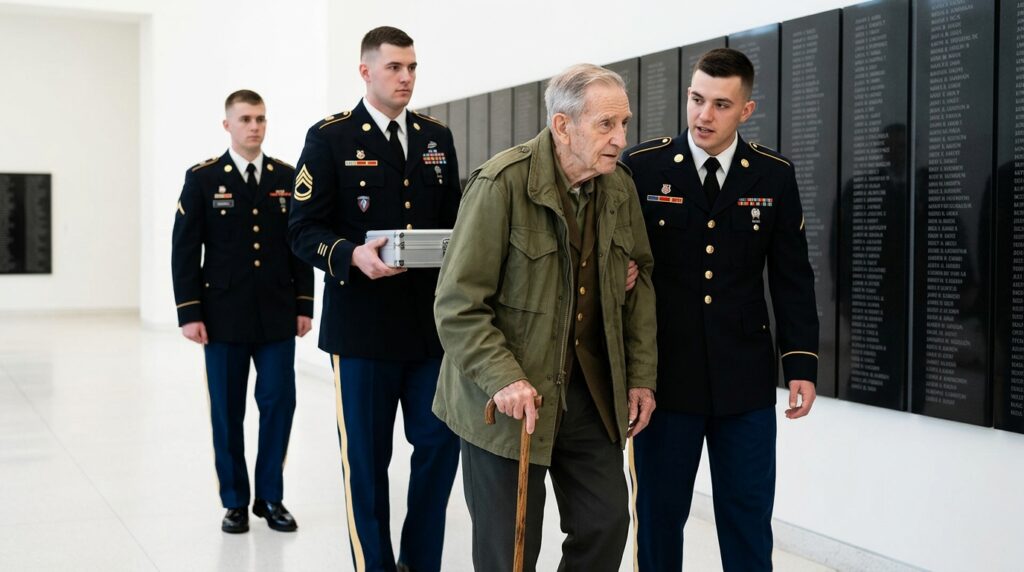
The wood of the cane scraped against the polished floor with a sound like a fracturing bone. Thomas’s knees buckled, his weight shifting forward toward the cold obsidian surface of the wall, but the young close escort was already moving. A hand caught Thomas beneath his elbow, firm and steady, holding him aloft with the practiced gentleness of someone accustomed to handling fragile, precious things. The broad-shouldered sergeant stepped closer, the metal presentation case in his grip tilting slightly as he used his own frame to block the old man from the view of the empty corridor behind them.
“Steady, sir,” the young one whispered, his breath warm against the chilly draft that seemed to rise from the base of the granite panels. “We’ve got you.”
Thomas didn’t speak. His throat felt dry, packed with the dust of old roads he had spent fifty years trying to forget. He reached out with his left hand, his skin looking like yellowed parchment against the deep, mirror-black stone. His fingertips found the newly carved letters. Unlike the smooth, worn grooves of the names around them—names that had settled into the monument over decades of rain and public tears—these edges were sharp. They were white, powdery with stone dust, a raw incision into the granite that felt almost hot to the touch.
Beside the name, the digits of the serial number were small, tucked against the margin like a mathematical footnote. It was the number that didn’t exist in the state registers, the one that had been scrubbed from his discharge papers with three heavy lines of purple ink.
“Where did you find this?” Thomas’s voice was a gravelly rasp, barely louder than the sound of his wool jacket rubbing against his collar. He did not look at the sergeant; his eyes remained fixed on the white dust clinging to his thumb. “The archives in St. Louis said the ledger burned in seventy-three. They told me there wasn’t a record of the valley. Not a scrap.”
The broad-shouldered sergeant remained still, his face cast in shadows by the overhead lights. He held the case level again, his knuckles whitening against the silver latches. “The ledger didn’t burn, sir. It was separated. We found it in a different annex, misfiled under a non-combat logistics designation.”
There was an unnatural precision to the explanation, a curated correctness that made Thomas’s ancient pocket watch feel heavier in his pocket. It ticked against his hip—a dull, rhythmic thrum that didn’t match the ticking of the grandfather clock in the hall entrance. The young escort looked between the two of them, his expression alert but guarded, as if he were guarding a perimeter that had already been breached.
Thomas let his hand drop from the stone. The white powder left a pale smudge across his calloused palm, blurring the lines of his life operational. “Logistics,” he muttered, a bitter film rising in his mouth. “We spent four days behind the ridge waiting for air support that never had a flight plan. They called that logistics?”
“The record has been amended now, Mr. Vance,” the sergeant said. His voice was lower now, lacking the formal cadence he had used when they first entered the rotunda. He stepped forward, his boots making no sound on the floor, and extended the metal case until it was directly between them. “The Department of the Army has certified the entry. This case contains the formal citation, the original unredacted discharge summary, and the commendation. It’s yours. It’s been yours for half a century.”
Thomas looked at the metal box. The aluminum casing was brushed, modern, completely devoid of the salt-crusted canvas and grease-pencil markings of the gear he remembered. It looked like a medical instrument or a piece of sensitive electronics. It didn’t look like the sovereign truth of a three-day slaughter.
With a slow, deliberate movement, Thomas reached out and touched the latch. The metal was freezing against his skin, carrying the temperature of the air-conditioned archive rooms where it had spent its final days of preparation. He didn’t pop the seal. Instead, his fingers trailed down to the corner of the box, where a small, blue grease-pencil mark—a single, handwritten number 4—had been partially scrubbed away but remained visible near the seam. It was an archivist’s old shorthand, an index marker from a personal collection, not a federal warehouse.
“You didn’t find this in an annex,” Thomas said, his gaze finally lifting to meet the sergeant’s eyes. The young soldier’s gaze didn’t waver, but his jaw tightened, the muscles along his neck locking like iron rods. “This didn’t come from a shelf in Missouri.”
The sergeant didn’t deny it. He simply held the weight, his chest rising and falling in a silent, disciplined rhythm. “The paperwork is official, sir. That’s what matters for the wall. The name stays. Nobody can take it down now.”
Thomas let his breath out through his nose, a long, whistling sigh that smelled of tobacco and the mints his daughter had forced him to swallow before they left the car. The validation was there, written in granite, but the air in the hall felt thin, as if the monument were pumping out the oxygen to preserve the stone. He nodded once, a brief, jerked movement of his chin, and allowed the young escort to turn him back toward the sunlit exit, leaving the sergeant alone for three seconds beside the raw white letters before the shadow of the corridor took them all.








