
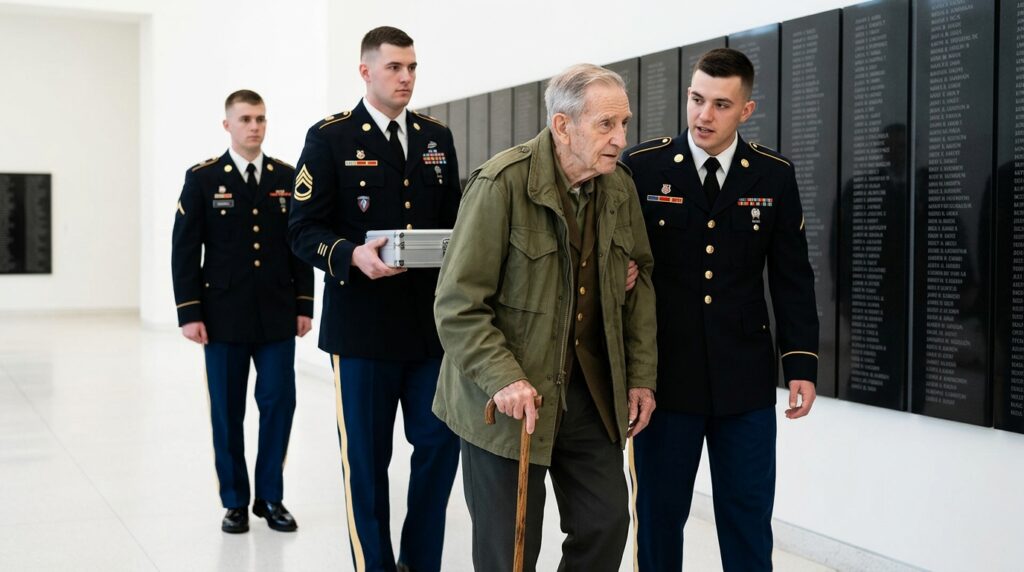
CHAPTER 3: THE PARCHMENT AND THE PORCH
The aluminum case sat on the laminate kitchen table, looking entirely out of place beside a salt shaker and a half-empty jar of instant coffee. The afternoon sun through the window caught the fine grain of the brushed metal, throwing a cold bar of light across the cracked vinyl wallpaper. Clara didn’t touch it. She stood by the sink, her fingers tracing the faded floral pattern of a damp dish towel, her gaze fixed on the box as if it might begin to hum.
“They didn’t charge you for it?” she asked, her voice carrying that quiet, defensive edge she always used when the past threatened to disrupt the routine she had built around him.
Thomas didn’t answer right away. He sat in the low-backed wooden chair, his cane leaning against his thigh, his calloused thumbs rubbing the silver casing of his pocket watch. The watch remained dead, its hands frozen at a quarter past four, but the mechanical weight of it felt grounded against the floaty, artificial shine of the presentation case. “No,” he said. “No charge. Just fifty years of interest.”
“The boys from the base,” she murmured, turning her back to the sink to lean against the counter. “The tall one with the stripes. He called the house twice before we left. He wanted to make sure you were the one coming. Not a proxy. He was very specific about that, Dad.”
Thomas grunted, his fingers transitioning from the watch to the silver latches of the case. They snapped open with a sharp, dual pop that sounded like dry twigs breaking in winter. The lid lifted smoothly, releasing a faint scent that wasn’t army canvas or gun oil; it smelled of cedar wood lining and archival plastic. Inside, cradled in custom-molded foam, lay a single leather-bound folder and a small velvet box containing the star-shaped medal.
He bypassed the medal entirely. His thick fingers reached for the folder, the leather supple but smelling too new, like a car fresh off the lot. When he flipped it open, the official document was there—the gold seal of the Department of the Army, the stamped signature of a three-star general, and the clean, re-typed narrative of an engagement in a valley that had been officially nameless until three weeks ago.
But as Thomas turned the heavy cream-colored page to find the original operational log—the carbon copy he had seen his captain sign in the bunker—his hand stopped. The brass brads holding the dossier together were slightly bent, the metal showing microscopic scratches where a pair of needle-nose pliers had forced them open and closed again.
Behind the official citation, the chronological record ended abruptly on November 12, 1974. The subsequent page was gone, its margin cleanly torn away, leaving only a microscopic thread of yellowed paper trapped beneath the binding. In its place was tucked a loose sheet of onionskin paper, so thin it was translucent, yellowed unevenly at the edges as if it had been stored inside an old book.
Clara stepped closer, her curiosity finally pulling her away from the sink. “What is that? Is that part of the record?”
Thomas pulled the paper free. It wasn’t an official form. It was a letter typed on a mechanical ribbon that had been failing, the letters E and R lifted slightly above the line, giving the text a staggered, halting rhythm. The letterhead was missing, cut off with a pair of kitchen shears, leaving a jagged top border.
To whoever pulls this folder from the lower basement, the letter began, the ink faded to a dim charcoal gray. The valley wasn’t a logistics error. We had three frequencies open on the ridge, and the command trailer in Danang acknowledged every transmission between midnight and dawn. The order to withhold the gunships didn’t come from a shortage of fuel. It came from the office of General Vance’s son, who needed thirty-six hours of quiet in the sector to clear the logging equipment out of the timber concession before the regional command changed hands. If you are reading this page, the boy survived the ridge, and somebody finally had the nerve to put his name on the wall. Don’t look for the rest of the log. It’s in a locker in Independence, under a lock that only opens for a name that matches the blood.
Thomas let the onionskin paper slide onto the table. The thin sheet didn’t flutter; it settled flat against the laminate, the light showing through the typed words until they seemed to blend with the gray swirls of the tabletop.
Clara reached down, her fingertips barely brushing the frayed bottom corner of the page. “Dad… who wrote this? It says ‘Vance’s son.’ That’s not… that’s not your name. You were just a corporal.”
Thomas looked out the kitchen window, toward the gravel driveway where the weeds were pushing through the stone. His reflection in the glass was pale, his lined face looking like a map of a country that had changed its borders while he was sleeping. The micro-mystery of the raw serial number at the wall wasn’t a clerical triumph; it was a trail of breadcrumbs left by someone who had broken into the house of the state to leave a confession.
“It wasn’t an annex,” Thomas said, his voice dropping into the sparse, transactional cadence he used when the weather turned bad before a harvest. “The sergeant. He told me they found it in an annex.”
“He was lying?” Clara’s hand stayed on the paper, her thumb pressed down on the typed date—December 4, 1974—which was exactly three weeks before Thomas had been discharged with a clean bill of health and a mouth full of silence.
The old pocket watch against his hip gave a sudden, singular click—not a sign of life, but the mainspring shifting under the change in temperature as the kitchen cooled. Thomas stood up, his joints popping in sequence, his hand gripping the wooden cane until his knuckles turned the color of the marble floor they had left behind. He didn’t look at his daughter, whose eyes were wide with a question she had been too afraid to ask for forty years.
“Get your coat, Clara,” he said, his boots shifting toward the back door. “We need to find a phone book for the reserve station. The big one. The sergeant isn’t through with this town yet.”








