CHAPTER 7: THE UNYIELDING CORE
The steel edge of Miller’s trench shovel bit into the baked orchard grass with a flat, metallic ring that jarred up through the wood handle. He threw his weight onto the iron step of the blade, his heavy boot heel forcing the metal three inches down into the dry, grey clay. A small cloud of fine silicate dust puffed out across the seam of the property line, settling on the white rubber trim of Brenda’s sneaker.
Arthur didn’t shift his palms from the foam grip of the mower. The engine housing beneath his forearms was clicking now, the hot aluminum shrinking in the dry wind as it shed the last of its operational heat. He watched the dirt curl off Miller’s shovel—not the loose, dark loam of a recently dug utility ditch, but the hard, flinty subsoil that hadn’t been turned since the county graded the original county line fifty years ago.
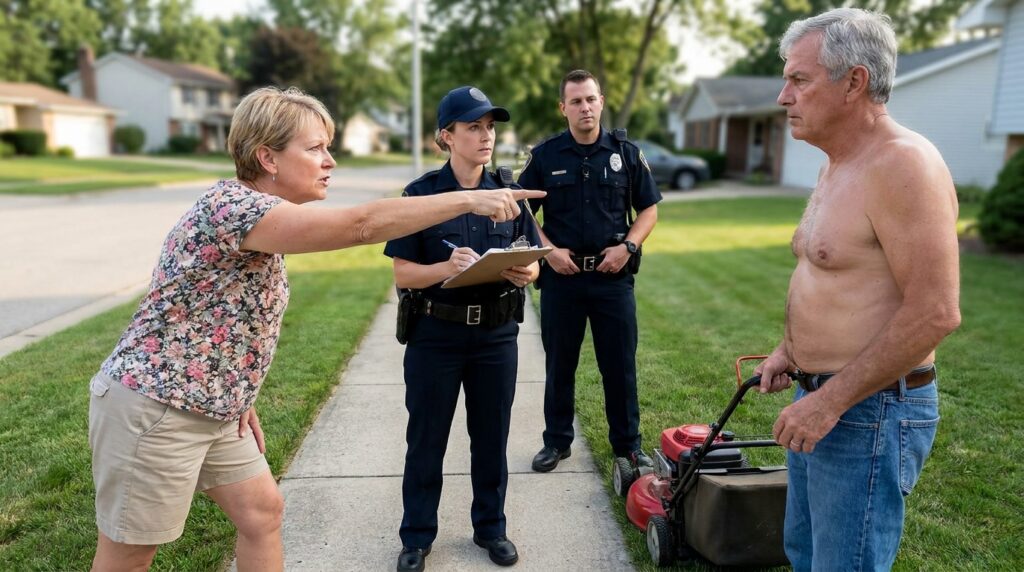
“Watch the clearance, Miller,” Ramirez said, her hand resting flat on the top edge of her clipboard. Her voice carried no more weight than a machine belt sliding over a pulley, but her boots didn’t move from the neutral zone of clover. “The original master coordinates show the datum point exactly twenty-four inches off the concrete apron. If the pin isn’t there, the entire subdivision plat shifts out to the township highway.”
Brenda took a step forward, her phone screen clutched against the front of her bright blouse like a shield. The battery icon was dark now, the digital scan of the 1991 paper locked behind a rectangle of dead black glass. Her lower jaw was set, the tendons in her neck tight under the dry midday light. “It’s not there, Deputy. My husband verified the lateral coordinates himself when they put the drainage grates in. The state took that three-foot section back during the orchard clearance. If he’s dug past the transition gravel, he’s trespassing on my private lot lines.”
The utility worker in the orange vest didn’t lift his T-wrench. He stood with his boots planted on the dry asphalt of the gutter, his oil-cloth ledger book open to the 1993 rejection notice. He spit a dark stream of tobacco juice onto the limestone rock at the curb. “The state didn’t take nothing on this side of the ditch, lady. The water board tried to claim a secondary run for the pressure release, but the court threw it out because the original land grants carried a non-severable surface title. If there’s an iron rod down there, it belongs to the man with the master deed.”
Arthur let his breath out through his nose, slow and quiet. His eyes remained fixed on the small square hole Miller was clearing. He knew the layout of the iron down to the millimeter. He’d helped the county team set the reference markers when his late wife, Martha, brought the certified land patents back from the state archives in ninety-four. Brenda’s husband had spent years using his position at the utility office to shift the imaginary lines on the subdivision sketches, trying to carve a clean, three-foot buffer zone out of Arthur’s grass so he could store his flatbed trailer without violating the county setbacks. But Martha had seen the play before the first post-hole was dug.
“Got steel,” Miller muttered. He dropped the shovel, his black-gloved fingers reaching into the hole to tear away a thick clump of matted fescue roots. He took a small brass brush from his vest pocket and scrubbed the top of an object buried six inches beneath the grade. “It’s an un-cleared surveyor’s stake, Ramirez. It’s got the old 1974 county stamp right across the crown. No lateral sleeve, no utility variance. The metal’s solid.”
Ramirez walked over to the edge of the pit, her leather utility belt giving off a sharp, dry creak as she leaned down to verify the stamp. She checked the alphanumeric sequence against the ledger sheet pinned to her clipboard, her pen drawing a thick, decisive black line through the pencil notation Brenda had spent forty minutes defending.
“The marker holds, Mrs. Geller,” Ramirez said, straightening her torso until her cap brim completely blocked the sun from Brenda’s eyes. “The 1974 boundary is the active legal baseline for this entire block. The mower deck is two inches inside the Vance lot. There is no municipal easement encroachment, and there is no property damage to your apron.”
Brenda’s fingers opened, the dead smartphone slipping an inch before her palm caught the plastic casing against her shorts. Her face had gone completely gray, the color of wet lime on a basement wall. She looked at the utility worker, then at Miller, her voice coming out as a dry, breathless whisper that barely carried across the ditch. “The file was extended. My husband had the signature from the road commissioner. It was in the desk… it’s part of the neighborhood record.”
“The road commissioner didn’t have the authority to alter a registered patent, ma’am,” Ramirez said, her voice dropping into the flat, final tone of a report being logged into a station computer. “The utility truck is going to clear the lane now. Miller, fill that hole back in.”
Arthur didn’t take his thumbs off the foam handle. He watched Brenda turn her back to the sidewalk, her white tennis shoes dragging through the dry limestone dust as she walked toward her porch steps. The floral blouse looked small now, the bright pattern losing its color against the shadow of her overgrown privet hedge. She had spent thirty years relying on the authority of an old desk file to crowd his space, never knowing that the real truth of the land—the clean, unencumbered title Martha had recorded in the deep archives—was something she could never touch with a phone call or a fake notice.
“Mr. Vance,” Ramirez said, turning her clipboard toward him as Miller began kicking the dry clay back into the hole. “You can finish your lawn now. We’ll be filing a formal report regarding the misuse of the municipal dispatch line with the town clerk.”
Arthur looked at the rusted red metal of the Craftsman deck, then at the single row of tall fescue remaining along the ditch. The sun was directly overhead now, the shadow of his machine falling straight down between his boots, exactly where the iron pin held the earth together.