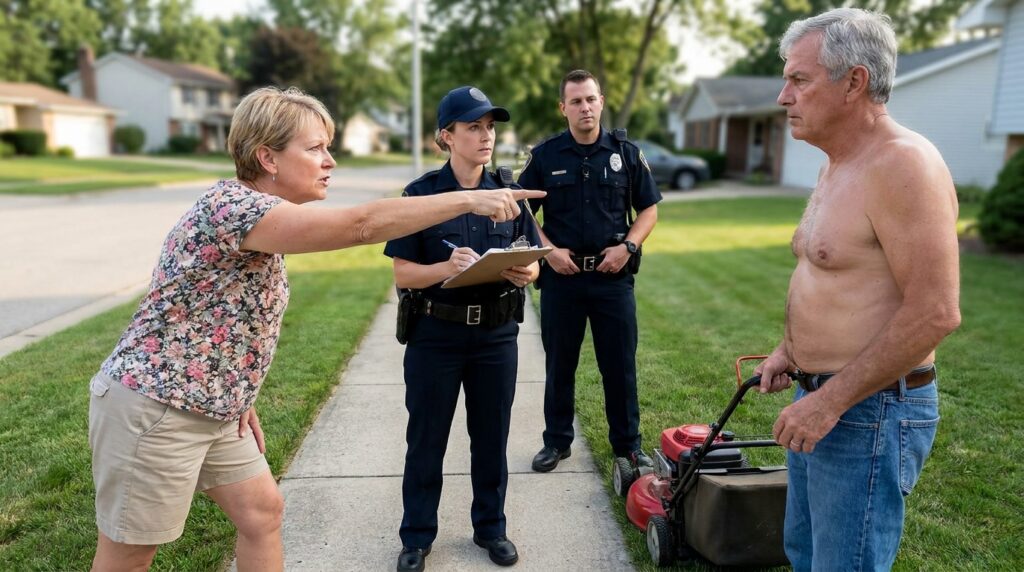
CHAPTER 3: THE APPROACHING TREAD
The whine of the alternator resolved into the slow, gravel-crunching bite of sixteen-inch steel-belted radial tires turning off the county blacktop. Brenda didn’t drop her arm. Her index finger remained stiff, suspended two inches above the red paint of the mower deck, a static pointer marking the legal void she claimed as her personal territory. The skin of her forearm was slick with sweat that had turned milky under her heavy application of drugstore lavender lotion, the scent hanging thick in the stagnant pocket of air between them.
Arthur lowered his grip on the starter rope by a fraction of an inch, letting the braided nylon slide back into the recoil housing with a soft, dry hiss. He didn’t turn his head toward the road. He watched the reflection in Brenda’s oversized sunglasses change from the pale green of his porch to the boxy, high-gloss white hood of a county-issue Ford Interceptor. The cruiser came to a stop forty feet away, its front bumper slightly overhang-riding the lip of the common ditch line. The engine kept running, a low, hydraulic thrum that vibrated through the parched sod and into the soles of Arthur’s work boots.
“He’s here, Arthur,” Brenda muttered. Her voice didn’t rise; it fell into a flat, triumphant drone that matched the mechanical idle of the squad car. She didn’t drop her phone. She simply lowered it to her hip, keeping the screen active, the pale blue glow of that 1991 document scan fading beneath the harsh, unshielded overhead sun. “Now you tell him about the stones. You tell him why your machine doesn’t have a factory discharge chute.”
The cruiser’s door didn’t slam with a sharp ring; it closed with the heavy, rubber-sealed thud of a vehicle that had seen three hundred thousand miles of county service. Arthur watched the silhouette of Officer Ramirez break the glare of the windshield. Her uniform shirt was crisp, the sharp polyester creases holding their edge against the noon humidity, but her leather utility belt gave off the dry, organic creak of old gear that had been conditioned with mineral oil too many times. Behind her, from the passenger side, Officer Miller stepped into the gravel flare, his hand not on his holster but resting flat against the heavy steel buckle of his duty belt, his eyes already sweeping the distance between the two mailboxes.
Arthur shifted his thumbs back to the top of the handlebar. His bare chest felt tight under the dry wind that blew off the asphalt, the dust from Brenda’s transition strip settling into the gray hair at his temples. He didn’t offer a greeting. In the valley, you didn’t talk until the shield crossed the ditch line; anything else looked like an early plea.
“Afternoon,” Ramirez said as she reached the edge of the clover strip. Her boots were black leather, polished but scuffed at the toe caps from the iron foot-pegs of the station scales. She didn’t look at Arthur’s lack of a shirt, nor did she look at Brenda’s floral blouse. Her gaze dropped instantly to the red housing of the Craftsman mower, tracking the wheel path through the cut fescue until she found the exact spot where the grass changed from two inches to four. “We got a call about a line dispute and a regular disturbance with flying debris. Who’s the caller?”
“I am,” Brenda said, stepping forward until the white canvas of her sneaker completely obscured the rusted iron washer in the dirt. She held her phone up like an exhibit in a probate hearing. “Brenda Geller. Eleven-fourteen Circle Drive. I have the active easement maps right here on my screen, Officer. He’s been running this commercial-grade equipment without a stone guard for forty minutes. He’s deliberately throwing limestone aggregate onto my apron to pit the surface.”
Ramirez stopped. She didn’t look at the phone Brenda was thrusting toward her face. Instead, she unclipped a heavy, brushed-aluminum clipboard from her vest tab, the metal corners pitted with gray oxidation from winter salt spray. Attached to the top sheet of white ledger paper was a photocopied grid map from the county tax assessor’s office—the legal master that every deputy carried when the calls came out of the subdivisions.
“Mr. Vance?” Ramirez asked. Her eyes turned to Arthur, steady, unaffected by the heat or Brenda’s high-frequency breath. “You want to clear the machine while we look at the pins?”
“The machine stays right where the line is,” Arthur said. His voice was a level monotone, the same tone he used when the line supervisor at the foundry tried to log a short heat on the books. “The deck is twenty-one inches. The left wheel is two inches inside the 1974 survey marker. If I move it back, she’ll say I altered the evidence.”
Brenda let out a short, reedy laugh that ended in a cough. “Evidence? Look at him, Officer. He’s been standing out here since ten o’clock trying to bait me into a confrontation. He knows my late husband worked the utility logs. He knows those old pipes run three feet under his current garden bed, and he’s trying to disrupt the town right-of-way before the inspection crew comes through next month.”
Arthur’s eyes narrowed by a millimeter. He didn’t look at Brenda; he looked at the top page of Ramirez’s clipboard. The document pinned there was a clean, digital printout from the 2022 registry, but beneath the modern laser font, there was a handwritten pencil notation in the margin that read: See Geller modification file ’91.
Miller had moved around the back of the mower now. His boots made a dry, rhythmic crunching sound in the orchard grass as he walked the boundary toward the ditch. He didn’t have his notebook out. He was looking at the ground, his eyes searching for the specific yellow plastic caps the utility company used to flag the gas mains, or the older, unpainted iron stakes that the modern sod had long since swallowed.
“Let’s keep this calm and figure out what happened here,” Ramirez said, her hand flattening against the top of the aluminum board as a sudden gust of wind caught the ledger paper, making the sheets snap like a dry branch. She turned her torso by thirty degrees, a deliberate physical block that forced Brenda to step back off the clover or risk touching the heavy nylon of the officer’s shoulder pad. “Mr. Vance, you say you haven’t crossed the pavement seam?”
“I haven’t crossed the iron,” Arthur said. He reached down with his right hand, his calloused palm catching the grease-caked casing of the mower’s oil dipstick, his fingers feeling the heat of the crankcase through the iron threads. “And the iron doesn’t move for the water district, and it doesn’t move for Brenda.”