CHAPTER 2: THE CURBSIDE FRICTION
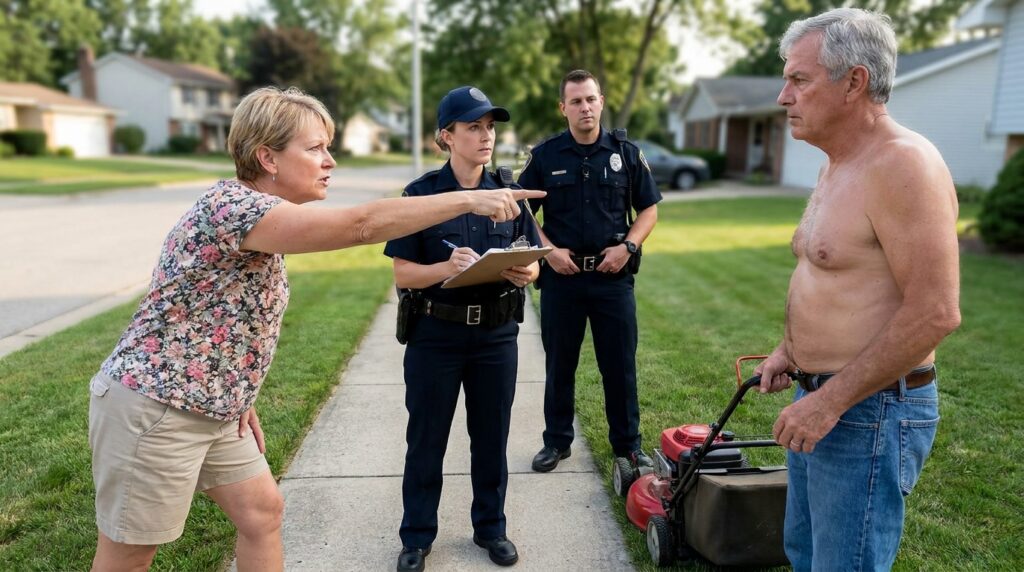
“The shroud is down, Brenda,” Arthur repeated, his forearm resting on the vibrating rubber of the handle. The heat from the exhaust manifold rose in oily waves between them, distorting the sharp floral pattern of her sleeve. “And the only thing hitting your pavement is the shadow of that hedge.”
Brenda’s chest heaved. The smartphone in her hand tilted, and for a split second, the glare of the noon sun caught the screen at a perfect oblique angle. Arthur’s eyes, trained by forty years of reading micrometer increments on oil-slicked steel, didn’t focus on the digital camera interface. He focused on the background application window she had open. It wasn’t the police dispatch screen yet. It was a high-contrast scan of an old plot map, the margins marked by a faint, blue-inked notary stamp from 1991—a document that shouldn’t have existed in the official county registry.
She saw him looking. With a quick, jerky twitch of her thumb, she swiped the screen black, her jaw tightening until the skin around her mouth went white.
“Don’t look at my phone, Arthur. You look at this curb,” she hissed, her voice dropping into a register that was far more dangerous than her public screams. She pointed her white tennis shoe toward the seam where the gray town asphalt met the gravel flare of her driveway. “Look at the pitting right there. Every time you bring this old piece of junk out here, you’re kicking up gravel from my transition strip. You’re eroding the base layer. I had an estimator out here last month from Piedmont Paving, and he told me the vibrations alone are cracking my apron.”
Arthur didn’t shift his weight. His work boots were anchored into the dry clay at the edge of his grass, right above where the surveyor’s iron rod sat in its concrete throat beneath the sod. “Piedmont Paving doesn’t do residential estimates for three feet of asphalt, Brenda. Not unless they’re already out here doing the county right-of-way.”
He knew how the world worked. He knew the cost of cold-mix asphalt, the price of a yard of crushed gravel, and the exact tone a municipal clerk used when they were trying to avoid a formal grievance. He also knew Brenda’s late husband had been an administrative helper for the water district before his heart gave out in the nineties. She had files. She had old carbon copies of utility maps that hadn’t been updated since the township re-zoned the orchards into half-acre lots.
Across the asphalt, the screen door of the Miller house creaked open three inches. A pale forearm appeared, holding a plastic pitcher of sweet tea, then vanished back into the shadows of the porch. The neighborhood was waking up to the theater. It was always the same script, played out on the hot strip of concrete that separated their lives.
“You think because you’ve been here since the trees were cleared that you own the air under the power lines,” Brenda said, her fingers tightening around the phone until her knuckles turned the color of lard. She took another half-step forward. The toe of her sneaker pressed into a tuft of un-mowed orchard grass that belonged entirely to Arthur’s deed. “But the town has an active ten-foot utility allowance from the centerline of the ditch. Your mower deck is twenty-one inches. You’re over the line by six, Arthur. Every single pass.”
Arthur looked down at her foot. The white rubber sole was touching a discarded rusted washer he’d dropped from his blade bolt three weeks ago. It sat precisely four inches on his side of the boundary.
“Brenda,” he said, his voice dropping into the quiet, transactional tone he used when an apprentice brought him a ruined piece of stock. “You’re standing on my grass.”
“I’m standing on public access!” She raised her voice again, the high pitch carrying down the block toward the cul-de-sac where two kids stopped their bicycles to watch. “I’m standing on the ground I pay municipal assessment taxes to maintain! You think you can just stand out here shirtless, looking like… like a vagrant, destroying my property value while I’m trying to keep this street looking respectable?”
She was performing now. She was looking past his shoulder toward the corner of the water tower road, her eyes scanning the shimmering horizon line for the dull white roof of a Ford Interceptor. She had already made the call—the phone was still warm from her cheek when she’d marched down the steps—and she was simply holding the line until the state or the county arrived to validate her perimeter.
Arthur didn’t give her the reaction she needed for her video. He didn’t swear, he didn’t raise his hands, and he didn’t step back onto his porch to hide his bare skin from the neighbors. He just reached down, his fingers catching the metal pull-start cord of the Craftsman. The braided nylon was frayed near the rubber handle, the grease from his palms turning the white fibers a dull, permanent charcoal.
“I’ve got three rows left near the ditch, Brenda,” he said, pulling the slack out of the rope until he felt the teeth of the flywheel engage against the compression stroke. “You might want to step back into your driveway. The exhaust on this thing blows to the right.”
“Don’t you dare start that engine while I’m speaking to you!” She lunged downward, her arm extending over the red steel cowling of the machine as if she could physically pin the flywheel with her palm. her phone screen flared again, and that old blue notary mark seemed to dance in the sun-glare right before his eyes. “If you pull that cord, Arthur, I’m telling the deputy you used the machine as a weapon. I’m telling them you lunged at me.”
Arthur didn’t pull. He held the tension on the rope, his eyes locked on her face. He could hear the faint, high-frequency whine of an alternator coming down the hill behind his garage. The patrol car was early.