CHAPTER 4: THE THRESHOLD SQUEEZE
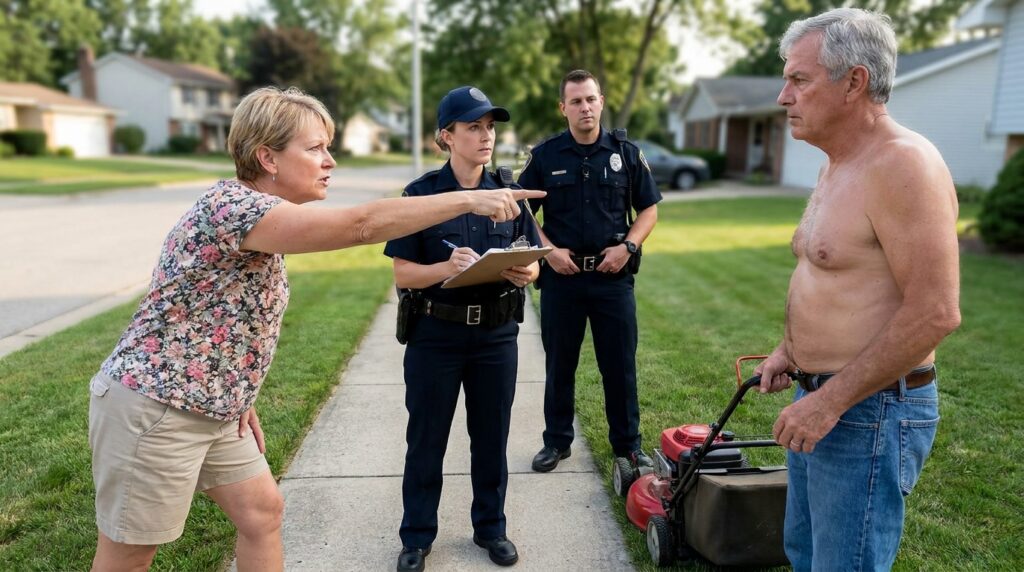
Brenda’s shoulder joint hitched, her weight rolling onto the ball of her right foot as she drove her smartphone forward like an index finger. Her floral sleeve caught the full glare of the cruiser’s overhead light bar, casting a moving violet shadow across the red metal cowling of Arthur’s parked machine. The air was thick with the scent of hot engine block and the flat, chemical stink of old gasoline sitting in a rusty float bowl.
“Look at the screen, Deputy!” Brenda’s voice had risen past the drone of the idling Interceptor, catching the attention of a man across the street who stopped uncoiling a garden hose to look. “The 1991 utility map shows a three-foot common variance right where his left wheel is resting. My husband signed off on it himself before the water line was laid. It’s a matter of record, and he’s violating it every single Saturday!”
Officer Ramirez didn’t look down at the glass face of the phone. Her fingers remained flat across the aluminum edge of her clipboard, her thumb holding down the modern county tax map. The paper didn’t have the old blue-inked notary stamp Brenda was flashing; it was clean, white, and divided by thin, unbroken black coordinate lines that allocated the land down to the hundredth of an acre.
“Ma’am, keep your hand back from the machine,” Ramirez said. Her voice didn’t carry any anger, but it possessed the heavy, unyielding weight of an iron latch dropping into a slot. She turned her torso by a fraction of an inch, using the stiff leather corner of her radio pouch to nudge Brenda back from the neutral strip of clover. “Mr. Vance, step around to the side of the deck. Miller, get the metal locator out of the trunk.”
Arthur didn’t pull his hands from the rubber foam of the handle. His calloused palms were gray with graphite grease from the mower’s height-adjustment lever, the skin dry and grooved like the face of an old file. He watched Officer Miller walk back to the white cruiser, his heavy utility boots making a short, sharp crunching sound against the loose limestone aggregate at the curb line. The trunk lid lifted with a metallic pop, revealing the rusted spare tire well and the gray canvas bag that held the station’s survey tools.
“The 1991 papers don’t change the concrete, Brenda,” Arthur said. His voice stayed flat, a low, mechanical growl that barely cleared the heat shimmer rising from the cylinder head. “Your husband drafted a lot of lines that didn’t get recorded at the county courthouse. He liked the look of a red pencil on a blue blueprint.”
Brenda’s face twisted, the pale skin around her nose turning the color of skim milk. She turned her phone toward Ramirez, her thumb frantically scrolling through a PDF document that showed a crude, hand-drawn map with an old notary seal at the bottom margin. The ink on the digital scan looked dark, almost purple against the gray grid lines, a remnant of the old spirit duplicators the water district used before the township centralized the engineering offices.
“It is recorded!” she snapped, her voice dropping into a sharp, transactional rattle. “It’s signed by the clerk of courts. The common easement allows for any neighboring property owner to clear debris up to three feet past the ditch line. You’ve been cutting my fescue down to the roots to make my side look un-mowed, Arthur. It’s a deliberate reduction of my property appearance.”
Ramirez tapped her pen against the aluminum board, the sound a steady, rhythmic click like a solenoid firing on a machine line. She looked from the digital scan on Brenda’s phone to the physical grass edge between the two properties. The cut fescue stopped cleanly along a straight line that followed the exact path of Arthur’s left wheels. Not a single blade of Brenda’s taller orchard grass had been nipped by the steel template beneath the deck.
“Miller,” Ramirez called out over her shoulder, her eyes never leaving the property line. “Bring the schematics for the 1974 master plat. The ones with the original iron stakes noted.”
Miller came back across the ditch, the gray canvas bag slung over his shoulder by a faded nylon strap. His hands were covered in thin, black mechanics’ gloves, the palms reinforced with Kevlar stitching that clicked against the metal shaft of the electronic pipe finder. He didn’t look at either neighbor; he kept his eyes on the dry clay, searching for the small, round depression where the sod had tried to heal over the surveyor’s work.
“We got a discrepancy here, Ramirez,” Miller said, his boots freezing right at the edge of the asphalt seam. He didn’t drop the machine; he just held it like an old gun, the gray plastic search head swinging an inch above the clover. “The old water district lines show a variance file that was opened in ninety-one but never stamped by the recorder. It’s listed as a pending draft on the historical log.”
Arthur felt a small, hard knot of muscle tighten in his jaw. He didn’t look down at his boots, but his heel pressed into the exact patch of earth where the iron rod sat six feet deep in the gray subsoil. He knew what was on that draft. He’d seen the paperwork thirty years ago when Brenda’s husband had tried to run a two-inch lateral line under his garden shed without paying the tap fee. His late wife had spent three days at the county seat with a leather folder full of original title receipts, ensuring that the clean deed stayed unblemished by any temporary utility access.
Brenda stepped forward again, her floral blouse brushing against the aluminum frame of Ramirez’s clipboard. Her fingers were trembling now, the phone screen flickering as the battery indicator dropped into the red. “It’s not a draft! It’s an approved modification! If you let him mow this last row, he’s going to destroy the ground markers the town needs for the drainage project next month!”
Ramirez didn’t answer her. She raised the clipboard to chest height, completely breaking the line of sight between Brenda’s phone and Arthur’s face. “Mrs. Geller, go back over to your driveway while Officer Miller runs the locator. We’re not doing this across the deck of a running machine. Move back now.”
The silence that followed was heavy, broken only by the low, regular throb of the Ford’s radiator fan kicking on against the noon heat. Arthur didn’t move. He stood shirtless in the sun, his thumbs hooked over the foam, waiting for the first ping of the detector to strike the iron beneath his feet.