CHAPTER 5: THE INTERACTION LINE
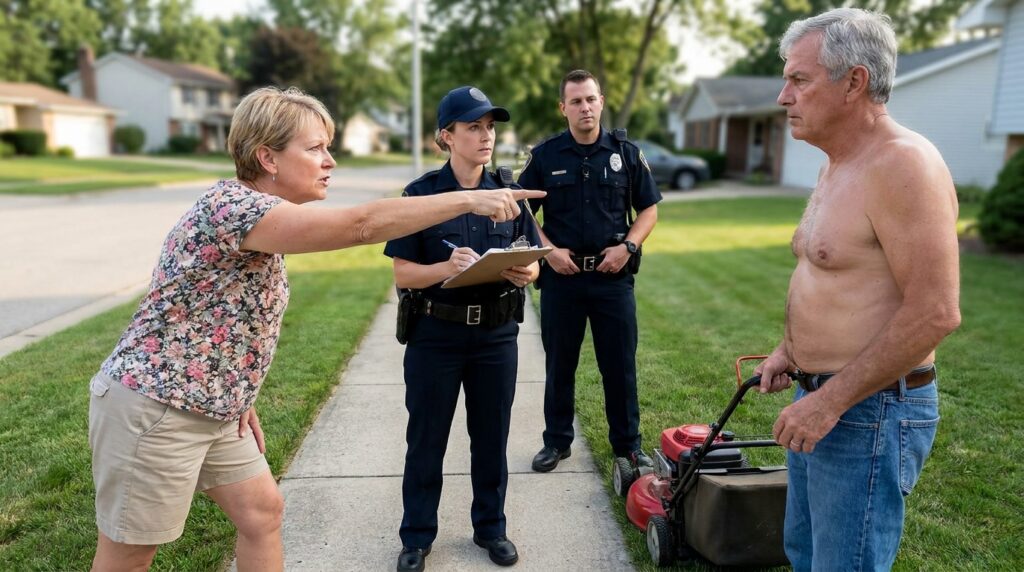
The heavy spring clamp of the aluminum clipboard clicked shut with a dull, flat snap that cut straight through the low hum of the squad car’s engine. Officer Ramirez adjusted her footing, her left service boot sliding an inch into the dry orchard grass, her shoulder silhouette completely eclipsing Brenda’s outstretched smartphone. The air hanging over the property line had turned thick, tasting of unburned oil and the alkaline bite of limestone dust kicked up from the curb.
Brenda didn’t drop the phone. Her knuckles remained pasty white against the plastic casing, her short blond hair clinging to her temples in damp streaks. She tried to peer over the rigid edge of the officer’s shoulder pad, her voice dropping an octave into a forced, shaking precision. “You’re not looking at the dates, Deputy. You’re letting him stand there on my transition strip while his machine sits right over the main lateral. My husband didn’t draft that line for nothing. The town registry has the pending file under Geller-Vance ’91. Look at the margin notes on your own paper!”
Ramirez didn’t turn around to address her. She held her line, her eyes scanning the dry sod between Arthur’s work boots and the gravel flare. “I’m looking at the plat map that came from the county recorder’s office twenty minutes ago, Mrs. Geller. It doesn’t have a pending status. It has an iron pin designation from the 1974 master survey. Miller, where’s that locator head?”
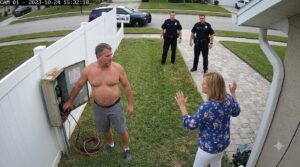
Arthur stood completely still behind the black foam handle of the Craftsman. He could feel the engine block cooling beneath his bare ribs, the heat radiating through his jeans like the face of a cast-iron stove left on after the shop closed. He didn’t offer to step away from the machine. His boots were anchored over the hidden marker, his heel pressing into the small, dry depression where the fescue gave way to the clover. He knew exactly what Miller was going to find with that machine, but his eyes were fixed on the pencil marking on Ramirez’s paper. The letters Geller-Vance ’91 weren’t in the standard county clerk’s script. They were written in the blocky, heavy-handed style of an old water district line foreman who spent thirty years using grease pencils on tracing cloth.
“The 1991 paper was a request, Brenda,” Arthur said. His voice was raw, the words coming out dry and low, barely lifting past the red steel deck of his mower. “Your husband brought it over in a manila folder on a Sunday morning while the concrete on my patio was still curing. He wanted three feet for a clean-out valve so he wouldn’t have to trench his own driveway. My wife told him no before he finished his coffee.”
Brenda’s mouth opened, her lower lip trembling until a small bead of saliva caught the sun-glare at the corner of her jaw. “She didn’t have the title cleared! The old orchard deeds had a standard five-foot municipal reservation from the ditch centerline. He had every right to sign that modification. He was the district clerk!”
“He was an assistant, Brenda,” Arthur said. He didn’t raise his hand, but his thumb traced the worn rubber grip of the throttle lever. “And an assistant can’t sign away an iron boundary pin just because he doesn’t want to dig through his own rock.”
Miller had reached the center of the clover strip now. The electronic pipe finder hummed in his black-gloved hands, a high, rhythmic buzz that altered its tone whenever the circular plastic search head passed over a rusted nail or an old piece of wire fencing buried in the clay. He swept the machine in a two-foot arc, his shoulders hunched under the weight of his vest, his eyes tracking the red digital needles on the small control box strapped to his waist.
“Got a hit here, Ramirez,” Miller called out, his boot heel tapping a spot four inches to the left of Brenda’s sneaker. “But it isn’t an iron pin. It’s an old cast-iron gate box. Looks like an unrecorded shut-off valve for the old lateral.”
Brenda’s chest expanded under her patterned blouse, her finger thrusting back toward the machine screen. “See! I told you! The lateral is right there! That valve belongs to the township utility grid, and his mower wheels are sitting directly on top of the access throat. That’s a Class B misdemeanor obstruction under county code!”
Officer Ramirez stepped forward, her leather utility belt creaking as she bent her knees to inspect the small circle of rusted iron Miller had uncovered with his boot. The metal cap was pitted, the square nut in the center filled with dry gray silt and dead grass roots. She didn’t look back at Brenda. She tapped the edge of her clipboard against her knee, her expression hardening as she noticed the specific ink discoloration on the document Brenda was holding—the purple mimeograph dye was faded, but the date at the bottom didn’t match the 1991 file. It said Draft Phase: September 1993.
Arthur didn’t shift his stance. A new vibration had entered the neighborhood grid—the distant, metallic rattle of a town utility truck coming down from the water tower hill. The situation wasn’t flattening out; it was pulling more weight onto the concrete strip. He could see the yellow strobe light on the truck’s cab flashing against the dry leaves of the oak trees, a regular, rhythmic warning that meant Brenda’s false call had gone all the way to the municipal supervisor’s desk. She had tried to lock him out of his own yard using her husband’s old workspace files, but she hadn’t accounted for the clean title his wife had paid off three decades ago.
“Mr. Vance,” Ramirez said, straightening up until her cap shadow fell across his chest. “Did your wife ever file a formal revocation for the utility access after ninety-one?”
“She didn’t have to file a revocation,” Arthur said, his fingers tightening on the mower handle until the black foam groaned against the steel tubing. “The variance never went past the first reading at the town hall. Brenda knows that. She’s got the rejection notice in the same folder she took that scan from.”
Brenda’s phone clicked as her thumb struck the power button, the digital screen going black in an instant as she pulled the device back against her stomach. “The rejection was stayed! We had the administrative extension through the end of the decade!”
The town truck braked at the curb line, its air brakes releasing with a loud, mechanical hiss that left a white cloud of dust hanging over the ditch. The door opened, and a man in an orange high-visibility vest stepped out onto the asphalt, a long steel T-wrench balanced on his shoulder like an iron bar.