CHAPTER 6: THE SHIFTING WEIGHT
The diesel exhaust from the town utility truck settled over the hedge line like unwashed wool, heavy and greasy with sulfur. The man in the orange high-visibility vest stepped off the cab run-board, his heavy-lugged rubber soles crunching into the dry limestone dust of the curb. The five-foot iron T-wrench balanced across his neck gave off a flat, zinc-plated ring every time his collar bone struck the shaft.
Arthur didn’t alter his grip on the Craftsman’s handle. He watched the utility worker approach the clover line, his eyes tracking the grease-darkened leather of the folder the man carried tucked under his armpit. It wasn’t a standard tablet; it was a bound ledger book with oil-cloth covers, the kind the public works grid foremen used to log physical anomalies that never made the digital conversion down at the county annex.
“What’s the freeze here, Ramirez?” the worker asked, his voice coming out as a wet, gravelly rasp from thirty years of breathing trench dust. He stopped three feet from the mower’s front axle, his eyes dropping to the newly uncovered cast-iron gate box. He didn’t look at Brenda’s phone or Arthur’s lack of a shirt. “We got an emergency call from dispatch about a localized line blockage and property sabotage. Who requested the line key?”
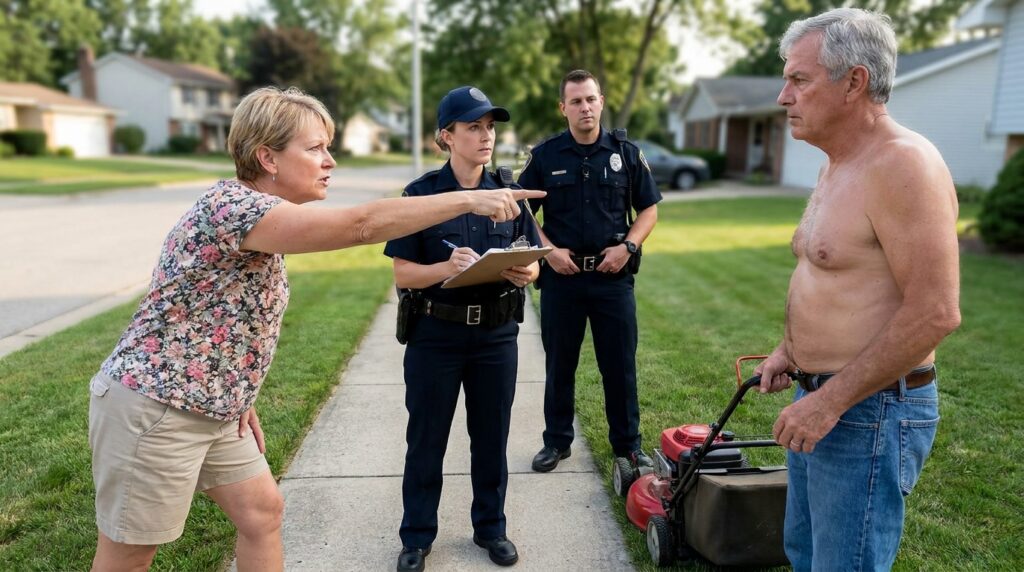
“I did,” Brenda said, her white sneaker pivoting on the grass to clear the path for him. She pointed her phone screen toward the heavy T-wrench. “The Geller-Vance lateral has an unrecorded check-valve right there under his wheel track. He’s deliberately compacting the fill dirt to crush the service sleeve. I want the main isolated and locked off before my basement backup gets worse.”
The worker looked down at the rusted iron cap Miller had scraped clean with his boot. He didn’t use his hands; he just tapped the square nut in the center with the hardened tip of his iron wrench. The metal gave off a low, solid thud—the sound of solid clay underneath, not an empty vault.
“This box has been cold since seventy-six, lady,” the worker said, pulling a stubby grease pencil from behind his ear to scratch a dull blue mark across the iron lip. “This was the old orchard feed line before they laid the twelve-inch main under the north ditch. There ain’t no water in this throat to shut off.”
Arthur felt the skin across his shoulder blades tighten under the dry wind. He didn’t drop his hands to his pockets, but his eyes locked onto the oil-cloth ledger book as the worker opened it against his thigh. The top page wasn’t a clean white tax plat; it was a hand-washed blueprint from September 1993, colored with bright red grease marks that slashed across the boundary line of Arthur’s lot.
“Check the modification registry on page twelve, son,” Arthur said to the worker, his voice level and dry as old cedar. “The ninety-one draft was pulled back by the county board because the engineering crew found out the easement lacked a proper signature from the true deed holder.”
Brenda’s phone clicked against her belt buckle as her hand dropped, her sunglasses slipping down the bridge of her nose to reveal the red, sun-strained rims around her eyes. “The signature was grandfathered through the district water board! My husband had the administrative sign-off! He kept the copy right here in our office for thirty years!”
“An assistant can’t sign an easement over land he don’t own, Brenda,” Arthur said, his fingers remains clamped on the black rubber foam of the mower handle. “And your husband knew that when the county sent the rejection letter back in ninety-three. That’s why he kept the file in his desk instead of sending it down to the courthouse.”
Officer Ramirez stepped between them again, her leather utility belt giving off that familiar organic creak as she reached out to touch the corner of the worker’s ledger book. Her fingernail tapped a small, faded square of purple ink at the bottom of the blue sheet—a stamp that read: Voided by Recorder – Incomplete Title.
The silence that followed was heavy, filled only by the distant, rhythmic thrum of the truck’s air compressor and the dry rattle of a locust somewhere in the old hickory stump. Arthur didn’t move his boots. He could see the decoy narrative Brenda had built for decades—the myth of the hidden utility right-of-way she used to control his fence line—crumbling under the weight of the old public works book. But his own final reality, the small piece of paper his wife had buried deep inside a tin box in their cedar chest before the illness took her, remained locked away from all of them.
“Miller,” Ramirez said, her face turning back toward the white cruiser. “Get the county supervisor on the radio. Tell them we have a civil boundary dispute using non-current municipal documents to summon emergency personnel.”
Brenda took two steps back toward her driveway, her floral blouse catching on a dry twig of the hedge line with a sharp, tearing pop. Her finger was still pointing at Arthur, but the strength had gone out of her wrist, her smartphone screen reflecting nothing but the gray, sun-cracked asphalt of her own empty apron.