Chapter 9: The Names That Stayed
The following spring, Maple Creek’s community garden opened for its second growing season.
There was no elaborate ribbon-cutting.
Emily had suggested a simple volunteer breakfast instead.
By eight o’clock, folding tables stood beside the entrance arch, covered with homemade muffins, coffee, fruit, and paper cups.
The raised beds had been prepared for planting.
Fresh compost darkened the soil.
Seed trays lined the greenhouse shelves.
The accessible tables had been completed, and the gravel path had been improved.
A new rainwater collection system stood near the tool shed.
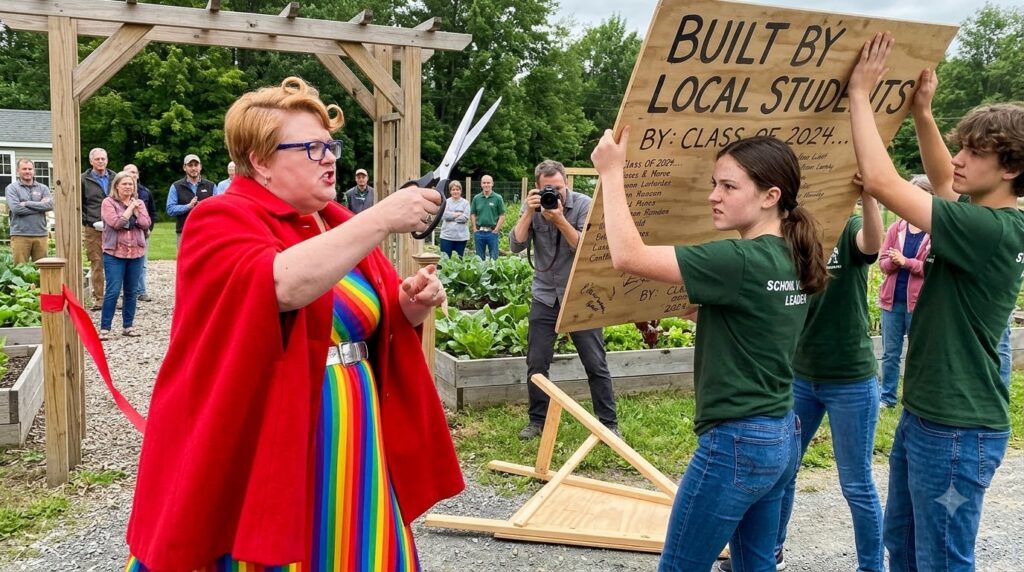
Most importantly, the recognition board had been repaired and permanently mounted beneath a small protective roof beside the entrance.
Its original words remained unchanged.
BUILT BY LOCAL STUDENTS.
Below them were the twenty-three names from the first year.
A second panel had been added for future volunteers.
Emily had insisted on that detail.
The garden was not supposed to become a monument to one graduating class.
It was supposed to keep growing.
Thomas arrived shortly after nine, walking slowly with his cane.
He wore a green flannel shirt and an old baseball cap that had belonged to Ruth.
Emily met him near the entrance.
He studied the new sign.
Then he looked toward the planting beds, where children were helping older volunteers place seedlings into the soil.
For a long moment, he said nothing.
Finally, he smiled.
“Your grandmother would have liked this.”
Emily slipped her arm through his.
“I think she would have told us the rows weren’t straight enough.”
Thomas laughed.
“She certainly would.”
The previous winter had been difficult.
The controversy had taken a toll on everyone involved.
The foundation had formally closed the disputed application without awarding funds. Its final correspondence documented the unauthorized sponsorship claims and the problems with the property authorization.
The Civic Improvement League had adopted new financial controls and a policy requiring board approval for grant applications.
Its new president had sent the garden association a written acknowledgment that the league had no ownership or management authority over the project.
The selectboard had closed its administrative review after confirming the limits of the town’s role and receiving the association’s supporting records.
The association’s finances had been reconciled and made available in an annual report.
Thomas and his attorneys had also completed a revised long-term land-use arrangement, with protections intended to preserve the garden’s charitable purpose and provide continuity beyond his lifetime.
The arrangement was not a guarantee that nothing could ever change.
No legal document could promise that.
But it gave the association a far stronger foundation.
As for Margaret, she had withdrawn from most public activities.
She no longer attended Civic Improvement League meetings.
Some neighbors still visited her.
Others kept their distance.
She had not issued a public apology to the students.
Emily had once believed that justice required Margaret to admit everything she had done.
Over time, she came to understand that accountability did not always arrive with a satisfying confession.
Sometimes it arrived through corrected records, stronger safeguards, and consequences that prevented the same harm from happening again.
The garden was still there.
The students’ names were still there.
Margaret no longer controlled the conversation.
That was enough.
Near noon, Daniel Brooks arrived with his camera.
He had been photographing the garden throughout the morning.
The image from the previous fall had become one of the most recognizable photographs in town.
But Daniel rarely displayed it anymore.
He preferred a different photograph.
It showed Emily, Tyler, Sophie, and several other students carrying the repaired recognition board back toward the entrance after the interrupted ceremony.
Their faces were tired.
Their clothes were dusty.
Nobody was posing.
They were simply working together.
Daniel had printed that photograph and given it to the school.
It now hung in the hallway outside the science classrooms.
Below it, Mrs. Hayes had placed a small plaque.
Community service is measured by what we contribute, not what we claim.
At the spring opening, Daniel asked Emily whether she wanted a photograph with her grandfather.
She agreed.
They stood beside the recognition board.
Thomas removed his cap.
Emily straightened his collar.
Daniel raised the camera.
Then Thomas stopped him.
“Wait a minute.”
He looked toward the planting beds.
“Get the others.”
Emily smiled.
She called Tyler, Sophie, Mrs. Hayes, George, Patricia, Frank, and the volunteers who had been working nearby.
More people joined.
A few children hurried over with muddy gloves.
The food pantry director stepped into the back row.
Someone brought an elderly neighbor’s folding chair closer so she could be included.
Daniel moved backward to fit everyone into the frame.
The group was too large for a neat photograph.
Some people were partly hidden.
A child looked in the wrong direction.
Thomas’s cap ended up in Frank’s hand.
Nobody minded.
Daniel took the picture.
This time, the recognition board stood beside the group rather than above anyone’s head.
It didn’t need to compete for attention.
The people around it were the reason it existed.
Later that afternoon, after most visitors had gone home, Emily remained behind to water the newly planted beds.
Thomas sat on a bench near the entrance.
The sun had broken through the clouds.
A soft breeze moved across the young lettuce leaves.
Emily finished watering and sat beside him.
“Grandpa, do you think Margaret will ever understand what she did?”
Thomas considered the question.
“I don’t know.”
Emily looked disappointed.
He continued.
“Some people spend so much time trying to prove they’re important that they forget how to be useful.”
She watched a robin hop along the edge of a planting bed.
“Do you think we should have handled anything differently?”
“Probably. Most things can be handled better when we look back.”
He paused.
“But you stood up for your friends. You checked the facts. You didn’t let someone else’s behavior turn you into the same kind of person.”
Emily leaned against his shoulder.
For a while, they sat without speaking.
Across the garden, the recognition board caught the afternoon light.
The names were clear.
The paint was fresh.
And the new planting season had begun.
In a few months, Emily would leave for college.
Other students would take over her responsibilities.
Some would make mistakes.
Some would discover talents they didn’t know they possessed.
The garden would face dry summers, heavy rains, broken tools, and difficult decisions.
It would need people willing to show up when the work was inconvenient.
That was how it would survive.
Not through one person’s photograph.
Not through a title.
Not through the loudest voice in the room.
But through the steady, ordinary generosity of people who understood that a community belonged to everyone willing to care for it.
Thomas rose carefully from the bench.
Emily offered him her arm.
Together, they walked toward the gate.
Before leaving, Emily glanced once more at the recognition board.
She remembered the terrible sound it had made when Margaret knocked it onto the gravel.
At the time, Emily had thought the ceremony was ruined.
Now she understood something different.
The board had fallen.
The names had not been erased.
And the people who had earned those names had picked it back up.
That was the story worth remembering.
The End.