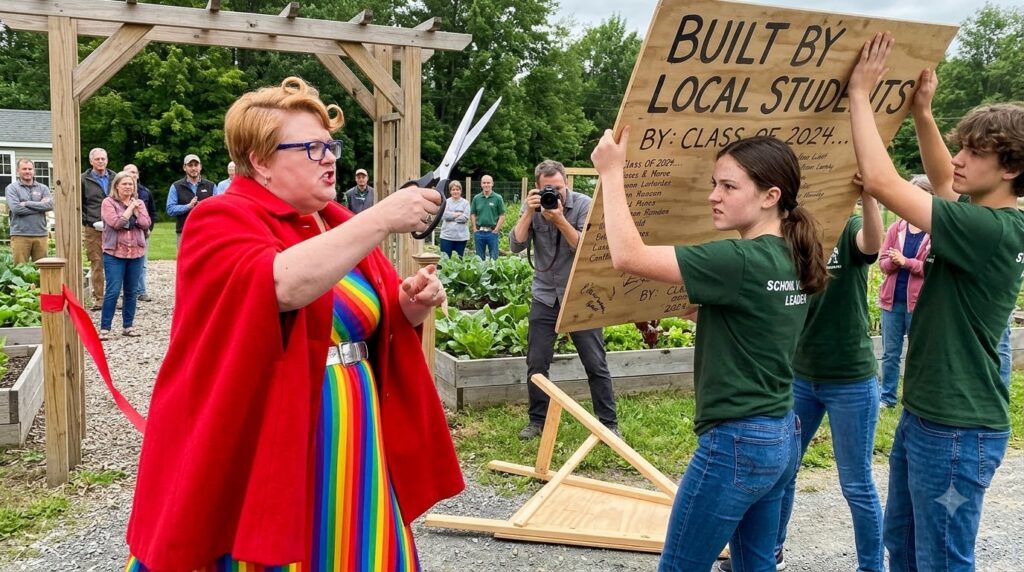
Chapter 7: What Margaret Was Afraid to Lose
Frank Whitcomb did not enjoy discussing his former wife.
Their marriage had ended seven years earlier, and he had worked hard to keep their disagreements private.
He had no interest in becoming part of a public campaign against her.
But after hearing what happened at the ribbon-cutting, he believed there was something Thomas and Emily needed to understand.
Margaret’s behavior had not begun with the garden.
Years earlier, when the Civic Improvement League was still thriving, Margaret had organized a major fundraising dinner.
The event was successful.
Local businesses contributed generously, and volunteers worked for weeks.
But when the regional newspaper published a photograph of the organizing committee, Margaret was standing near the edge of the group.
The article praised several volunteers by name.
Margaret was mentioned only briefly.
According to Frank, she remained angry about that article for months.
She believed she had been humiliated.
Afterward, she began insisting on controlling photographs, publicity materials, and speaking arrangements for league events.
She wanted her name attached to every success.
Over time, the need for recognition became more important to her than the work itself.
Frank didn’t excuse it.
He simply described what he had seen.
“She thinks if people stop noticing her, they’ll forget she matters,” he said.
Thomas listened without interrupting.
He had known Margaret’s parents and remembered her as a bright, ambitious teenager.
He also remembered her mother, a woman who measured success through appearances and social standing.
But Thomas knew that difficult family expectations did not remove personal responsibility.
Many people grew up under pressure without mistreating others.
Emily asked Frank whether Margaret had financial problems.
He shook his head.
“Not that I know about. She’s comfortable enough. This isn’t about needing the grant to pay her bills.”
“Then why the administrative fee?”
“Because being paid to run the garden would make her position official. It would give her a title, a budget, and something to point to.”
Emily looked across the beds.
The students had never discussed titles.
They had divided responsibilities according to who could do the work.
Tyler knew construction.
Sophie was good with organizing volunteers.
Emily handled schedules and communication.
Mrs. Hayes helped with science education.
Thomas offered experience and patience.
Nobody needed to be the most important person.
The garden worked because no single person was indispensable.
That afternoon, Frank helped the students rebuild the arch.
He showed them how to reinforce the joints and anchor the posts more securely.
By sunset, the entrance was standing again.
The repairs cost less than anyone expected because Frank had donated the materials.
Emily thanked him.
He nodded.
“Just make sure you keep it safe.”
As he prepared to leave, Thomas approached.
“Frank, I appreciate what you’ve done.”
Frank looked uncomfortable.
“I should’ve spoken up years ago when Margaret started treating people this way.”
Thomas placed a hand on his shoulder.
“You can’t answer for another person’s choices.”
Frank considered that.
“No,” he said. “But I can answer for mine.”
The following week, the foundation completed its preliminary review.
Its findings were serious.
The grant application had identified the Civic Improvement League as the garden’s authorized sponsor without adequate supporting documentation.
The property authorization signature appeared to have been copied from an unrelated document.
Margaret had submitted the application through the foundation’s online portal using her own account.
The foundation requested a written explanation and notified the league’s board.
Patricia received a copy because she remained listed as a former financial officer.
She called Emily that evening.
“The league is holding an emergency meeting,” she said.
Margaret’s presidency was now in question.
But the foundation’s letter also contained an important warning.
The garden association would need to strengthen its documentation and public communications to prevent similar disputes.
Emily understood.
Winning an argument would not be enough.
The students needed to build an organization that could survive after they graduated.
And that meant making one final decision about the future of the land.