Chapter 2: The Garden That Grew From a Promise
By the following morning, Daniel Brooks’s photograph had traveled farther than anyone in Maple Creek expected.
It appeared first on the town’s community Facebook page.
Then someone shared it with a regional Vermont news group.
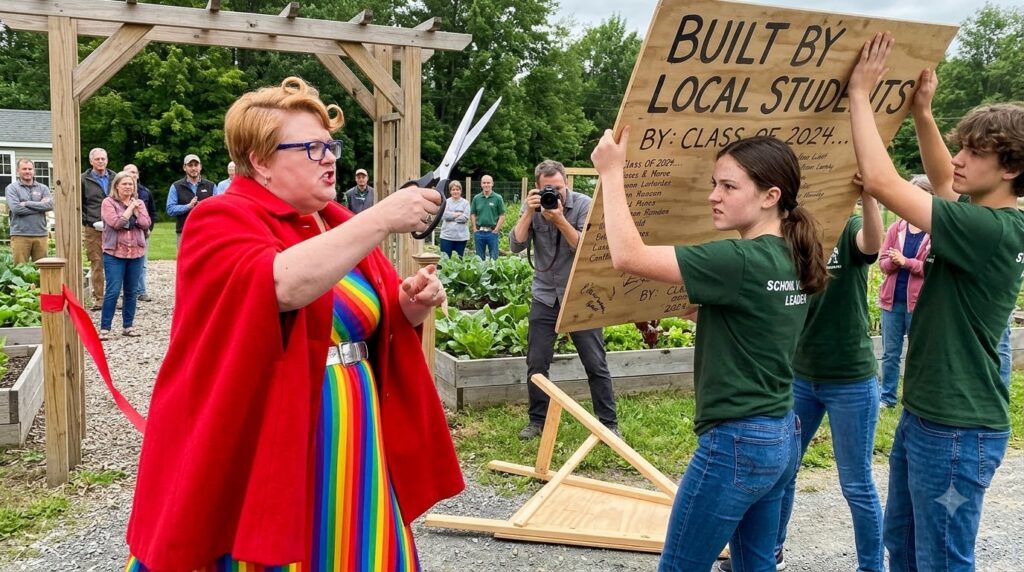
By breakfast, hundreds of people had seen Margaret Whitcomb standing beneath a board that credited the students whose ceremony she had interrupted.
Most of the comments supported the teenagers.
Some residents recognized Margaret immediately.
Others wanted to know why an adult had taken ceremonial scissors from a high school student and knocked over a recognition board.
Emily didn’t read all the comments.
She was sitting at her grandfather’s kitchen table, looking through a folder of documents that smelled faintly of old paper.
Thomas lived in a white farmhouse at the edge of town, less than a mile from the garden. His wife, Ruth, had died four years earlier after a long illness.
For most of their marriage, the couple had maintained a vegetable patch behind the house.
Ruth had believed that every child should know how to grow something.
She had also believed that no neighbor should have to choose between buying groceries and paying the heating bill.
When Ruth died, Thomas found a notebook among her gardening supplies.
On the first page, she had written a simple wish.
Someday, I’d like to see a garden where young people and older neighbors work together, and everyone has something to take home.
Thomas had kept that notebook in his bedside drawer.
Last spring, when Emily needed a senior-year community leadership project, he showed it to her.
The idea grew quickly.
The town had an unused half-acre parcel near the library, originally part of the Parker family property. Thomas had retained ownership after selling the surrounding land decades earlier.
He offered the parcel for a student-led community garden, provided it remained available for public benefit.
Emily recruited classmates.
Their science teacher, Mrs. Linda Hayes, helped prepare a proposal.
A local lumberyard donated discounted materials. A retired plumber installed a water connection at cost. Parents contributed tools, compost, seedlings, and countless hours of labor.
The students organized fundraisers.
They washed cars.
They sold homemade pies.
They collected small donations at the town’s summer market.
By September, they had built twelve raised beds, two accessible planting tables, a composting area, and a narrow gravel path suitable for wheelchairs.
They had also arranged for a portion of the harvest to go to the town food pantry.
The project wasn’t expensive by municipal standards.
Its value came from the people who had built it.
Emily opened another folder.
Inside was a signed agreement between Thomas and the Maple Creek Community Garden Association, a newly formed nonprofit organization.
The agreement granted the association permission to use the land for ten years, with renewal provisions and restrictions intended to protect its charitable purpose.
Margaret Whitcomb’s name appeared nowhere.
“Then why does she keep saying she controls the property?” Emily asked.
Thomas rubbed his forehead.
“Because she’s been trying to change that.”
He explained that Margaret had approached him six weeks earlier.
She was president of the Maple Creek Civic Improvement League, a private volunteer organization that had once helped organize parades, holiday decorations, and downtown beautification projects.
In recent years, its membership had dwindled.
Margaret had become increasingly determined to make the league appear indispensable.
She offered to place the community garden under its sponsorship.
Thomas declined.
The students already had a nonprofit association, adult advisers, insurance arrangements, and a volunteer management plan.
Margaret returned twice.
On her third visit, she suggested that the garden would be more successful if the Civic Improvement League controlled publicity, fundraising, and future improvements.
Thomas again refused.
“She told me I was making a mistake,” he said.
Emily leaned forward.
“What kind of mistake?”
Thomas hesitated.
“She said there were people at town hall who believed the land arrangement hadn’t been handled properly.”
Emily stared at him.
“Was it?”
“Yes. As far as our attorney and the association’s records show.”
“Then why didn’t you tell me?”
Thomas looked toward the window.
Outside, the last yellow leaves of autumn clung to the maple trees.
“I wanted you to enjoy yesterday. You’ve worked hard enough.”
Emily understood his intention.
But she also understood something her grandfather had overlooked.
Margaret had not simply tried to steal a photograph.
She had been laying claim to the project for weeks.
Across town, Margaret was sitting in her home office, studying Daniel’s photograph on her computer.
Her phone had been ringing all morning.
She had ignored most of the calls.
But one message caught her attention.
It came from a member of the Civic Improvement League’s finance committee.
The message asked why Margaret had submitted an application for a $25,000 community improvement grant using the garden’s name.
Margaret closed the message without answering.
Then she opened a folder labeled Garden Development Proposal.
Inside were documents that the students had never seen.
And one of them contained a signature that was not hers to use.