Chapter 8: A Town Decides What Matters
The Civic Improvement League’s emergency meeting took place in the basement of the public library.
Only nine voting members attended.
Margaret arrived carrying the same binder she had brought to the selectboard meeting.
This time, however, the room was not filled with sympathetic neighbors.
It was filled with people who had spent years working beside her.
They knew her strengths.
They also knew her habits.
Patricia attended as an invited former treasurer.
She did not speak until the board chair asked her to explain the grant documents.
Margaret insisted that she had been acting to protect the garden.
She argued that the students would eventually graduate, leaving the project without leadership.
She said the Civic Improvement League had been unfairly excluded from an important community initiative.
When asked about Thomas’s signature, she claimed she believed his public support for the garden extended to the grant application.
The board chair pointed out that a public thank-you letter did not authorize a separate organization to represent itself as the land’s sponsor.
Margaret grew angry.
She accused the members of abandoning her.
She reminded them of every fundraiser she had organized.
She listed the holidays she had sacrificed and the weekends she had spent volunteering.
Nobody denied those contributions.
But the question before the board was not whether Margaret had ever done good work.
It was whether she had acted properly in this matter.
After a lengthy discussion, the board voted to remove her as president under the league’s bylaws.
The vote was seven to two.
The board also withdrew the disputed grant application, formally disavowed the unauthorized sponsorship claims, and agreed to cooperate with the foundation’s review.
Margaret left before the meeting ended.
For the first time in many years, she no longer held a leadership position in the organization that had become central to her identity.
News of the vote spread quickly.
Some residents felt she had been treated too harshly.
Others believed the consequences were overdue.
Thomas refused to participate in the arguments.
He was more interested in what happened next.
At Caroline’s recommendation, the garden association held an open community meeting.
Residents were invited to review its mission, finances, and long-term plans.
Emily presented a proposal for a permanent governing board that would include student representatives, adult volunteers, and members with financial and gardening experience.
She recommended staggered terms so the organization would not depend on any single graduating class.
George offered to continue as treasurer until a successor could be trained.
Mrs. Hayes agreed to coordinate school involvement.
Frank volunteered to oversee annual safety inspections of the wooden structures.
Patricia offered bookkeeping assistance.
The association also adopted a written policy requiring approval before anyone could use its name, photographs, or project materials in outside fundraising.
It wasn’t glamorous work.
There were no ribbons.
No dramatic speeches.
Just folding chairs, paper agendas, and neighbors willing to take responsibility.
But Emily found the meeting more satisfying than any ceremony.
People asked thoughtful questions.
They discussed winter maintenance.
They planned a seed-starting program for spring.
Several older residents volunteered to mentor students in gardening, carpentry, and food preservation.
A local nurse suggested adding another accessible planting table.
The town food pantry director asked whether the garden could reserve additional beds for vegetables that stored well through winter.
The project was becoming something larger than a school assignment.
Then Thomas made an announcement.
He had met with Caroline and an estate-planning attorney.
Rather than leave the land arrangement dependent on his personal ownership indefinitely, he intended to establish a long-term legal structure protecting the property for community gardening.
The details would require careful review, including tax, land-use, and nonprofit considerations.
But his goal was clear.
He wanted the garden to remain available to future generations.
Emily looked at her grandfather.
He seemed smaller than he had a year earlier.
His hands shook more often.
He tired easily after long afternoons outdoors.
But his eyes were bright.
“This was Ruth’s idea,” he told the room. “I just happened to have the land.”
Several people smiled.
Emily knew better.
Her grandmother had dreamed of the garden.
Her grandfather had trusted young people enough to help them build it.
And now the community was taking responsibility for keeping it alive.
The final obstacle came from an unexpected place.
Margaret sent Thomas a handwritten letter.
It was not an apology.
She claimed that the public controversy had damaged her reputation and demanded that he stop discussing her involvement in the garden.
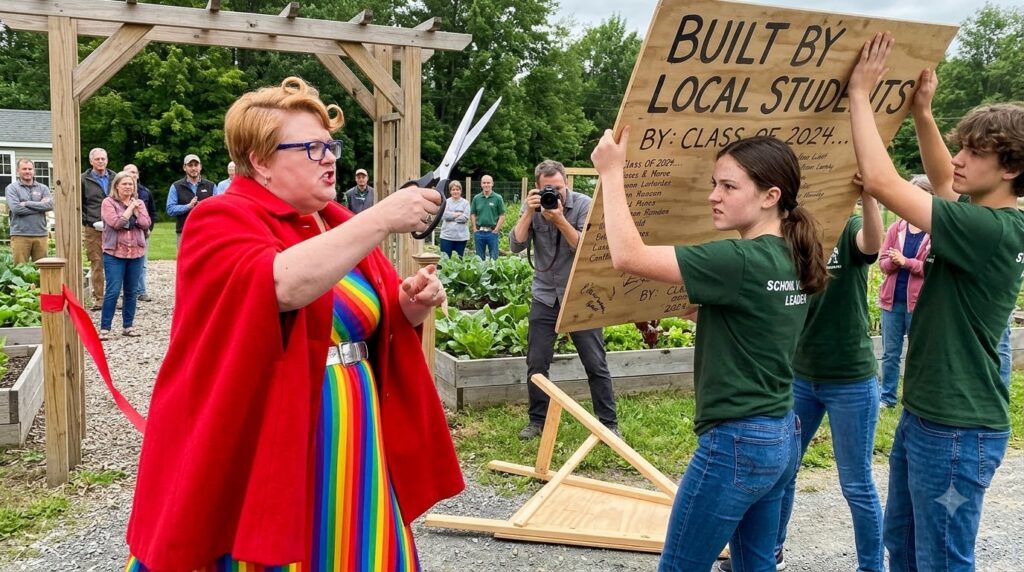
She also requested that Daniel remove the ribbon-cutting photograph from public circulation.
Thomas read the letter once.
Then he handed it to Caroline.
Emily asked what they should do.
Caroline explained that they should avoid speculation and unnecessary public accusations, preserve the letter, and continue communicating accurately about the project’s records and governance.
The photograph documented a public event.
But its existence did not justify harassment or endless personal attacks.
Thomas agreed.
He had never wanted Margaret humiliated.
He wanted her interference to stop.
And as winter approached, he hoped that might finally be possible.