Chapter 6: The Missing Money That Wasn’t Missing
Margaret’s spreadsheet showed $9,460 in donations and only $6,180 in recorded expenditures.
She argued that the difference represented money the association had failed to explain.
The numbers looked troubling at first glance.
Several residents leaned forward.
A man near the back asked whether the students had access to the bank account.
Another wondered why the association had not published a full financial report.
Emily felt the familiar sting of being treated as irresponsible simply because she was young.
But this time, she did not respond in anger.
Mrs. Hayes stood and asked whether the board would allow the association to submit its records.
Helen agreed.
The meeting had already run late, and the board was not equipped to conduct a financial examination that evening.
It directed the town administrator to review the documents relevant to any town involvement and invited the association to provide a written reconciliation.
Margaret objected.
She wanted an immediate finding that the garden’s management was inadequate.
Helen refused.
“No determination will be made from a spreadsheet without supporting records.”
The meeting ended without the outcome Margaret wanted.
But the accusation remained.
The next morning, Emily, Mrs. Hayes, and the association’s volunteer treasurer, a retired accountant named George Miller, gathered at the school library.
George had maintained the garden’s financial records since the association opened its bank account.
He was sixty-eight, methodical, and famously unwilling to throw away a receipt.
He spread folders across two tables.
The apparent discrepancy became clear within an hour.
Margaret’s spreadsheet combined cash donations with the estimated value of donated materials and services.
It then compared that total against cash expenditures alone.
The difference was not missing money.
It was largely the value of lumber, compost, tools, and professional services that had been donated rather than purchased.
The spreadsheet also omitted a bank balance of $1,140 that remained reserved for spring planting.
George prepared a reconciliation showing each contribution, expenditure, donated item, and remaining balance.
The figures balanced.
But one question bothered him.
“Where did Margaret get these numbers?”
The spreadsheet included information from an early fundraising summary that had circulated only among the association’s planning committee and a handful of community partners.
Emily remembered that Margaret had attended one preliminary meeting as an observer.
At the time, she had offered to help with publicity.
The committee had shared a summary with her.
She had used it to create a misleading picture.
George was furious, though he expressed it quietly.
“Numbers can be truthful individually and dishonest together,” he said.
Emily wrote that sentence in her notebook.
It described the entire situation.
Margaret had taken real pieces of the project and rearranged them until they appeared to belong to her.
She had used the students’ proposal.
She had used Thomas’s name.
She had used legitimate donation figures.
And she had used her history of volunteer work to make her claims sound credible.
The association submitted its financial reconciliation to the town administrator and the foundation.
Caroline also requested that the foundation preserve the grant application, attachments, and submission records.
Two days later, the foundation’s program director contacted Thomas.
The application had been placed on hold pending review.
No grant money had been awarded or distributed.
The director confirmed that the foundation had received a property authorization document bearing Thomas’s signature.
Thomas repeated that he had not signed it for that purpose.
The foundation began an internal review and informed Margaret that she would have an opportunity to respond.
For Emily, the most difficult part was waiting.
She wanted a clean ending.
She wanted someone to announce that the garden was safe and Margaret could never interfere again.
Instead, there were procedures, meetings, documents, and delays.
Then an unexpected problem arrived.
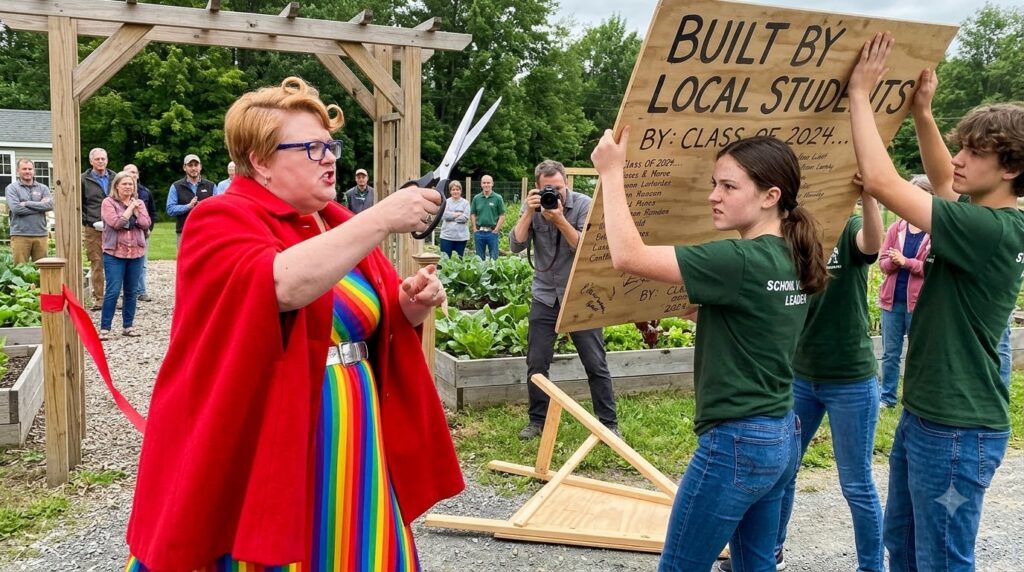
A heavy overnight storm tore loose part of the garden’s entrance arch.
The damaged crossbeam fell across the gravel path, blocking access to the raised beds.
Nobody was injured.
But the entrance had to be closed until repairs could be completed.
The students gathered Saturday morning to inspect the damage.
Tyler examined the fallen timber.
Sophie photographed the broken hardware.
Emily looked toward the recognition board, which they had temporarily moved into the tool shed for protection.
The garden seemed strangely empty without it.
Then a pickup truck stopped beside the fence.
The driver was Frank Whitcomb, Margaret’s former husband.
He stepped out wearing a faded work jacket and carrying a carpenter’s tool belt.
Frank had worked in residential construction for thirty years.
He looked at the damaged arch.
Then at Emily.
“I heard you could use a hand,” he said.
Emily wasn’t sure what to say.
Frank glanced toward the garden beds.
“Whatever happened between Margaret and this project, these kids shouldn’t lose what they built.”
He opened the truck bed.
Inside were new posts, brackets, and weather-resistant lumber.
For the first time in days, Emily felt something other than anxiety.
But Frank had brought more than repair materials.
He had information about why Margaret had become so determined to control the garden.