Chapter 5: When the Town Started Taking Sides
By Thursday, the community garden had become the most discussed subject in Maple Creek.
Not because of vegetables.
Not because of the students’ achievement.
Because residents were being asked to decide whom they trusted.
Margaret spent the days before the selectboard meeting making phone calls.
She contacted former league members, business owners, and several elderly residents who remembered her family’s long history in town.
She described the ribbon-cutting incident as an unfortunate misunderstanding.
She claimed the students had become emotional.
She suggested that Emily’s grandfather had been influenced by people who did not understand nonprofit administration.
And she insisted that the Civic Improvement League had the experience necessary to protect the garden’s future.
Some people believed her.
Margaret had organized the Fourth of July parade for years. She had helped raise money for the fire department. She had delivered holiday meals to homebound neighbors.
Those contributions were real.
To residents who knew only that side of her, the idea that she had deliberately tried to take over a student project seemed difficult to accept.
Other people remembered a different Margaret.
They remembered committee meetings where volunteers were publicly humiliated.
They remembered donors whose names disappeared from programs.
They remembered the way she took credit for work that others performed.
The town began dividing into camps.
Emily hated it.
At school, classmates asked whether the garden would close.
One student said her father believed the whole controversy was being exaggerated.
Another reported that her grandmother had received a call from Margaret urging her to attend the meeting.
Mrs. Hayes reminded the students that disagreement was part of community life.
But she also warned them not to argue about the case on social media.
“Let the records speak,” she told them.
Meanwhile, the garden faced a more immediate problem.
A local supplier called to postpone delivery of materials for the accessible planting area.
The company had heard rumors that ownership of the property was disputed.
Its manager wanted clarification before sending employees onto the site.
The association’s insurance agent also requested documentation confirming who controlled the property and supervised volunteers.
No one had canceled coverage, but the requests created delays.
Emily began to understand how damaging uncertainty could be.
Even an unsuccessful challenge could slow a community project.
Thursday evening arrived cold and windy.
The meeting room at town hall filled long before the scheduled start.
Residents stood along the walls.
Several students sat together in the second row.
Thomas occupied a chair near the aisle, his cane resting against his knee.
Patricia sat beside Caroline.
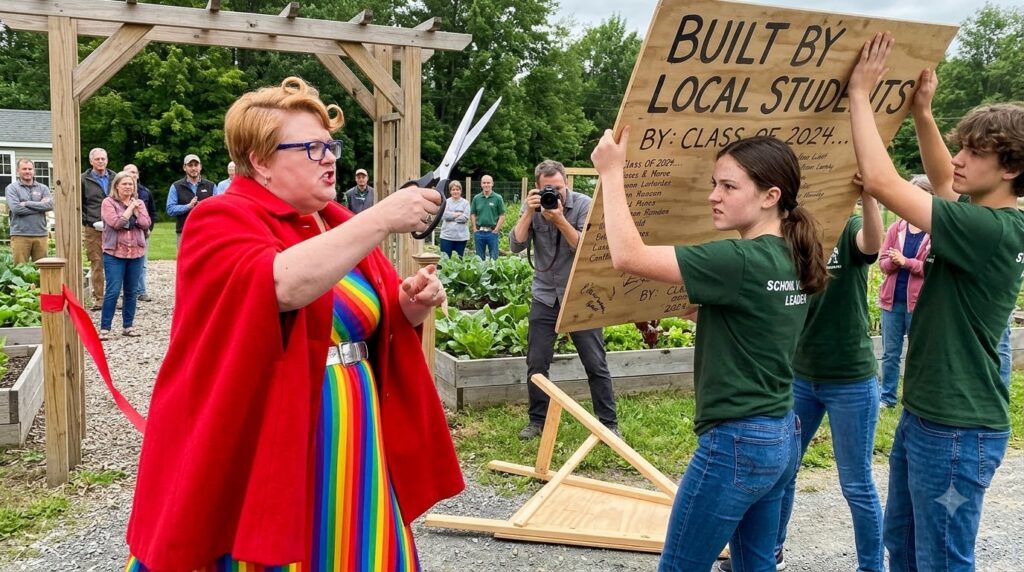
Margaret entered wearing a royal-blue coat and carrying a thick binder.
She smiled at familiar faces.
She shook hands.
She behaved as though the previous Saturday had never happened.
When the garden item was called, Selectboard Chair Helen Foster explained that the board had received correspondence questioning the project’s governance.
The board had not determined that any wrongdoing had occurred.
Its purpose was to clarify the town’s involvement and decide whether further administrative review was necessary.
Margaret spoke first.
She described her years of volunteer service.
She praised the students in general terms.
Then she argued that enthusiasm was not a substitute for experienced management.
She claimed the Civic Improvement League could provide stability, professional fundraising, and continuity after the students graduated.
Her presentation was polished.
For several minutes, Emily worried that it might work.
Then Caroline stood.
She explained that the land was privately owned by Thomas Parker and had been licensed to the garden association.
The town had not been asked to transfer ownership or appoint a new operator.
The association had filed its organizational documents, adopted bylaws, appointed adult board members, and arranged insurance.
Caroline submitted copies of those records.
She also explained that the Green Valley Community Foundation had been notified of a disputed grant application.
The selectboard chair leaned forward.
“Mrs. Whitcomb, did your organization receive authorization from Mr. Parker to represent itself as the garden’s sponsor?”
Margaret adjusted her glasses.
She said she had acted in good faith based on discussions with community members.
Helen repeated the question.
Margaret’s answer became less direct.
She spoke about public benefit.
She spoke about experience.
She spoke about how young people needed guidance.
But she did not produce a signed authorization from Thomas.
Then Thomas rose.
The room became quiet.
He did not accuse Margaret of a crime.
He did not insult her.
He simply stated that he had never authorized the Civic Improvement League to control the garden or use his signature on a grant application.
“I gave those young people permission to build something,” he said. “I did not give anyone permission to take it away from them.”
Several residents applauded before Helen called for order.
Margaret’s expression hardened.
She opened her binder and announced that she had evidence of serious irregularities in the association’s finances.
Emily felt her pulse quicken.
Margaret held up a spreadsheet.
According to her, thousands of dollars in donations had never been properly accounted for.
For the first time that evening, the room’s sympathy shifted toward uncertainty.
Even Thomas looked startled.
Emily knew the students had kept careful records.
But she had never seen the spreadsheet Margaret was holding.
And she suddenly understood that the next challenge might be harder to answer than the first.