Chapter 1: The Ribbon Wasn’t Hers to Cut
The scissors were halfway through the red ribbon when seventeen-year-old Emily Parker realized they were no longer in her hand.
One moment, she had been standing beneath the wooden entrance arch of Maple Creek’s new community garden, preparing to celebrate eleven months of hard work. The next, a large woman in a bright-red cape had seized the ceremonial scissors and shoved herself into the center of the gathering.
The blades snapped shut.
The ribbon fell in two pieces.
And Margaret Whitcomb raised the scissors above her head as though she had just won an election.
Emily stood frozen.
Around her, nearly forty residents of the small Vermont town stared in disbelief. Parents held phones. Retired teachers exchanged confused glances. A little boy clutching a paper cup of lemonade stopped drinking.
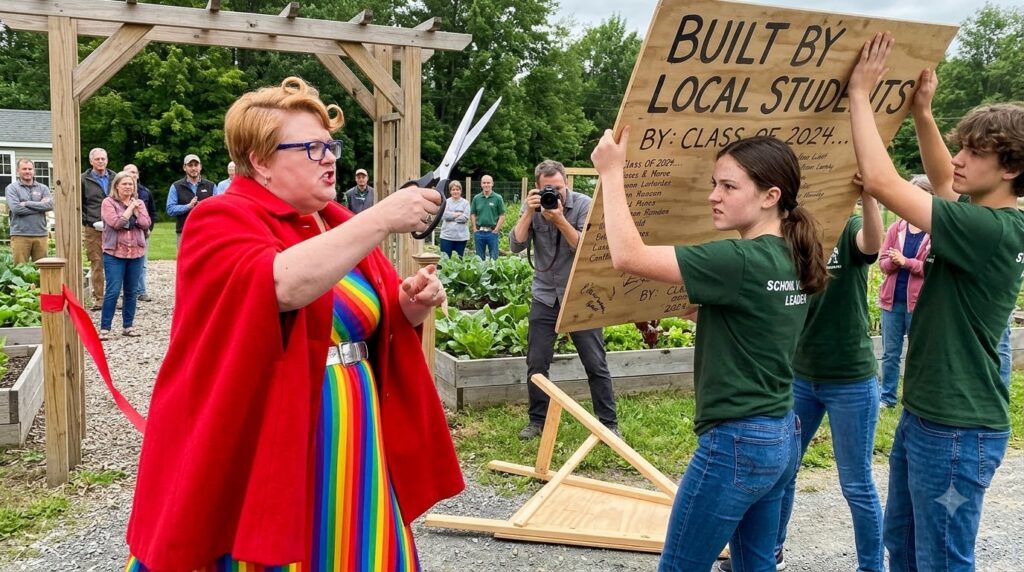
Margaret, fifty-three, was difficult to overlook even on an ordinary day. She had a very large frame, a short strawberry-blonde pixie haircut with one carefully curled lock over her forehead, and square blue glasses. Today, she had dressed for maximum attention: a flowing red cape coat, a rainbow-striped dress, an enormous silver belt, and bright-yellow boots.
She had arrived less than ten minutes earlier.
She had not planted a seed, hammered a board, or carried a single bag of soil.
Yet she stood beneath the arch as if the entire garden belonged to her.
Before Emily could recover the scissors, Margaret swung her free elbow toward the wooden recognition board standing beside the entrance.
The board carried the names of twenty-three students who had helped build the garden.
Across the top, in large green letters, were five words:
BUILT BY LOCAL STUDENTS.
Margaret struck its upper corner.
The lightweight board tipped backward, slipped off its stand, and crashed onto the gravel.
Emily jumped away as the wooden frame landed near her shoes.
A startled gasp traveled through the crowd.
Margaret barely looked down.
“Forget their names! I’m the reason we’re here!”
Her voice carried across the vegetable beds and toward the little white church on the neighboring property.
Emily felt her face burn.
For eleven months, she had worked on this project after school, on weekends, and through a summer that had been unusually hot by Vermont standards.
She remembered the first Saturday when only four students had shown up. She remembered blistered palms, bent nails, and a truckload of donated lumber that had arrived three hours late.
She remembered her grandfather kneeling in the dirt, teaching them how to level a raised bed properly.
And now this woman had knocked their names into the gravel.
“We built every single garden bed!” Emily shouted.
Margaret dismissed her with a wave.
Then she turned toward Daniel Brooks, the forty-year-old community photographer standing several feet away.
“Well? Aren’t you going to take my picture?”
Daniel lowered his camera slightly.
He had been hired by the town’s community development committee to document the opening. His assignment was straightforward: photograph the student volunteers, the ribbon-cutting, and the residents who had supported the project.
Margaret was not on his list of speakers.
She wasn’t even on the planning committee.
Daniel glanced at the fallen board.
Two students, sixteen-year-old Tyler Morgan and eighteen-year-old Sophie Bennett, had already hurried forward. They crouched beside the frame, carefully lifting it from the gravel.
Emily joined them.
Together, they raised the recognition board above shoulder height.
Margaret noticed the movement and stepped directly between them and Daniel’s camera.
She spread her red cape wide.
For a moment, she looked like a furious theater performer attempting to block the final scene of a play.
Daniel simply adjusted his angle.
He raised his camera toward the three students holding the board.
The names came into view above Margaret’s head.
Margaret turned.
Her expression changed from smug satisfaction to outrage.
She thrust the scissors upward.
“Put that down! This is MY picture!”
Daniel pressed the shutter.
Click.
The photograph captured everything: Margaret’s furious face, the scissors pointed toward the sky, the students standing firmly behind her, and the recognition board held high enough for every name to be seen.
It also captured something Margaret had not noticed.
Behind the students, near the wooden arch, stood seventy-four-year-old Thomas Parker.
Emily’s grandfather.
His face was pale.
His hands were trembling.
Thomas had spent forty-two years teaching industrial arts at Maple Creek High School. He had helped design the garden beds and had supervised their construction.
He was also the man who had donated the land.
Margaret had spent the previous month telling people that she had personally secured the property.
Thomas had remained silent because he disliked public arguments.
But when the recognition board hit the ground, something in him changed.
He stepped forward slowly.
“Margaret,” he said, his voice quiet but unmistakably firm. “You need to leave.”
For the first time that afternoon, Margaret seemed genuinely surprised.
Then she smiled.
It was not a friendly smile.
“Thomas, I think you’d better be careful about what you say in front of these people.”
Emily looked between them.
Her grandfather’s expression told her there was more to this than a ruined ceremony.
And when Margaret added that the town council would soon be reviewing the garden’s ownership, Emily felt a cold knot form in her stomach.
The ceremony had lasted barely ten seconds before everything went wrong.
But the real fight over the garden was only beginning.