
CHAPTER 8: THE WARDENS LEDGER
The line didn’t shear cleanly. When the hydraulic pressure hit ninety pounds, the cylinder casing cracked along a vertical seam that had been weakened by decades of hard-water scaling. The metal tore open with a sharp, high-pitched scream, spraying a needle-thin stream of pressurized fluid straight across my forearm, cutting through the heavy nylon of my civilian jacket like a razor.
I didn’t let go of the carbon seal. I leaned my weight into the valve body, feeling the cold, greasy iron vibration translate directly through my bones as the internal locking pin finally snapped under the hydraulic spike.
Down the gallery, the iron gate didn’t slide; it fell, the modified deadbolts giving way with a concussive bang that shook the stone lintels. The five federal whistleblowers were out before the drainage water reached their knees, their rotting civilian woolens heavy and trailing black limestone mud through the trench. They didn’t ask questions. They followed the path I’d carved through the dumbwaiter shaft, scrambling upward into the steam-choked carcass of the laundry facility while the lower gallery began to fill with the unpurified gray wash from the main pond.
I didn’t go up with them.
The counselor paused at the lip of the lift shaft, his heavy silver signet ring catching the dull amber glare of a dying security cell. “The central corridor is locked from the bubble, investigator. If you go up the administration stairs, you’re walking into a live tactical sweep.”
“The Warden didn’t close the books on the regional ledger yet,” I said, my voice dry, tasting of sulfur and the copper tang of my own bleeding fingers where the hydraulic spray had peeled the skin back from the knuckles. “If those warrants don’t leave the facility tonight, the transport deletions become permanent records by sunrise.”
He didn’t try to pull me back. He knew the math of the house as well as I did. He turned, his shoulder pushing the younger systems analyst toward the broken ventilation grille, leaving me alone at the base of the administrative stairwell.
The staircase was solid granite, thirty steps that led from the wet dark of the foundations directly into the rear alcove of the executive suite. The air here didn’t smell of laundry bleach or sulfur; it was cool, dry, heavily conditioned, carrying the scent of expensive floor wax and old institutional paper. My civilian boots left dark, watery rings on the desaturated marble tiles as I reached the top landing.
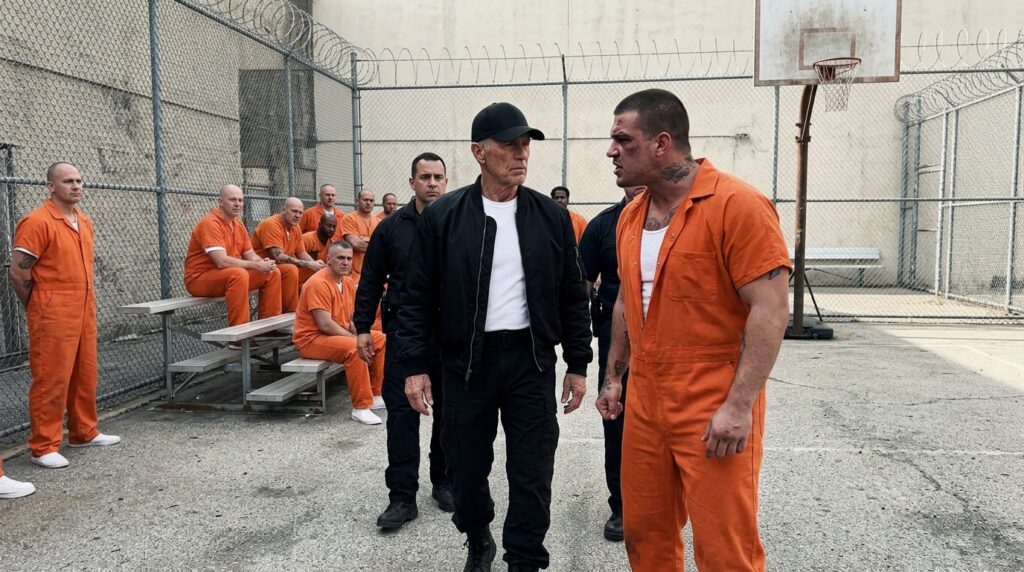
The master alarms were still howling through the inner walls, a low-frequency pulse that made the glass panels in the visiting alcove vibrate within their rubber gaskets. The facility was eating itself from the inside out. Through the reinforced observation slits, I could see the reflection of searchlights sweeping across the empty basketball stanchions in the yard. The evening shift hadn’t just rotated; they had withdrawn to the perimeter, leaving the cell blocks to clear themselves before the state transport vehicles arrived to clean up the margins.
The door to the Warden’s private office was unlocked.
She was sitting behind a massive desk of polished slate, her uniform cap placed precisely on the corner of an empty blotter sheet. She didn’t have a weapon in her hand. She was watching a row of eight small cathode-ray monitors that tracked the deployment of the auxiliary guards along the North Block perimeter. The green light from the screens cast sharp, hard lines across her clean-shaven face, making her eyes look like small, dead coins in the gloom.
“You’re nine minutes behind the schedule, investigator,” she said, her voice retaining that smooth, unbothered cadence that had come through the laundry room speaker. She didn’t look up from the glass. “The maintenance logs indicated the line pressure should have cleared the utility gallery by two-fifteen. You must have used the manual bypass.”
“The bypass works fine when the packing glands are manual,” I said, dropping the wet canvas sack onto the center of her slate desk. The carbon ledgers inside let out a heavy, damp slap that left a dark ring on the stone surface. “The Assistant Warden’s payroll details are inside. They won’t match the federal manifests you’ve been sending to the logistics trust.”
The Warden finally turned her head, her jawline tightening as her eyes found the grease-pencil cross on my unmanifested intake copy. “The logistics trust doesn’t read the financial sheets, mister. They read the entry logs. And according to the mainframe, your transport order was canceled forty-eight hours ago by a regional clerk who died three years ago in a private sanitarium.”
She reached down, her fingers sliding a heavy, double-walled steel dispatch box out from the recessed drawer beneath the desk. The surface was painted a dull military olive, the serial number on the latch plate matching the exact prefix stenciled on the blue junction valve in the sub-level gallery: 42-A.
“The real warrants aren’t financial records,” she whispered, her hand resting on the lock cylinder without turning it. “They’re executive deletions signed by three separate directors who sit on the board of Logistic Solutions. Every man down in that vault was a senior auditor who realized that the corporate fleet was moving cargo between international ports without going through the customs house at the capital. If those men leave this facility alive, the monopoly drops by forty percent before the morning trading session opens.”
She wasn’t defending her greed; she was maintaining the structure. In her mind, the elimination tier was a necessary extension of the state’s logistical infrastructure, a clean, silent drainage channel that kept the machinery of the regional economy from throwing a rod.
“The lane is too narrow for a negotiation, Warden,” I said.
I didn’t draw a weapon. I reached across the table, my hand closing over the steel dispatch box before her fingers could engage the secondary safety toggle. My knuckles were raw, the blood from the hydraulic cut smearing across the olive-drab paint, but my grip was sovereign. The weight of the box was forty pounds of solid iron and paper—the exact weight of twenty men’s lives hidden behind an administrative seal.
The Warden didn’t scream for the backup guards. She looked at the blood on the slate desk, then up at my face, her pupils reflecting the green grid of the security screens behind me.
“You can’t walk them out through the gate,” she said, her voice dropping into a dry, precise whisper that matched the sound of the wind through the razor wire outside. “The perimeter guards have orders to shoot anything that moves in civilian clothes. As far as the state is concerned, the riot has already crossed the threshold of the administration building.”
“Then we’ll use the main yard,” I said, dragging the steel box off the desk. “The big man by the basketball hoop left a lot of dust in the lane. It’s going to take them a long time to clean it up.”
I turned toward the rear exit that led to the visiting alcove, my heels striking the marble with a heavy, deliberate rhythm. Behind me, the cathode-ray tubes flickered twice before dying completely as the primary circuit breakers down in the boiler room finally dissolved under the live steam. The green grid vanished, leaving the office in total, desaturated dark, save for the white sweep of the perimeter searchlights cutting through the reinforced glass like a cold razor.
The ultimate reality of the house was out in the open now, the decoy secret broken, but the horizon was still locked down behind five tiers of reinforced concrete and four hundred yards of unwashed steel wire.








