
CHAPTER 2: INTAKE VERIFICATION
The grease-pencil cross on the intake form was still wet enough to smear if a sleeve caught the edge of the clipboard. It wasn’t an administrative error; it was a deliberate omission, a clean subtraction of legal existence. In a facility built on five hundred tons of reinforced aggregate, an unsigned entry sheet meant nobody was accountable when the cell door remained deadbolted during a fire drill.
The intake officer didn’t look up from his terminal. He was a small man named Miller, his scalp showing pink and slick through a sparse gray comb-over that smelled faintly of cheap pomade and stale tobacco. His fingers hit the keys with a dull, rhythmic clack that sounded like dry gravel falling into an empty bucket. Every three or four strokes, the old cathode-ray tube monitor flickered, casting a pale, greenish hue over the flaking institutional paint of the alcove walls.
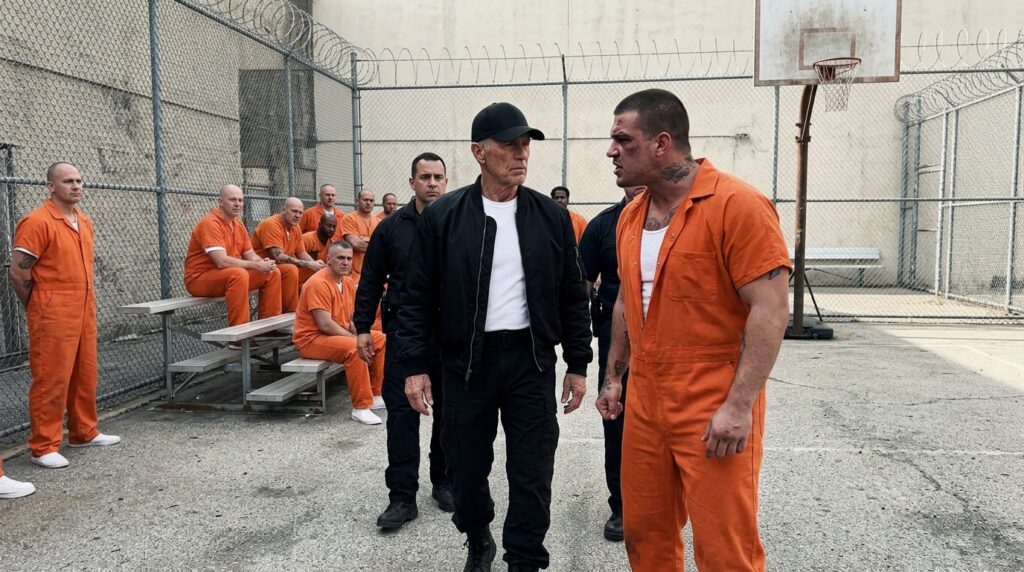
“Civilian garments,” Miller said, his teeth clicking together on the final syllable. He didn’t state it as a question. He wrote it down in a ledger whose leather binding had cracked along the spine, revealing the coarse gray gauze underneath. “One black bomber jacket, heavyweight nylon. One white knit undershirt. Cargo trousers, dark. Boots, non-standard issue. No personal effects listed on the manifest. No wallet. No identification.”
“The authorization was cleared out of the regional office three days ago,” I said. My voice was flat, keeping the cadence short to match the transactional silence of the corridor behind us. “Check the secondary secure terminal. The one unlinked from the state mainframe.”
Miller’s fingers hovered over the keyboard for a fraction of a second. The motion was so subtle another man might have missed it, but the sudden tightening of the skin around his jawline told the real story. He knew about the secondary terminal. He also knew exactly why it was sitting beneath a canvas dust cover in the Assistant Warden’s private office instead of down here in the booking cage.
“There is no secondary terminal on this shift, visitor,” Miller replied, his voice dropping into that rhythmic, bureaucratic drone used by men who have spent twenty years hiding behind state guidelines. He finally raised his eyes, and they were yellowed at the corners, the pupils small and hard like bird shot. “What isn’t on the main screen doesn’t exist within these coordinates. As far as the Commonwealth is concerned, you’re an unscheduled transport drop with a defective movement order. That means you stay in the intake tier until someone with a gold badge signs off on the custody transfer.”
Behind me, the guard who had escorted me from the yard shifted his feet. The heavy leather of his utility belt let out a dry, rhythmic creak as he leaned his shoulder against the iron bars of the cage. He was the one who had seen the big man hit the bleachers; he knew the weight I carried in my boots, but his loyalty belonged to the shift schedule, not to a civilian without a paper trail.
“We can’t leave him in general holding, Miller,” the escort guard said, his tone casual but his eyes fixed on the hallway behind the desk. “Not after what happened by the basketball hoops. The North Block boys are already passing the word through the pipe-chase. If he’s down there when the evening shift rotates, the whole tier goes loud.”
“Then he goes to Unit Four,” Miller said. He didn’t hesitate. He pulled a rusted iron key from a drawer beneath the desk—a long, double-bitted piece of steel that had been worn smooth by decades of oil and skin. He dropped it onto the counter with a heavy, metallic clink that echoed off the low concrete ceiling. “Solitary intake. No privileges. No yard rotation until the administrative discrepancy is corrected from the top.”
I looked at the key. The notch on the third bitt was filed down manually, a crude modification designed to bypass the secondary safety lock on the isolation cells. It was an old trick used in maximum-security houses when the staff wanted to ensure a door could be opened from the outside without triggering the master indicator board in the control bubble.
“Who ordered the cross on the sheet, Miller?” I asked, my hand resting flat on the cold laminate of the counter, just three inches from the clipboard.
The old clerk froze. The clacking of the terminal keys had completely stopped now, leaving only the low, three-hundred-hertz hum of the fluorescent tube overhead. A single bead of sweat broke from his hairline, tracing a slow line down the side of his nose before stopping at his gray mustache.
“The sheet comes down from the front office exactly how it’s supposed to come down,” Miller muttered, his voice losing its bureaucratic rhythm, becoming sharp and defensive. “I don’t question the margins. I just ink the numbers. Move along before I log you as non-compliant.”
I didn’t press him. In an environment defined by rusted surfaces and institutional inertia, pressing a man like Miller only made him tighten his grip on the ledger. Instead, I picked up the heavy iron key myself, the cold metal biting into my palm with an old, familiar weight. The iron had an odor—iron and zinc and old grease—the smell of a cage that had held fifty generations of desperate men.
“Show me the tier,” I said to the escort guard.
He didn’t answer with words. He reached out and grabbed the iron gate, pulling it open with a long, screeching groan that scraped against the ears like a file on a saw blade. The green paint on the bars was flaking off in long, curled scabs, revealing the pitted dark metal underneath.
As we stepped into the narrow, unlit corridor that led toward Unit Four, the heavy door behind us swung shut with a definitive, mechanical thud that rattled the glass in the booking cage. The light from the terminal screen disappeared, replaced by the amber glow of a single low-wattage security bulb thirty feet down the passage.
The floor here was uneven, the concrete pitted and stained with decades of chemical wash that had eaten through the sealant. My boots made a dry, hollow sound against the stone. Every twelve feet, a narrow slit in the wall revealed a view of the pipe-gallery—a dark, wet space filled with the hiss of steam lines and the steady, rhythmic drip of alkaline water hitting uninsulated iron.
“You made a lot of work for a lot of people out there today,” the guard said, his voice muffled by the narrowness of the walls. He didn’t turn his head around to look at me, but his hand stayed hooked near his restraint canister. “Big Curtis was supposed to stay on that block until the winter hearings. Now he’s in the infirmary with a broken jaw, and his people are going to want to know who paid for the strike.”
“They can ask the Assistant Warden,” I said, watching the way his shoulders twitched at the title. “He seems to be the one managing the books this month.”
The guard stopped outside a heavy, solid-steel door that bore the number 412 in fading white stencil. The iron surface was cold to the touch, sweating with the humidity that rose from the lower utility levels. There was no observation window, only a narrow food slot secured by two external slide bolts.
“This is you,” the guard said, reaching for the key in my hand. “No electronics. No civilian belts. Jacket stays on the hook inside. If you need water, use the basin. Don’t touch the emergency valve unless you want fifty gallons of gray water on your mattress.”
He turned the key in the lock. The tumblers fell with a heavy, double-clack that signaled the engagement of the modified deadbolt. As the door swung open, the air that came out was thick, smelling of old lye and the specific, metallic tang of unwashed copper pipes.
I stepped into the dark of the cell, my heels catching the edge of the iron bunk frame. Before I could turn to check the hinge alignment, the door was slammed shut behind me. The deadbolt engaged with a final, echoing strike that vibrated through the concrete floor and directly into the soles of my boots.
The darkness was almost total, save for a three-inch line of amber light that filtered through the gap beneath the door. I stood motionless for sixty seconds, letting my eyes adjust to the low-contrast environment, my ears sorting through the ambient noise of the block—the distant clank of a steam pipe, the shuffle of feet three levels up, and the distinct, rhythmic scratching of something metallic moving inside the ventilation shaft right above my head.
I reached out into the dark, my fingers finding the rough concrete of the rear wall. The surface was flaking, the lime dust coming off on my fingertips like flour. But three inches below the corner vent, my knuckles struck something different—a small, hard ridge of plastic tape hidden beneath a layer of gray primer.








