
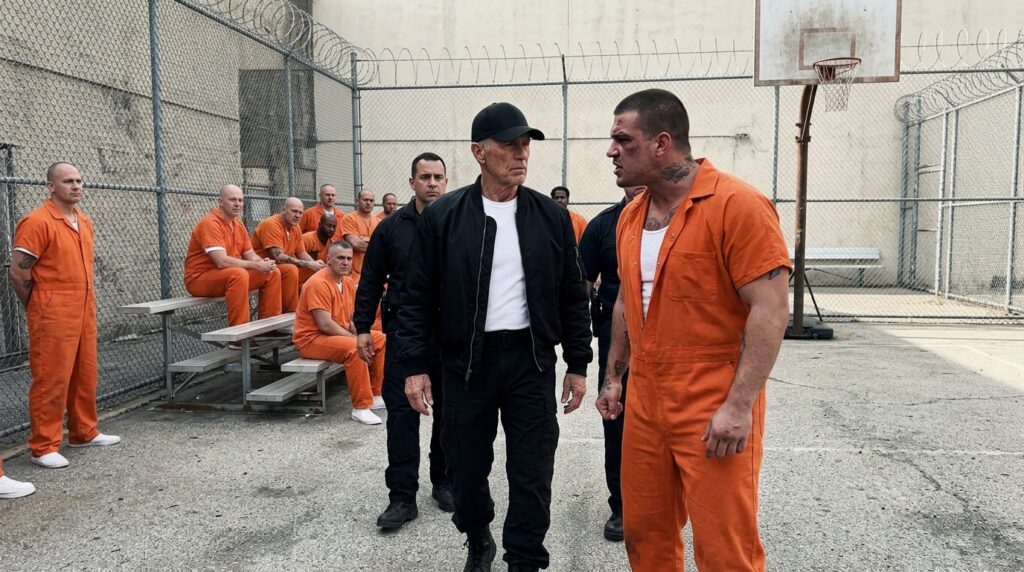
CHAPTER 1: THE FIRST STRIKE
The heat in the yard smelled of fried transmission fluid and dead grass. It came off the asphalt in waves, thick enough to blur the silhouettes of the men clustered around the rusted steel of the basketball stanchions. They didn’t move. They just watched the heels of my civilian boots drag a pair of thin, straight lines through the limestone dust.
“Keep walking, old man,” the guard behind me muttered. His thumb was hooked over the top of his heavy nylon utility belt, right next to the expired canister of chemical restraint. His uniform shirt was dark with sweat between the shoulder blades, a gray stain shaped like a spade. “Center line. Don’t look at the fences.”
I didn’t need to look at the fences to know the razor wire was unwashed, catching the glare of the noon sun like teeth. My civilian bomber jacket felt like a sheet of lead across my shoulders. Every stitch of it held the grease of five states I’d left behind to get to this dirt lot, and right now, the fabric was sticking to the white cotton of my undershirt. I kept my chin level with the third button of the guard’s collar ahead of me. One foot, then the next. Three miles of concrete wall enclosing four hundred men who spent their days counting the cracks in the aggregate.
Then the shadow came.
He was twenty-eight, maybe thirty, with a neck like an unbarked pine log and an orange jumpsuit that had been torn away at the seams to give his shoulders room to breathe. A map of blue ink crept up his throat, disappearing into a jawline that had taken three separate breaks and healed crooked every time. He didn’t drop into a stance. He just stopped, six feet out, directly where the limestone dust gave way to the sun-baked tar.
“You think that jacket makes you untouchable in my yard, old man?” His voice was thin, reedy, dried out by tobacco and institutional lime. He stepped closer, the smell of sour onions and cold grease coming off his skin.
The guard behind me stopped. I could hear the leather of his holster creaking as his weight shifted backward, away from the lane. No one called for a backup. No one blew a whistle. The silence that hit the yard was absolute, the kind of quiet that only happens when three hundred men realize the rules have been temporarily suspended for their entertainment.
The big man crowded the gap. He didn’t want a fight; he wanted a submission he could show to the bleachers. He leaned his weight forward, his chest catching the front of my jacket, pushing me down. My left knee hit the crushed stone, the sharp gravel biting through the black cargo pants until it found the bone. The heat from the ground came through the fabric instantly, dry and smelling of old iron.
“Look up when I’m talking to you,” he whispered.
I stayed down for two seconds. I looked at the dust between his boots. A small piece of green bottle glass was embedded in the tar right beneath his left arch, worn smooth by thousands of standard-issue soles. I didn’t breathe through my nose. I kept my mouth slightly open, letting the dry air ground me.
When I moved, I didn’t use the civilian jacket for leverage. I drove straight up from the right heel, catching him before his weight could reset. My right boot found the soft pocket behind his left knee, a clean, short snap that broke his balance before he could swing his arms. As he tilted, I drove the palm of my hand into the center of his chin—not a punch, just three pounds of meat and bone meeting the nerve cluster at forty miles an hour.
The sound was like an axe hitting dry cedar.
He went backward three feet, his boots skidding through the limestone before his shoulders took the brunt of the lower metal bleacher rail. The steel groaned, a dull, vibrating ring that stayed in the air long after his head hit the dirt.
I stayed centered in the lane. My jacket hadn’t even unzipped. Behind me, the guard’s hand was still hovering over his belt, his fingers twitching against the nylon. Across the yard, by the chain-link partition, a middle-aged man in an identical orange suit lowered his water cup, his eyes locked on the dust rising around the big man’s head.
The big man didn’t get up. He lay there, his fingers curled into the gravel, a single drop of dark, unoxidized blood starting to form at the corner of his nostril.
“Moving,” I said to the guard ahead of me. I didn’t look back at the bleachers. I kept my eyes on the heavy iron door at the end of the lane, where the shadow of the cell block overhang began.
The guard didn’t move for three seconds. Then, with a slow, mechanical jerk of his chin, he stepped forward, his boots crunching into the limestone. As we crossed into the shadow of the threshold, the cool air of the interior hit my face, smelling of damp disinfectant and wet wool.
I reached into my pocket, my fingers brushing against the small brass buckle stitched into my seam. My skin was dry, but the metal was cold.
“Warden’s waiting,” the guard said, his voice lower now, almost a whisper against the concrete corridor. He didn’t look at my face as he pulled the heavy iron lever to unlock the inner gate, but his hand stayed six inches away from his side. “But she didn’t say nothing about you keeping that coat.”
Across the desk in the reception alcove, an open clipboard held a single yellowed carbon copy of an intake sheet—and where the federal authorization signature should have been, there was only a black grease-pencil cross.








