
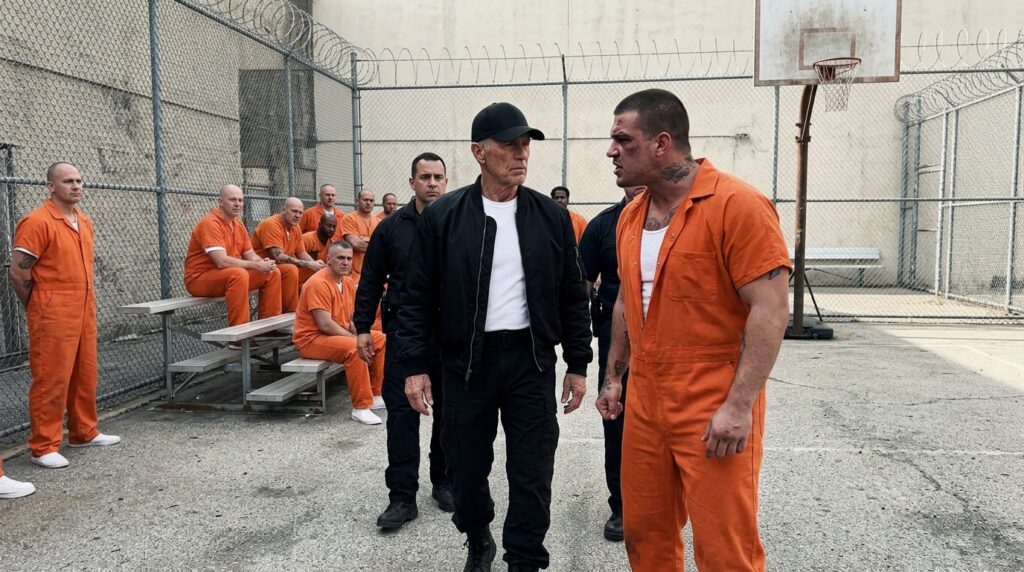
CHAPTER 3: THE BROKEN BALANCE
The ridge of plastic tape beneath the gray primer didn’t have time to reveal its shape. The air in the pipe-chase on the other side of the wall suddenly compressed, a cold draft whistling through the ventilation grille with the sharp smell of burnt industrial wiring. Then came the heavy, unhurried thud of four pairs of steel-toed boots hitting the concrete floor of the intake corridor.
There was no warning siren. No three-tone chime announcing a midnight count.
A heavy iron bar rattled against the exterior slide bolts of cell 412, the sound raw and immediate in the enclosed space. The double-bitted key turned in the modified mechanism with a dry, mechanical screech that felt like iron shavings being ground into my teeth. The door swung open fast, hitting the rubber wall-bumper with a dull thud that sent a small shower of dried lime dust down from the lintel.
“On your feet, civilian,” a voice commanded from the threshold.
It was a guard captain named Vance. He didn’t have a tactical helmet on, nor did he carry a standard wooden baton. Instead, he wore an old leather jacket over his unbuttoned uniform shirt, his hands buried deep inside the pockets where the silhouette of a compact, unissued rimfire automatic showed against the hide. Behind him stood three senior tier guards, their faces desaturated by the amber security bulbs, their breath smelling of cold coffee and zinc lozenges.
I didn’t rush to get up from the iron bunk. I slid my legs over the edge of the frame slowly, my heels tracking the layout of the pit-marks in the floor. “The booking sheet said twenty-four hours of administrative hold before a tier assignment.”
“The booking sheet is currently sitting in a shredding bin down in the basement,” Vance said, his voice dropping into a low, dry rasp that barely carried past the doorframe. He jerked his chin toward the hallway. “Get moving. We’re taking the utility stairs before the tower shift rotates.”
The three guards stepped into the small cell, their bulk filling the room until the air felt scarce and oily. They didn’t touch me, but they kept their elbows tucked close to their sides, their shoulders squared to block any lateral movement toward the ventilation shaft. I walked between them, the civilian bomber jacket swishing against the coarse fabric of their trousers as they guided me out into the narrow corridor.
The prison was entirely different at two in the morning. The daytime roar of five hundred men screaming across the tiers had subsided into a low, vibrating hum—the collective breathing of a locked-down population mixed with the constant, distant thrum of the facility’s auxiliary generators. We bypassed the master control bubble entirely, taking a sharp left through an unmarked fire door whose hydraulic arm had been disconnected and tied off with copper wire.
We descended a flight of narrow, spiral iron stairs that led deeper into the subterranean foundation of the complex. The walls here were unpainted, rough-poured concrete showing the grain of the wooden forms used to cast them forty years ago. Water dripped from the overhead conduit lines, leaving long, rust-colored streaks that looked like dried grease along the seams.
“You broke the balance,” Vance said as we hit the bottom landing. He stopped under a bare hundred-watt bulb that was caked with grease and dead moths. He turned to face me, his hands still deep in his leather pockets. “Big Curtis was the only thing keeping the laundry detail moving fifty thousand pounds of linen a week without a labor strike. The front office had a deal with him.”
“The front office has a deal with a lot of people,” I said, my back resting against the cold concrete of the stairwell. “Some of those deals involve payroll slips that don’t go through the state treasury.”
Vance’s left eye twitched, a micro-expression that lasted less than a syllable before his face settled back into a mask of hardened pragmatic indifference. “You think you’re the first operative they’ve sent down here with a civilian coat and a blank manifest? Every two or three years, some committee in the capital wants to audit the operational margins. They send an investigator who doesn’t mind getting his boots dirty. They think they’re going to find a box of cash or a ledger with double columns.”
“And what do they actually find, Captain?”
“They find out that the walls are five feet thick,” Vance whispered, leaning in until I could smell the tobacco juice on his breath. “They find out that if thirty guards don’t show up for work tomorrow morning because the local union is angry about the overtime adjustments, the state has to call in the National Guard to clean up the blood. The Assistant Warden doesn’t run this yard because he’s greedy, mister. He runs it because he’s the only one who knows how many cartons of cigarettes it takes to keep the North Block from burning down the boiler room.”
The three guards behind him didn’t look at me; they were monitoring the corridors on either side of the junction, their ears tuned to the distinct sound of the steam valves clicking in the dark. They were part of the machine, as much a part of the structural geometry as the rusted iron tie-rods holding the foundation together.
“So where are we going?” I asked, my fingers sliding into my cargo pocket, feeling the small, hard outline of the brass buckle stitched into the lining.
“We’re going to see if you’re as smart as you are fast,” Vance said. He pulled his hand out of his pocket, holding a small brass padlock key between his thumb and forefinger. It was the companion piece to the file-down key Miller had dropped on the counter. “The Assistant Warden wants to see if you can read an invoice. If you can, you might survive until the weekend hearings. If you can’t, Curtis has four brothers on the evening kitchen crew who are very particular about how the meat-cleavers are sharpened.”
He stepped toward a heavy, reinforced door that bore a fading stenciled sign reading MAIN LAUNDRY – AREA B. The bottom of the iron frame was blackened by decades of detergent overflow and stagnant moisture, the metal flaking away in long, brittle layers that crumbled like dried leaves if touched.
Vance didn’t open the door himself. He handed the brass key to the youngest guard, then turned back to me, his face half-hidden by the harsh shadow cast by the bare bulb overhead.
“If you find what you’re looking for in there, remember one thing,” Vance said, his voice dry like sand shifting in a pan. “The paperwork down here doesn’t belong to the state. It belongs to the people who have to live inside the walls after your transport order expires.”
The guard turned the key in the lock, and the heavy door slid back into the wall with a hollow, metallic groan that resonated through my boots. The air that poured out of the dark space was warm, heavy with the suffocating scent of industrial chlorine and wet canvas.
I walked into the room without looking back, my boots gripping the slippery tiles of the floor. Behind me, the iron door didn’t just shut—the electronic deadbolts engaged with three separate, distinct clicks that cut off the amber light from the corridor entirely. I was alone in the dark, surrounded by thirty industrial washing drums that looked like silent iron furnaces in the gloom, and the scratching sound inside the ventilation shaft had just started up again, right above the main water intake manifold.








