
CHAPTER 7: THE RUSTED LATHE
The three-horsepower electric motor didn’t start with a soft hum; it cracked to life with a deep, inductive growl that shook the floor plates of the base maintenance shop. The heavy leather drive belt slapped rhythmically against the iron pulleys, throwing the bitter, sharp scent of old grease and cold sulfur cutting oil into the damp air.
Mac stood foreground left, his work boots planted deep into the layer of dried metal shavings that covered the concrete floor. His large, calloused hands were wrapped around the manual cross-feed lever of an ancient LeBlond engine lathe. The machine was a massive wedge of rusted, grey-painted iron, a relic from the pre-digital era when tolerances were measured by physical dial markers rather than software algorithms.
“Keep the coolant line open, Miller,” Mac commanded. His voice didn’t rise to a shout, but its low, raspy cadence tore beneath the scream of the cutting tool. “If that polymer shell catches too much friction before the blade sinks into the sleeve, it’ll melt to the spindle and blind the lens-train completely.”
“Coolant is flowing, Msgt,” Specialist Miller said, standing foreground right. His hands were braced against the iron bedway, his face splattered with a fine mist of water-soluble oil. He was holding the flexible zinc nozzle steady, directing a milky stream of fluid directly onto the nose of the XM-30 prototype. The scope was clamped tightly inside the four-jaw chuck, spinning in a blur of gray plastic and silver aluminum.
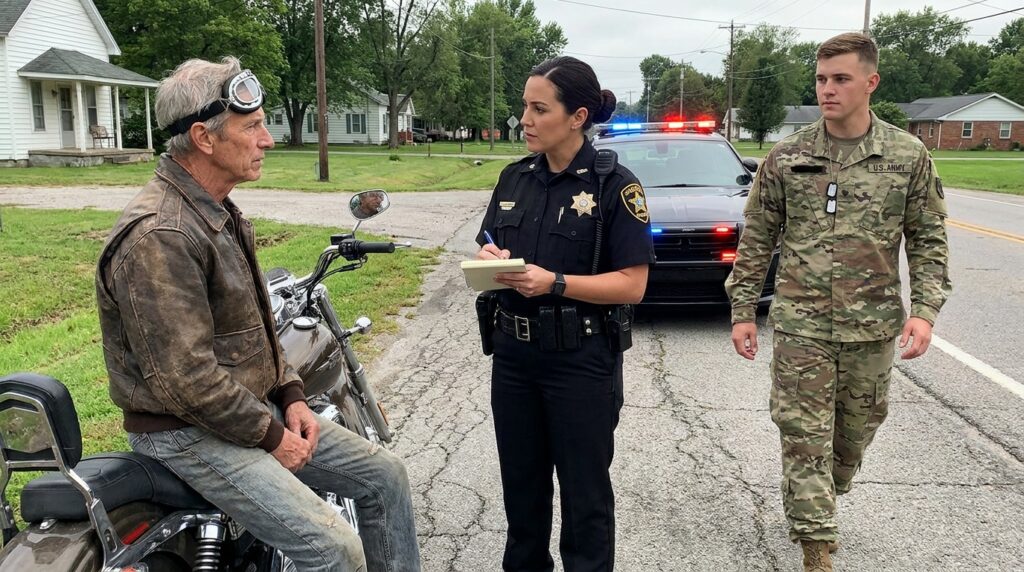
Behind them, the heavy timber double doors of the shop shuddered as a military police vehicle came to a hard stop in the gravel lane outside. The red and blue strobe lights cut through the rain-streaked windowpanes, casting long, fractured shadows across the back wall where Sergeant First Class Rodriguez stood guard with his arms crossed over his chest.
“They’re out there, Mac,” Rodriguez said without turning his head. His eyes were fixed on the door handle. “Vance brought the base provost marshal with him this time. They’ve got a formal injunction from the regional procurement command. They’re giving us two minutes to pull the power switch.”
“A machine doesn’t care about an injunction, Sergeant,” Mac muttered. His ice-blue eyes were narrowed, tracking the micro-movements of the cutting edge as it advanced across the face of the proprietary casing. “It only cares about the material in front of it.”
With a slow, practiced twist of his wrist, Mac engaged the automatic longitudinal feed. The high-speed steel tool bit made contact with the outer metal shell. Instead of the long, curling ribbons of silver alloy that a true military-grade magnesium housing should throw, the lathe bit tore loose a dry, powdery spray of desaturated gray composite. The shavings didn’t look like metal; they looked like charcoal dust, dropping into the oil pan with a dull, granular hiss.
“Look at the chip color, son,” Mac said to Miller, pointing his oil-stained thumb toward the point of impact. “That’s not machined material. That’s commercial resin injection-molding. They painted the outer skin with aluminum flake to fool your logistics scale, but the structural core is nothing but household glue and charcoal filler.”
“Stop the machine!”
The shop doors banged open against the brick interior wall, letting in a cold gust of rain and the sharp smell of wet wool. Derek Vance rushed into the light of the overhead lamps, his white lab coat soaking wet at the shoulders, his face distorted in a mixture of terror and corporate fury. Elena Vance followed immediately behind him, her aluminum briefcase held low, her silver-rimmed glasses clouded with mist. Two military policemen stood in the threshold, their hands resting cautiously on their duty belts as they looked at the massive iron lathe.
“This is property destruction under a federal defense contract!” Vance screamed, his voice cracking over the roar of the motor. He lunged toward the main electrical breaker box on the wall. “That unit is part of a certified tier-one deployment batch! You’re destroying the evidence of a system verification!”
“The evidence is already on the floor, son,” Mac said. He didn’t turn the switch. Instead, he reached down and pulled the feed clutch lever back, stopping the carriage precisely three inches deep into the center of the scope.
The lathe spindle slowed to a heavy, clanking halt.
With a practiced motion of his thick fingers, Mac reached into the open cut of the housing, using his short offset driver to pry the split halves of the outer casing apart. The plastic shell cracked open with a dry, hollow snap, revealing the hidden interior core of the device to the glare of the shop lamps.
There was no magnesium alloy sleeve. There was no iron recoil dampener. The internal objective lens-train was held in place by a series of thin, brittle polymer rings that had already begun to warp and yellow from the heat of the cutting tool. But beneath the lower mounting plate, embedded directly into the structural bed of the resin, sat a small piece of scrap steel that had been stamped with an original 1982 blueprint code. On the bare metal, scrawled in faded blue ink that had been preserved by old grease, were the manual calculations for an entirely different weight profile—the original contract specifications written forty years ago by MacAllister himself.
“Elena,” Vance whispered, his voice suddenly losing its transactional edge, becoming thin and hollow as he looked at the exposed interior. “The software logs… the simulation profile didn’t show…”
“The simulation was programmed to match the fake weight, Derek,” Elena Vance said, her corporate composure finally shattering as she looked at the faded blue ink on the internal steel plate. She didn’t raise her briefcase; her fingers simply loosened, letting the aluminum handle slide down against her side. “The factory manager substituted the magnesium core to cover the cost of the digital component overrun. They used the old contract codes to bypass the arsenal inspection gate because they knew the legacy database didn’t have a cross-reference for the composite density.”
Miller stepped away from the lathe, his face completely rigid as he looked from the exposed plastic rings to Vance. The active-duty soldier didn’t yell; his voice had a cold, quiet discipline that carried more danger than a live round. “We took these into the field at Bliss, Mr. Vance. We told you the tracking was throwing five mils of drift after the second magazine. You told us it was a software patch.”
“The patch covered the thermal expansion,” Mac said softly, his voice cutting through the damp chill of the maintenance shop as he wiped his calloused hands on a piece of waste rag. He looked at the two military policemen standing in the doorway, then back to the yellowed invitation paper on the workbench. “They wanted you looking at the computer screen because as long as the digital crosshairs looked straight on a monitor, nobody would notice that the iron sights were missing. The General knew they were building a phantom rifle. He just needed a pair of hands old enough to find where they buried the truth.”
The room went completely quiet except for the slow, rhythmic drip of the cooling oil falling off the iron bedway into the pan below. The last layer of the deception had been torn wide open on the rusted lathe, leaving the civilian contractors standing in the shadow of a master who had measured reality with his fingers before their code had ever been written.








