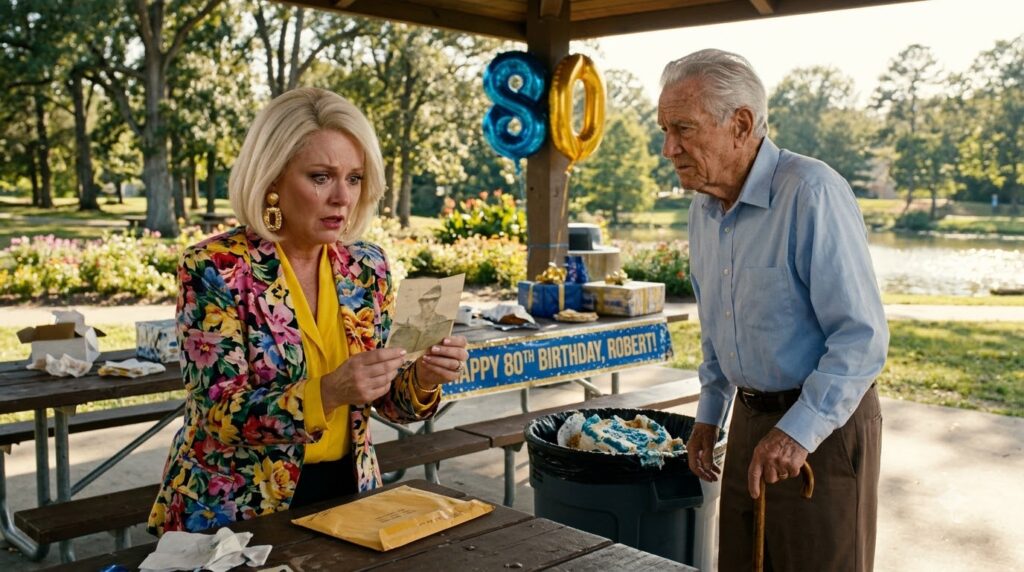
Chapter 9: What Remains After the Apology
The months that followed were quieter.
Karen did not return to the HOA board.
She stopped attending meetings unless an issue directly affected her home.
She began spending more time with Thomas, helping him restore old furniture in their garage and visiting her mother, who lived forty miles away.
The changes were not immediate or effortless.
Sometimes Karen still caught herself becoming impatient when a neighbor parked too close to her driveway or someone failed to maintain a flower bed.
She still liked things orderly.
She still had strong opinions.
But she was learning that having an opinion did not give her the right to control another person’s life.
One afternoon, she found an old photograph of her father sitting at the kitchen table.
Daniel was laughing.
Karen couldn’t remember what had amused him.
She studied his face for a long time.
Then she placed the photograph beside a copy of the letter he had written to Robert.
The two images reminded her of different kinds of courage.
One involved surviving a war.
The other involved learning how to live afterward.
Across town, Robert returned to his familiar routines.
He watered his tomatoes.
He fed the sparrows.
He watched baseball games with his grandson.
He continued attending occasional veterans’ gatherings, although he preferred sitting near the back.
The birthday incident gradually faded from public conversation.
The video remained online, but Robert rarely thought about it.
What mattered more was the photograph.
And the letter.
After nearly fifty years, he had recovered a piece of his past.
He and Karen began exchanging occasional notes.
At first, they concerned Daniel.
Karen sent copies of childhood photographs.
Robert identified several men in her father’s military pictures.
He explained where the photographs had been taken and shared small details that had never appeared in official records.
Eventually, their correspondence became less formal.
Karen asked about Robert’s garden.
Robert asked about Thomas’s furniture projects.
There were still boundaries.
Robert did not invite Karen into every part of his life.
Susan remained protective of her father.
And Karen never asked them to pretend the birthday incident had been harmless.
But trust, they discovered, did not always return in one dramatic moment.
Sometimes it grew through ordinary acts of consideration.
The following spring, the Willow Creek HOA introduced a revised community conduct policy.
It required board members to document enforcement decisions, respect municipal boundaries, and provide residents with a clear process for challenging fines.
Michael Harris also organized a volunteer program to help older homeowners with small maintenance tasks.
Participation was voluntary.
Residents could request assistance without surrendering control over their property.
Robert approved of that detail.
He had never liked being treated as helpless simply because he was old.
The program’s first project was repairing the porch steps of a ninety-one-year-old widow named Eleanor Price.
Karen volunteered.
She arrived in work gloves and an old sweatshirt.
Nobody gave her a leadership role.
She carried supplies, swept sawdust, and served lemonade.
When Eleanor thanked her, Karen smiled.
“Glad I could help.”
That evening, Thomas found her sitting on the back porch.
She looked tired.
But peaceful.
“Good day?” he asked.
Karen nodded.
“I think so.”
Thomas sat beside her.
For a while, they watched the sun disappear behind the trees.
Then Karen said something he had waited years to hear.
“I spent so much time trying to make this neighborhood perfect that I forgot it was full of people.”
Thomas took her hand.
She looked toward the old toolbox in the garage.
“Dad would have liked Robert.”
Thomas smiled.
“I think he already did.”
Karen laughed softly.
And for the first time, the memory of her father brought more gratitude than regret.