Chapter 4: The Rules Karen Forgot
The Willow Creek HOA board met in a modest conference room above the neighborhood recreation center.
Karen arrived fifteen minutes early.
She wore a bright turquoise jacket, white slacks, and gold earrings large enough to catch the overhead lights.
Her appearance was immaculate.
Her confidence was not.
Six board members sat around the conference table.
At the far end was Michael Harris, the association’s vice president.
Michael was sixty-seven, a retired civil engineer who had lived in Willow Creek since the first houses were built.
He had often disagreed with Karen’s methods.
Until recently, he had preferred quiet negotiation over public confrontation.
The birthday incident changed that.
Michael opened the meeting with a copy of the association’s governing documents.
“The board needs to establish what authority we actually have,” he said.
Karen crossed her arms.
“I’ve been president for nine years. I know our rules.”
Michael slid a map across the table.
The map showed the Willow Creek subdivision, its privately maintained common areas, and the adjoining municipal park.
The lakeside pavilion was clearly outside the HOA boundary.
“Then you know this park isn’t ours.”
Karen stared at the map.
She had seen it before.
Many times.
But she had always regarded the public park as part of the neighborhood’s overall appearance.
In her mind, that had made it her responsibility.
Michael continued.
“The association cannot reserve municipal property without following the same process as everyone else.”
Another board member, Patricia Lewis, opened a folder.
Patricia was a retired school principal who had joined the board three months earlier.
She had spent the previous evening reviewing HOA expenditures.
“I also have questions about the luncheon you planned.”
Karen stiffened.
“What about it?”
“There was a request to reimburse catering expenses from the community-events budget.”
“It was a planning function.”
“Then why wasn’t it on the board calendar?”
Karen looked around the table.
Nobody offered support.
Patricia continued.
“The invoice lists twelve guests, including two real estate agents who don’t live here.”
Karen felt her cheeks grow warm.
She had invited the agents because she wanted them to recommend Willow Creek as a desirable neighborhood.
In her mind, the luncheon served a legitimate purpose.
But she had not obtained board approval.
Michael spoke carefully.
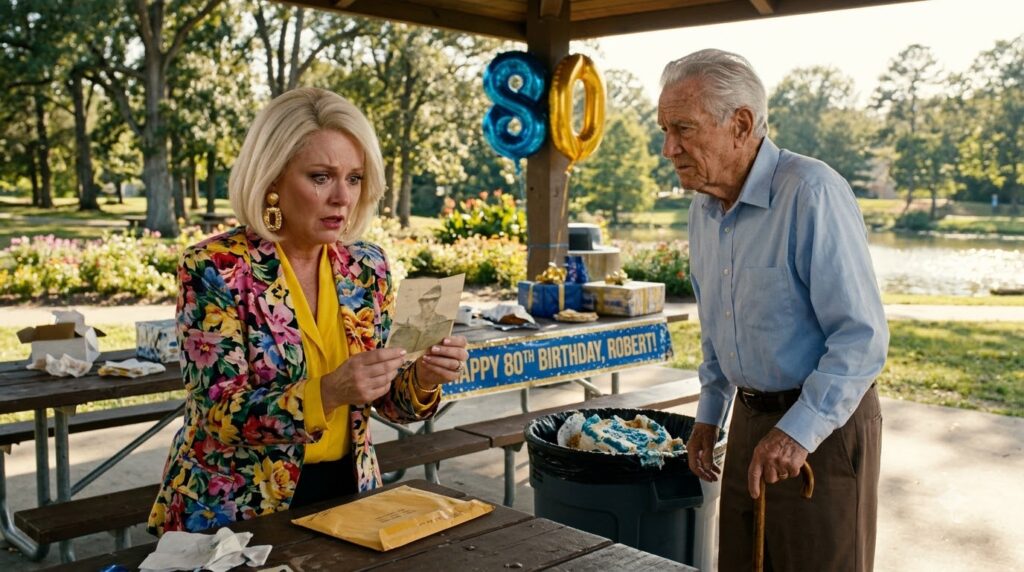
“This isn’t just about a damaged birthday cake. It’s about the limits of your office.”
Karen looked toward the window.
For years, residents had praised her when the lawns were trimmed, the entrance flowers bloomed, and property maintenance improved.
She remembered the long evenings spent negotiating contracts and resolving disputes.
Surely those efforts counted for something.
Yet every time she tried to defend herself, she saw Robert standing beside the ruined birthday table.
She heard his voice.
I saved his life in Vietnam.
The board voted to suspend Karen’s authority to act on behalf of the association pending a formal review.
The vote was five to one.
Karen was the only dissenting member.
Michael would serve as acting president.
The board also agreed to cooperate with the town’s investigation and review recent HOA spending.
Karen gathered her papers without speaking.
Outside, several residents stood near the recreation center entrance.
Some watched silently.
Others whispered.
A woman who had once thanked Karen for organizing a neighborhood cleanup turned away as she passed.
Karen climbed into her car and sat behind the steering wheel.
She had imagined that the worst consequence would be an embarrassing video.
Instead, the life she had built around being HOA president was beginning to collapse.
That evening, Thomas found her in the garage.
She was sitting beside an old workbench that had belonged to her father.
Daniel’s tools still hung above it.
Wrenches.
Pliers.
A wooden-handled hammer.
A metal toolbox with his initials painted on the lid.
Thomas sat beside her.
“The board called me,” he said.
Karen nodded.
For several minutes, neither spoke.
Then Karen asked a question that surprised him.
“Did Dad ever tell you about a man named Robert Miller?”
Thomas thought carefully.
“No. But he mentioned someone called Bob.”
Karen looked up.
Thomas continued.
“Your father used to say he owed a man named Bob more than he could ever repay.”
Karen’s eyes filled.
“Why didn’t he tell us?”
“Maybe he tried.”
Thomas reached into the old toolbox.
Beneath a stack of instruction manuals was a small envelope.
On the front, in Daniel Whitmore’s handwriting, were three words:
For Bob Miller.
Karen stared at it.
The envelope had never been mailed.