Chapter 3: A Town That Had Seen Enough
By seven o’clock that evening, the video had spread throughout Willow Creek.
It was only forty-three seconds long.
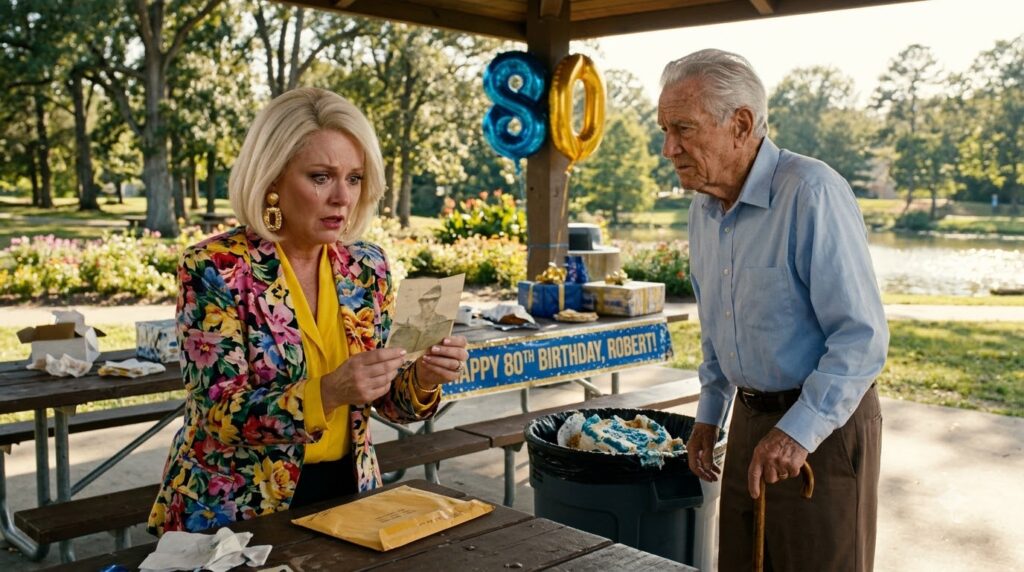
The recording began with Karen slamming the metal sign onto Robert’s birthday table.
The sound of crushed gift boxes was unmistakable.
Then came Karen’s declaration that the pavilion belonged to the HOA.
Finally, the camera captured Robert standing silently beside the wreckage while his daughter pleaded with Karen to stop.
The young man who recorded it was twenty-four-year-old Ethan Brooks, the grandson of one of Robert’s neighbors.
He had not intended to become involved in a neighborhood controversy.
He had come to the party to help carry chairs.
But when Karen began threatening an elderly man, Ethan reached for his phone.
He posted the video with a simple caption:
This is how our HOA president treated an 80-year-old Vietnam veteran on his birthday.
By morning, thousands of people had watched it.
Former residents shared stories of receiving fines for minor landscaping violations.
A retired teacher described being threatened over a wheelchair ramp.
Another homeowner recalled receiving a warning for displaying a small American flag during Memorial Day weekend.
Some accusations were disputed, and others involved rules that had been approved by the association years earlier.
But the video gave residents a reason to examine the leadership they had tolerated.
Karen’s husband, Thomas, watched it at their kitchen table.
He was sixty, a retired insurance adjuster with thinning gray hair and a habit of reading the newspaper from beginning to end.
He watched the recording twice.
Then he set down his coffee.
“Karen, what were you thinking?”
She stood beside the counter, still wearing yesterday’s gold bracelets.
“The pavilion was needed for an HOA planning meeting.”
Thomas looked at her.
“Was there actually a meeting scheduled?”
Karen hesitated.
She had wanted the pavilion for a private luncheon with several board members and local real estate contacts.
The gathering was meant to discuss improvements to the neighborhood’s image.
There was no official HOA meeting.
Thomas knew the difference.
“Did you reserve it?”
Karen opened her mouth, then closed it.
He leaned back.
“You didn’t.”
“I am the president of this association.”
“You’re not the owner of the public park.”
Karen turned toward the window.
For years, she had believed that strong leadership meant refusing to give ground.
She had spent countless evenings reviewing neighborhood complaints, organizing maintenance projects, and arguing with contractors.
Some of that work had genuinely benefited Willow Creek.
But somewhere along the way, she had begun confusing responsibility with authority.
Thomas spoke again.
“That man knew your father.”
Karen stared at the backyard.
“I know.”
“Then you know what Dad would have thought about what you did.”
She flinched.
Thomas rarely invoked Daniel’s memory.
He had loved his father-in-law.
Daniel had helped him rebuild the engine of his first car and taught him how to repair a broken fence instead of replacing it.
“He would have been ashamed,” Karen whispered.
Thomas did not contradict her.
Across town, Susan Miller was dealing with a different problem.
Robert had barely touched his dinner.
He sat in his living room, the damaged keepsake box resting on his lap.
Susan had offered to replace it.
Robert refused.
“Your mother gave me this box when I came home.”
That settled the matter.
Susan sat beside him.
She had spent the afternoon answering calls from neighbors, reporters, and people claiming to represent veterans’ organizations.
Most were sympathetic.
Some wanted Robert to give interviews.
Others wanted Karen publicly humiliated.
Robert wanted none of it.
“I don’t want my birthday turned into a circus,” he said.
Susan nodded.
But she was worried.
Her father had become quieter since the incident.
He was not angry in the way she expected.
He seemed tired.
And that frightened her.
Later that evening, the director of Willow Creek Parks and Recreation called.
Her name was Helen Carter, a practical woman in her early sixties who had worked for the town for nearly thirty years.
She had reviewed the reservation records.
Robert’s family had paid for the pavilion six weeks earlier.
The HOA had no reservation.
Furthermore, the pavilion stood on municipal property.
Karen had no authority to remove anyone.
Helen promised to document the damage and refer the matter to the town attorney for review.
Susan thanked her.
Then Helen mentioned something unexpected.
“We’ve received several complaints about the HOA claiming control over public spaces.”
Susan frowned.
“How many?”
“Enough that we’re reviewing the records.”
The following morning, Karen received an official notice from the town.
It requested a written explanation of the incident and warned that damage to municipal property could result in financial liability.
But another letter arrived that afternoon.
This one came from the HOA board.
An emergency meeting had been called.
And for the first time in nine years, Karen Whitmore would not be chairing it.