Chapter 6: The Cost of Being Right
Karen had always believed that admitting a mistake made a person vulnerable.
Her father had taught her otherwise.
She simply had not listened.
Over the next two weeks, the consequences of her behavior became impossible to ignore.
The town completed its initial review.
The Parks Department confirmed that Robert’s family had held a valid reservation and that Karen had no authority to interfere.
The damaged picnic table required repairs.
Several decorative fixtures had been broken.
The town sought reimbursement for documented damage and administrative costs, while leaving the family’s private losses to be resolved separately.
The HOA board formally declined to cover Karen’s personal actions.
Karen hired an attorney.
After reviewing the evidence, the attorney advised her that the video, reservation records, and witness statements made the central facts difficult to dispute.
He also explained that a personal apology would not replace financial responsibility.
Karen agreed to pay the town’s documented costs.
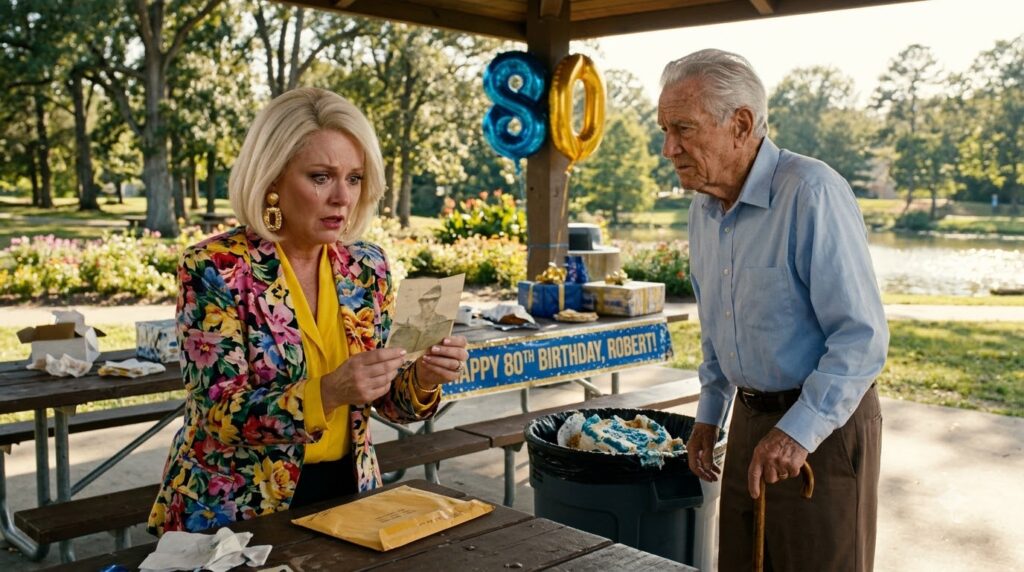
She offered to reimburse Susan for the ruined cake, damaged gifts, and repair of Robert’s keepsake box.
Susan accepted payment for the cake and gifts after discussing it with her father.
But Robert wanted the original box repaired, not replaced.
Karen contacted a local woodworker who specialized in restoring antique furniture.
She paid for the repair without asking for recognition.
Meanwhile, the HOA investigation continued.
Patricia Lewis found that Karen had repeatedly approved small discretionary expenses without proper board documentation.
Most involved landscaping, neighborhood events, and promotional materials.
There was no evidence that she had stolen money.
But the records revealed a pattern of decisions made without appropriate approval.
The board introduced stricter purchasing procedures and required two signatures for certain expenditures.
Karen resigned as HOA president before the final review meeting.
Her resignation was brief.
She acknowledged exceeding her authority and apologized for the harm caused to Robert Miller and his family.
The board accepted it.
Michael Harris became interim president until the next election.
Several residents celebrated the change.
Others felt uneasy about how quickly a person could become the object of public ridicule.
Karen had done something cruel.
But some of the online comments had grown cruel as well.
People posted photographs of her home.
Strangers called her telephone.
One person left a threatening message on her answering machine.
Thomas contacted the police about the threats.
Susan publicly asked people to stop harassing Karen.
Her statement was simple.
“My father wants accountability, not revenge.”
The message changed the tone of the local discussion.
Some people ignored it.
Many listened.
Robert himself had little interest in the public argument.
He was more concerned about the small vegetable garden behind his house.
His tomatoes needed pruning.
His porch railing needed painting.
And the wooden ramp leading to his back door had begun to loosen.
He had always preferred doing his own repairs.
But his knees no longer allowed him to work the way he once had.
One afternoon, Michael Harris stopped by with two neighbors.
They had organized a volunteer repair day for several older residents.
Robert reluctantly accepted their help.
As the men worked, Michael mentioned that Karen had resigned.
Robert paused.
“She didn’t have to lose everything over my birthday.”
Michael set down his drill.
“She didn’t lose everything. She lost a position she was misusing.”
Robert considered that.
There was a difference.
He had seen men lose rank in the military.
Some had deserved it.
Others had been treated unfairly.
But he had also learned that responsibility meant accepting consequences without pretending they were persecution.
Michael asked whether Robert would attend the next HOA community meeting.
Robert shook his head.
“I’m not interested in neighborhood politics.”
“We’re planning to discuss how residents should be treated. Especially older residents.”
Robert looked toward the freshly repaired railing.
“Then maybe I should come.”
A week later, Karen received a letter from the association.
It contained no threats.
No fines.
No accusations.
It was an invitation to attend the meeting as an ordinary homeowner.
For the first time in nine years, she would have no special seat, no gavel, and no authority over anyone else.
She almost threw the letter away.
Then she remembered her father’s words.
The strongest people aren’t the ones who can make others obey them.
She placed the invitation on the kitchen table.
And decided to attend.