Chapter 5: The Letter That Waited Fifty Years
The envelope was yellowed and slightly brittle.
Karen held it as though it might fall apart between her fingers.
A faded postage stamp had been attached to the upper-right corner, but there was no address.
Only the name.
For Bob Miller.
Thomas suggested that they leave it unopened until they could ask Robert whether he wanted it.
Karen agreed.
For the first time in days, she resisted the urge to take control of a situation.
The following morning, she called Susan.
Susan answered after several rings.
“Mrs. Whitmore?”
Karen nearly hung up.
She had rehearsed an apology throughout the night, but the words sounded inadequate now.
“I found something that belonged to my father. It’s addressed to your dad.”
Susan was silent.
Karen explained about the envelope.
Then she asked whether she could deliver it.
Susan’s answer was cautious.
“My father doesn’t want visitors right now.”
“I understand.”
“Especially not people connected to what happened.”
Karen looked down.
“I understand that, too.”
Susan eventually agreed to accept the letter herself.
They arranged to meet outside the public library.
Karen arrived without jewelry, wearing a plain blue sweater and dark trousers.
Susan noticed the change but said nothing.
Karen handed over the envelope.
“I haven’t opened it.”
Susan examined her father’s name.
“Thank you.”
Karen took a breath.
“I’m sorry for what I did.”
Susan looked at her steadily.
Karen continued.
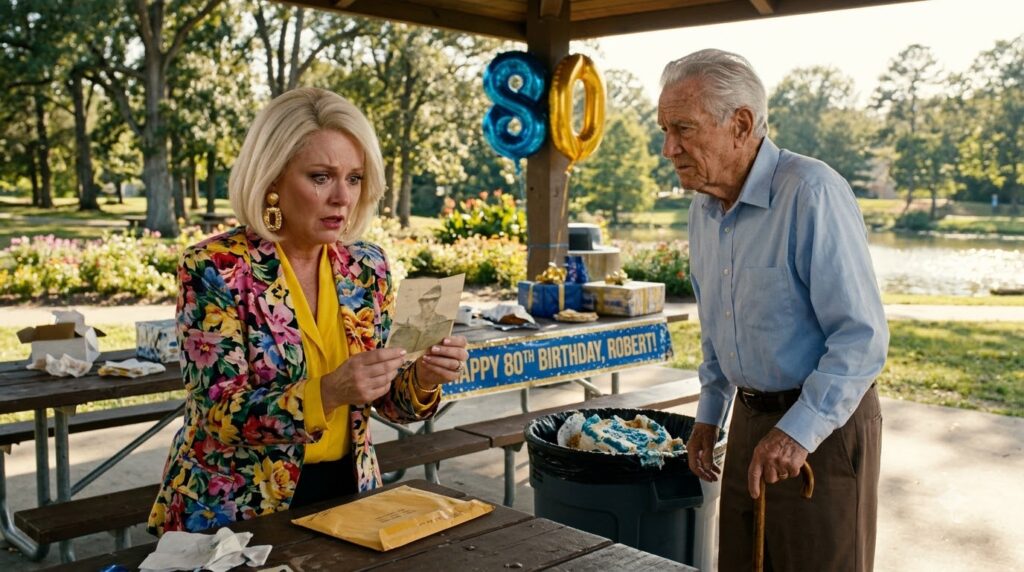
“I had no right to interrupt his birthday. I had no right to damage his things. And I had no right to treat him that way.”
The apology came without an excuse.
Susan appreciated that.
But she wasn’t ready to forgive.
“My father spent weeks looking forward to that party,” she said.
Karen nodded.
“He hasn’t celebrated his birthday properly since Mom died. This was supposed to be special.”
“I know.”
“No, Mrs. Whitmore. You know now.”
Susan placed the envelope in her handbag.
Then she walked away.
Karen stood beside her car for a long time.
There was nothing left to argue.
That afternoon, Susan brought the letter to Robert.
He sat on his back porch, watching sparrows gather around a bird feeder.
When Susan showed him the envelope, his expression changed.
He recognized Daniel’s handwriting immediately.
“Where did you get this?”
Susan explained.
Robert ran his thumb across the name.
He had not heard from Daniel in nearly forty years.
Their friendship had survived the war but struggled against the ordinary distances of civilian life.
Robert had returned to Ohio.
Daniel had settled in Virginia before moving west with his family.
For a while, they exchanged Christmas cards.
Then Robert changed jobs, moved twice, and lost several addresses.
Eventually, the letters stopped.
He had wondered about Daniel for decades.
Susan asked whether he wanted to open the envelope.
Robert nodded.
Inside were two sheets of paper.
The letter was dated November 14, 1979.
Robert began reading.
Daniel wrote about his family, his work, and the difficulty of finding words for something that had happened eleven years earlier.
He described waking in a military hospital, frightened and confused, unable to remember how he had escaped the fighting.
Later, someone told him that Bob Miller had stayed beside him and helped carry him to safety.
Daniel had never forgotten.
But the most important part of the letter was not about the battlefield.
It was about the years afterward.
Daniel wrote that he had watched his daughter grow up, attended her school performances, taught her to ride a bicycle, and celebrated each birthday knowing that those moments might never have happened.
He wrote that Bob had given him more than another chance to live.
He had given him the opportunity to become a father.
Near the bottom, Daniel had added a final paragraph.
I hope someday Karen understands that the strongest people aren’t the ones who can make others obey them. They’re the ones who know when to help someone who cannot help himself.
Robert stopped reading.
His eyes filled.
He folded the letter carefully.
Susan rested a hand on his shoulder.
For a long time, he said nothing.
Then he looked toward the yard.
“That sounds like Danny.”
Susan asked whether he wanted to see Karen again.
Robert shook his head.
“Not yet.”
He placed the letter inside the damaged keepsake box.
Then he asked Susan to bring him the photograph.
He studied the two young soldiers.
One had saved the other’s life.
Neither had known what their families would become.
Robert turned the photograph over.
For the first time, he noticed something written faintly beneath the original inscription.
It was a short message in Daniel’s handwriting.
If we get home, Bob, dinner’s on me.
Robert smiled through his tears.
“Danny,” he whispered, “you still owe me dinner.”