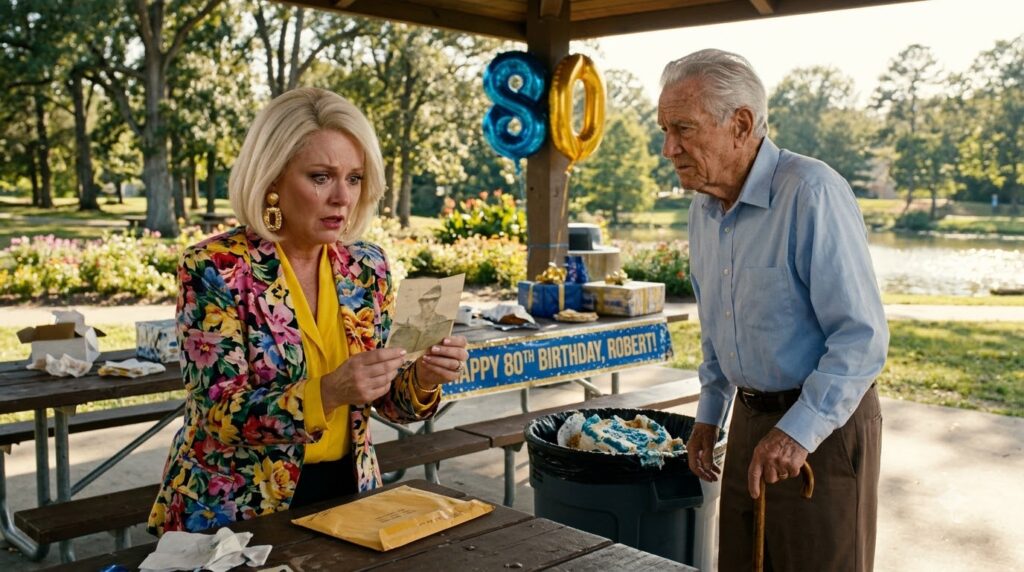
Chapter 7: A Different Kind of Courage
The community meeting was held on a Thursday evening.
More than seventy residents filled the recreation center.
Some came because they wanted changes to HOA rules.
Others wanted to hear how the board intended to prevent future abuses.
A few were simply curious whether Karen Whitmore would appear.
She did.
She arrived five minutes before the meeting began, wearing a simple navy dress.
Thomas accompanied her.
They sat near the back.
Nobody applauded.
Nobody greeted her warmly.
But nobody asked her to leave.
For Karen, that was enough.
Michael opened the meeting with a summary of the board’s findings.
He explained the distinction between municipal property and HOA common areas.
He described the new financial approval procedures.
He also announced that the association would establish a resident advisory committee, including senior homeowners and people with disabilities.
The goal was to ensure that enforcement decisions considered accessibility, fairness, and reasonable accommodation.
Karen listened.
Some of the proposals were sensible.
Others would require careful implementation.
A month earlier, she would have interrupted to explain why the board was moving too slowly.
Now she kept her hands folded in her lap.
Then Michael introduced Robert Miller.
Robert walked toward the front of the room with his cane.
Susan remained nearby in case he needed assistance.
He wore the same light-blue shirt he had worn on his birthday.
Karen noticed immediately.
Robert stood behind the microphone.
He looked across the room.
“I’m not much of a public speaker,” he began.
A few people smiled.
“I spent most of my life working, raising a family, and trying to stay out of other people’s business.”
He paused.
“I’ve lived long enough to know that every community needs rules. Rules help us live together. But rules are supposed to protect people. They’re not supposed to make one person feel bigger than everyone else.”
The room was silent.
Robert continued.
“When I was young, I served with men from every kind of background. Some were educated. Some weren’t. Some had money. Most didn’t. But when somebody was hurt, none of that mattered.”
Karen lowered her eyes.
Robert looked toward the back of the room.
“I was fortunate enough to help a young man named Daniel Whitmore come home.”
A murmur passed through the audience.
“His daughter and I met under unfortunate circumstances.”
Karen felt Thomas take her hand.
Robert continued.
“I won’t pretend what happened didn’t hurt. It did. My family worked hard to give me a good birthday. I was looking forward to it.”
His voice weakened slightly.
Then he steadied himself.
“But I’ve also lived long enough to know that one terrible decision doesn’t have to become the whole story of a person’s life.”
Karen began crying.
Not loudly.
Not dramatically.
She simply couldn’t stop the tears.
Robert looked away from her and addressed the room.
“I don’t want special treatment because I’m a veteran. I want the same respect every person deserves.”
He stepped back from the microphone.
The applause began slowly.
Then the entire room stood.
Karen remained seated for a moment, overcome.
Finally, she rose with everyone else.
When the applause ended, Michael invited questions.
Karen raised her hand.
Several people turned.
Michael hesitated, then recognized her.
Karen walked toward the microphone.
Her hands trembled.
“I owe Mr. Miller and his family an apology.”
She looked at Robert.
“What I did was wrong. Not because I discovered who you were. Not because of the photograph. It was wrong before I knew anything about you.”
Susan watched carefully.
Karen continued.
“I treated you as though your celebration mattered less than what I wanted. I damaged things that were precious to your family. I embarrassed you in front of people who love you.”
She swallowed.
“I can’t undo that.”
There was no attempt to blame stress, misunderstanding, or HOA policy.
Karen took a breath.
“I’m sorry.”
Then she stepped away.
The room remained quiet.
Robert nodded once.
It was not forgiveness.
Not yet.
But it was acknowledgment.
After the meeting, Karen approached Susan.
She asked whether Robert might someday allow her to hear more about Daniel’s time in Vietnam.
Susan considered the question.
“I’ll ask him.”
Karen nodded.
“Thank you.”
As she and Thomas walked toward the parking lot, she noticed the elderly residents gathering near the entrance.
A woman using a walker struggled with the heavy door.
Karen instinctively moved forward and held it open.
The woman thanked her.
Karen smiled.
For once, she had helped someone without needing to be in charge.