Chapter 8: Justice at the County Courthouse
The hearing took place on a cold Monday morning in early December.
Karen entered the county courthouse wearing a simple navy-blue suit.
Her hair was neatly styled.
She wore no oversized jewelry.
There were no reporters waiting inside the courtroom, although several local journalists sat in the back.
Daniel Brooks attended because he had been asked to provide testimony.
Thomas Whitaker sat beside Linda Carver.
Eleanor Peterson was also present.
Harold remained at home, continuing his recovery.
Karen noticed Eleanor immediately.
The older woman sat quietly with her hands folded in her lap.
She looked tired.
But she held herself with dignity.
Karen wanted to approach her.
Her attorney advised her to wait until the proceedings ended.
The hearing was straightforward.
The prosecutor summarized the evidence.
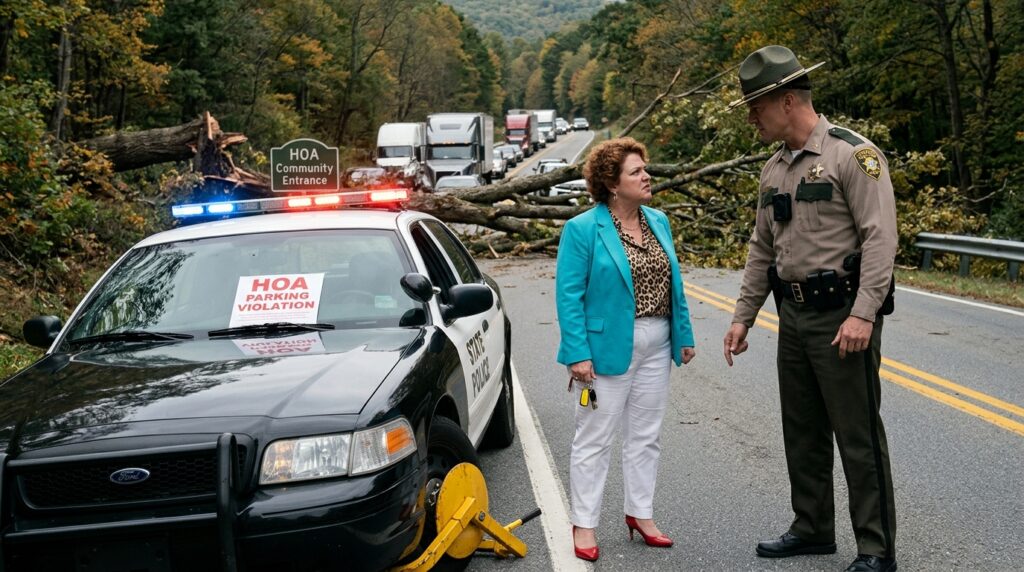
The state highway had been intentionally obstructed.
Karen had operated the tractor.
She had continued pulling the tree despite warnings.
The obstruction had delayed traffic, including an ambulance transporting a seriously ill patient.
The gate collapse had caused substantial property damage.
Karen’s attorney did not dispute the central facts.
Instead, he explained that Karen had agreed to resolve the criminal case through a negotiated plea.
She would accept responsibility for the applicable offenses.
The agreement included a substantial fine, probation, community service, and reimbursement obligations for documented public costs, subject to the court’s approval.
Separate civil claims involving the HOA remained unresolved.
When the judge asked whether Karen wished to speak, she stood.
Her hands trembled slightly.
For years, Karen had been comfortable speaking before crowded rooms.
She had delivered lectures about rules, responsibility, and proper behavior.
Now she struggled to find the words.
She looked toward the judge.
Then toward the people sitting behind her.
“I believed being in charge meant I could decide what was best for everyone.”
She paused.
“I was wrong.”
Her voice grew quieter.
“I endangered people who had nothing to do with our neighborhood. I damaged property that belonged to the community. And I treated disagreement as if it were disobedience.”
She glanced toward Eleanor.
“I am deeply sorry.”
The courtroom remained silent.
The judge accepted the plea agreement after reviewing its terms and confirming Karen understood her obligations.
He emphasized that public roads existed for everyone.
Private organizations could establish lawful rules for their own property.
They could not place personal preferences above public safety.
Karen listened without interrupting.
The sentence was serious but did not include incarceration.
She would be required to comply with probation conditions, complete community service, and satisfy the financial obligations imposed by the court.
The judge also warned that any future violations could carry additional consequences.
Outside the courtroom, Karen approached Eleanor.
For a moment, neither woman spoke.
Karen’s eyes filled with tears.
“I don’t expect you to forgive me.”
Eleanor studied her face.
She was not interested in public apologies or dramatic gestures.
Her husband had nearly died.
Their retirement had been disrupted by hospital appointments, medications, and rehabilitation sessions.
Forgiveness was not something she could offer simply because Karen had finally admitted wrongdoing.
But Eleanor also knew that bitterness could become a burden.
She told Karen that Harold was improving.
He could walk short distances with assistance.
He hoped to return to his garden by spring.
Then Eleanor said something Karen would remember for the rest of her life.
“An apology matters most when it changes what you do next.”
Karen nodded.
She had no answer.
Daniel watched the exchange from several feet away.
He had expected Karen to remain angry and defiant.
Instead, he saw a woman who finally seemed to understand the consequences of her actions.
He did not feel sorry for her.
But he was relieved that she had stopped denying what happened.
As everyone left the courthouse, Thomas approached Karen.
He explained that the HOA’s civil claim would continue.
The association needed reimbursement for unauthorized expenditures and damage.
Karen said she understood.
Thomas was surprised.
There was no argument.
No threat.
No demand for special treatment.
For the first time in years, Karen accepted a decision she did not like.
And that small change would matter more than she realized.