Chapter 4: The Man in the Ambulance
Harold Peterson survived.
The news reached Daniel Brooks two days after the highway incident.
He was sitting in a truck stop outside Knoxville when his dispatcher called.
The county hospital had confirmed that Harold had undergone emergency treatment and was recovering.
Daniel leaned back in his seat and closed his eyes.
He had been thinking about the ambulance ever since leaving Lakeview Estates.
Truck drivers were accustomed to delays.
Traffic jams, construction zones, mechanical failures, and bad weather were part of the job.
But this delay had been different.
Someone had created it deliberately.
And an elderly man’s life had been caught in the middle.
Daniel had lost his own father to a heart attack eight years earlier.
His father, a former Army mechanic, had collapsed while repairing a lawn mower.
The ambulance arrived quickly, but there had been nothing the doctors could do.
Since then, Daniel had never forgotten how helpless a family could feel when every second mattered.
He called the hospital and asked whether he could leave a message for Harold’s family.
The receptionist could not share private medical information, but she agreed to pass along his name and phone number.
That evening, Eleanor Peterson called him.
Her voice was soft and tired.
She thanked him for helping the police clear the road.
Daniel told her he had only done what anyone should have done.
Eleanor disagreed.
She explained that Harold had received treatment for a serious heart attack and would require rehabilitation.
The doctors were cautiously optimistic.
But the delay had frightened her more than she could describe.
She had spent forty-eight years beside her husband.
They had survived layoffs, a house fire, the loss of Harold’s younger brother, and the difficult years of raising children on a modest income.
She had never imagined that a stranger’s argument over a private gate might threaten the life they had built together.
Daniel listened quietly.
Before ending the call, Eleanor asked him a question.
“Why would someone block a road that everybody needs?”
Daniel looked through the windshield at the passing traffic.
“I wish I knew, ma’am.”
Meanwhile, the investigation into the highway obstruction was expanding.
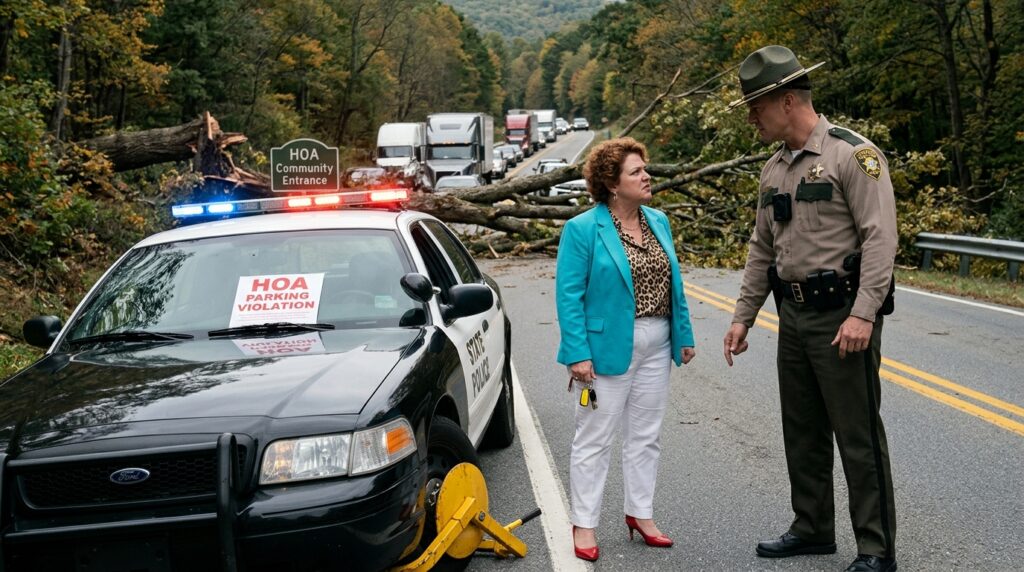
State transportation officials inspected the site and confirmed that the fallen oak trunks had been deliberately positioned across the roadway.
The trees had originally stood on a narrow strip of land near the highway boundary.
Their exact ownership and the legality of their removal required further review.
But there was no dispute about the highway itself.
It was public property.
And Karen had no permit to close it.
Investigators also interviewed Travis Cole, the landscaping contractor.
Travis was thirty-eight, with sunburned arms and a reputation for taking difficult jobs at short notice.
He admitted that Karen had hired his crew to cut several trees.
But he insisted he had never agreed to block the highway.
According to Travis, Karen originally described the project as clearing storm-damaged vegetation from association property.
His crew had cut and moved the trunks to a staging area near the entrance.
When he realized Karen intended to drag them onto the road, he refused to participate.
Karen became furious.
She accused him of abandoning the job.
Then she rented the tractor herself.
Travis had left before the obstruction began.
His employees confirmed the account.
Investigators obtained text messages showing Karen’s growing frustration.
One message was particularly revealing.
If the state won’t protect our entrance, I’ll make sure nobody can use that road.
Another message instructed Travis to finish the work before the transportation department’s scheduled inspection.
When investigators asked Karen about the messages, she claimed they had been misunderstood.
She insisted she had been protecting residents from dangerous trucks.
But the evidence was becoming difficult to explain away.
That same week, a local reporter named Emily Foster began examining Karen’s history as HOA president.
Emily was fifty-one and had spent most of her career covering schools, property disputes, and county government.
She wasn’t interested in turning a neighborhood argument into entertainment.
She wanted to understand how one person had gained enough power to create a public safety emergency.
Her first interviews were with Lakeview Estates residents.
Several spoke openly.
Others requested anonymity.
They described years of aggressive enforcement notices, unexpected fines, and threats of legal action over minor violations.
One retired nurse had received repeated warnings because her grandson parked a pickup truck in her driveway.
A widower had been fined for planting flowers outside an approved color scheme.
Another couple had been threatened with a lien over a decorative mailbox.
The stories shared a troubling pattern.
Karen had gradually transformed ordinary neighborhood rules into instruments of personal control.
But Emily’s most important discovery came from an unexpected source.
A former HOA secretary had kept copies of meeting records from three years earlier.
Those records showed that residents had repeatedly asked the board to improve traffic safety near the entrance.
They had requested better visibility, safer turning lanes, and cooperation with the state.
Karen had rejected every proposal.
Not because the improvements were unnecessary.
But because she believed allowing state engineers near the gate would weaken the HOA’s authority.
Emily began to understand the larger story.
The destroyed gate was not simply the result of one reckless afternoon.
It was the consequence of years of decisions nobody had been willing to challenge.